Dale Mabry
Highway, Adamo Drive and MacDill Avenue
|
Captain
Dale Mabry |
Col. & Dr.
Frank S. Adamo |
|
 |
 |
|
Read these articles at TampaPix on Facebook
|
|
|
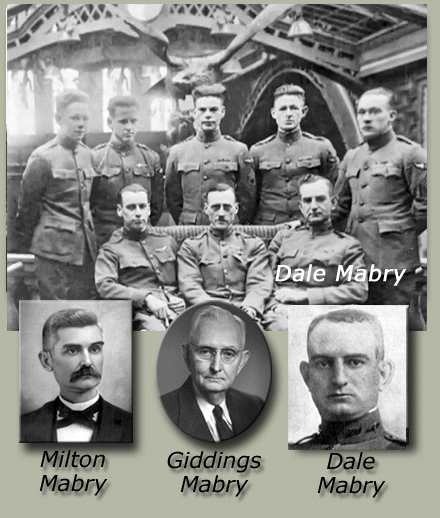
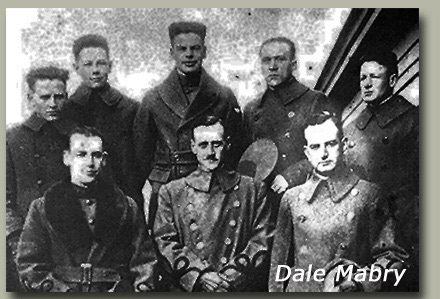
TOP PHOTO:
The crew of the airship "ROMA"(*
indicates survived the crash): Front row, L
to R, 1st Lt. Walter J. Reed*, Maj. John Thornell and
Capt. Dale Mabry; back row, left to right,
Sgt. Virgil C. Hoffman, Sgt. Joseph M.
Biedenback*, Staff Sgt. Marion J. Beall,
Master Sgt. Roger C. McNally, and Master
Sgt. Harry A. Chapman*. All were aboard when
the Roma crashed.
Dale Mabry (March 22, 1891–February 21,
1922) was an American World War I aviator.
Mabry, a native of Florida, was a son of
former Florida Supreme Court Justice and Lt.
Gov. of Florida Milton Harvey Mabry (b.
1851).
|
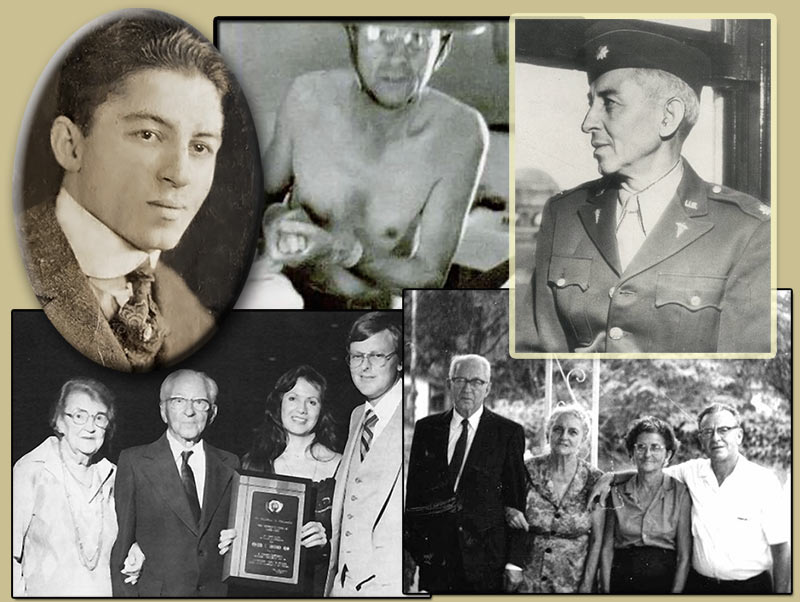
Dr. Frank Scozzari Adamo
-
Clockwise from Top
left - A young Dr. Frank Adamo, possibly late 1910s to 1920s.
Photo provided by Barbara Lewis, Dr. Adamo's granddaughter.
-
1941 Lt Col Frank
Adamo MD, photo taken by Life magazine photographer in the
Philippines early in 1941.
-
Col. Frank
Adamo in uniform, 1940s
-
Dr. Adamo with his
sisters, Francesca, Angelina, and brother Phillip.
-
Group photo:
Adamo, the oldest living past president of the Medical
Association at 88, was made the first recipient of the award.
His family was on hand the night the Ybor Optimist Club
honored Dr. Frank S. Adamo in October, 1981. A handsome plaque
designating the World War II hero El Mejor Ciudadano de Ybor
City. Mrs. Adamo is seen at the doctor’s right, while his
grandson, Frank Saxon, and Mrs. Saxon, extend
congratulations.
|
|
Mabry was born in Tallahassee, the son of
Judge Milton H. Mabry and Ella Dale Mabry.
He was educated in the public schools in
Florida and graduated from Mariona Military
School, Marion, Ala. For several years
he was associated in the real estate
business in Tampa with his brothers,
Attorney Giddings E. Mabry and Milton H.
Mabry, Jr., former county commissioner.
Dale left his business in Tampa to enter the
second officers' training camp at Ft.
Oglethorpe, Gal, in August 1917. Just
before completing his training there he went
to Atlanta and took the exam for the air
service, and was commissioned a lieutenant.
He was sent to France in December, 1917 and
remained there in active service until
armistice. He was promoted to captain,
commanding the Tenth Balloon Co. He
made a fine record for efficiency, and after
he returned to the states in 1919 he entered
the regular army as a captain.
Capt. Mabry was sent to Rome in the summer
of 1921 as one of the company of flyers to
bring the Roma to the U.S., the government
having purchased the giant dirigible from
Italy. He was on the Roma when it made
its first trial trip.
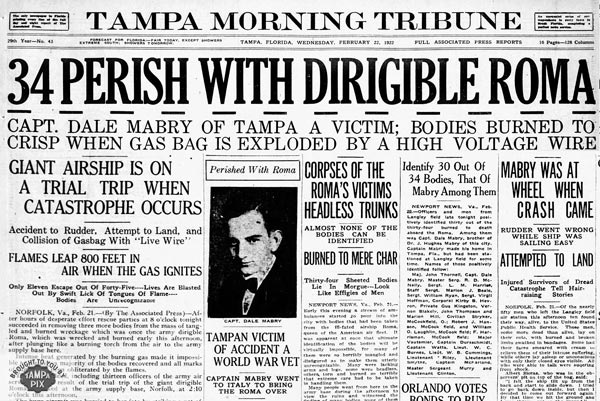
Capt. Mabry was 30 years old and unmarried
when he perished in the Roma disaster.
Besides his two brothers, Giddings Eldon
Mabry and Milton Harvey Mabry, Jr., he was
survived by another brother, Dr. Jesse
Hughes Mabry of Newport News, Va., a sister
Elyse (Mrs. Taver Bayly of Clearwater) and a
half brother Horton Mabry of Sanford.
See photos of the Roma and the crash
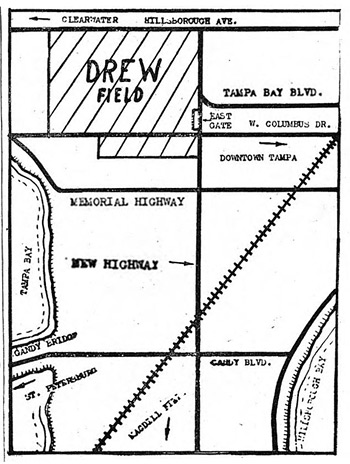
During construction of MacDill air field in
1939, Lisbon Avenue was extended as the
first road to the base and was soon renamed
after Col. Leslie MacDill (MacDill Ave.)
Bayshore Boulevard was a brick street that
terminated at the base boundary, where
motorists sometimes got stuck in the sand at
the end.
The best
highway to the MacDill field was an
extension of Vera Avenue, which became Dale
Mabry Road. Dale Mabry Highway was
built along Vera Ave which was a north/south
neighborhood street south of Laurel Street
(with a couple of short sections around
Spruce St. and around Tampa Bay Blvd.). The
extension to Hillsborough Ave. as Dale
Mabry, connected Drew Field with MacDill
Field.
Story from Sept. 30, 1943 Drew Echoes,
Drew Airfield weekly paper:
Dale
Mabry Road Opened Saturday to Drew Traffic
The war effort got a shot in the arm and
rough-riding Drew Field soldiers got a new
deal in bus transportation with the official
opening of the new $1 million Dale Mabry
highway Saturday.
The smooth,
straight-away concrete road, which greatly
speeds important Army traffic between Drew
and MacDill Fields, was dedicated at
ceremonies at the east gate by Mabel Mabry,
a niece of Captain Dale Mabry, the highway's
namesake. Mabry, a Tampa Army balloonist,
was one of 33 persons killed in the
explosion-crash of the dirigible Roma at
Hampton, VA, in Feb. 1922.
The first
automobile to enter the highway--a sleek red
convertible belonging to the upper income
bracket and driven by Otis E. Pruitt,
Clearwater--also picked up the first GI to
hitch a ride on the eight mile road, Sgt.
Harry Evans. As far as the dogfaces were
concerned, the road was really officially
opened when Evans caught the hop.
Immediately following the hitchhiking Evans
came a string of automobiles bearing Miss
Mabry and other relatives of Dale Mabry, the
mayors of Tampa, St. Petersburg, and
Clearwater, and city and county officials
from Hillsborough and Pinellas Counties.
Spurred by
the 69th Air Force Band, conducted by
Warrant Officer Lester G. Baker, the
ceremonies continued 30 minutes and were
broadcast by Station WDAE.
The first
bus to use the new route left the east gate
at 4pm. Busses now use Dale Mabry Highway to
Memorial Highway, travel east on Memorial to
Howard, then north on Howard to Cass, and
east on Cass to the terminus at the Allied
Building. A. Pickens Coles, president of Air
Base Lines, said the new route is about
three-tenths of a mile longer than the old
route over narrow, bumpy, equipment-wrecking
Tampa Bay Blvd, but pointed out that the
running time is about the same and that
passengers get the benefit of a smooth ride.
Luminaries
Attend
Among Army officials who attended the ceremonies were
Brigadier Gen. Westside T. Larson, Commanding Gen. of the 3rd
Air Force; Brig. Gen. Stephen H. Sherrill, Commanding Gen. of
AWUTC; Col. Melvin B. Asp, Drew Field Air Base Area Commander;
Col. Thomas S. Voss, MacDill Field Air Base Area Commander;
Col. Thomas W. Walton, 3rd Fighter Command executive officer;
Col. R. W. McNamee, AWUTC executive officer; and Col. Stephen
C. Lombard of 3rd Air Force Hqtrs, and Lieut. Col. William H.
Fillmore, Drew Field executive officer.
In addition to Miss Mabry,
other relatives of the highway's namesake present were
Giddings E. Mabry and Milton H. Mabry, Jr, brothers; Mrs.
Tavor Bayly, sister; and Mrs. James R. Boring Jr., Mrs. Paul
D. Cochran Jr., and Barbara Mabry, nieces.
The Mabrys were a prominent family in
Tallahassee. Dale Mabry Municipal Airport in
Tallahassee, the city's first airport, is
also named after him. The original
Tallahassee Airport location was on Dale
Mabry Field, a WWII Army Air Corps flight
training facility. There is a Dale Mabry
Elementary school named after him in Tampa.
Dale Mabry's brother, Giddings Eldon Mabry,
came to Tampa in 1901 and started a private
law practice. He was later joined by Doyle
E. Carlton and Judge OK Reaves. Carlton would become Governor of Florida during the
Great Depression, then rejoin Mabry &
Reaves. The law firm of Mabry, Reaves &
Carlton was instrumental in the development
of early Tampa,
including Davis Islands, and eventually became the
law firm of Carlton Fields Ward Emmanuel
Smith & Cutler by the 1960s; it is now known
as
Carlton Fields.
Mabry Family Genealogy
Don't miss
this exceptional video about the Roma and
Capt. Mabry.
Dale Mabry wasn't extended north of
Hillsborough Ave. until around 1955. Not only did they have to
build an overpass at Hillsborough Avenue and the railroad tracks
near Gunn Highway, the entire new highway to the north had to
be cut through the cow pastures to its new northern terminus
(probably the junction with US-41 at Land O’Lakes).
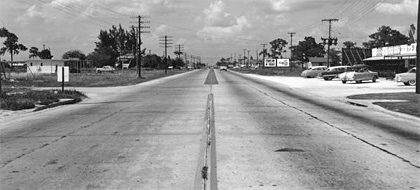
Dale Mabry
looking north with intersection of Gray St.
on the left, April 1954
State Archives of Florida, Florida Memory,
http://floridamemory.com/items/show/103856
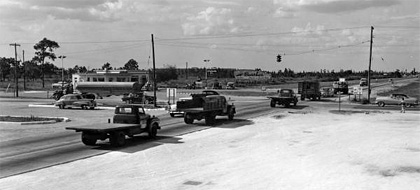
Dale Mabry
looking northwest toward the intersection of
Columbus Drive and Bartke's billboard. April
1954
State Archives
of Florida, Florida Memory,
http://floridamemory.com/items/show/104656
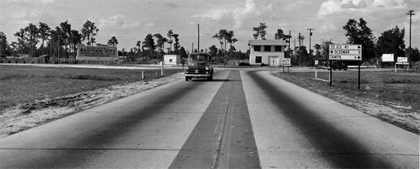
The terminus
of Dale Mabry at Hillsborough Ave.,
April
1954
State Archives
of Florida, Florida Memory,
http://floridamemory.com/items/show/104655
 |
Most of
the following story was written by Gary
Mormino, director of the Florida Studies
Program at USF - July 18, 2010.
Other sources: LIFE Magazine "Bataan
Wounded Lived With Pain."
Every day,
thousands of motorists travel Adamo Drive, a
busy 7-mile stretch of State Road 60 that
carries motorists between the Channelside
District of downtown Tampa and South
Falkenburg Road on Brandon's western edge.
Few remember for whom the street was named;
even fewer pronounce the name ah-DAH-mo, as
Dr. Adamo would have. But Frank Adamo was a
gentleman and never complained.
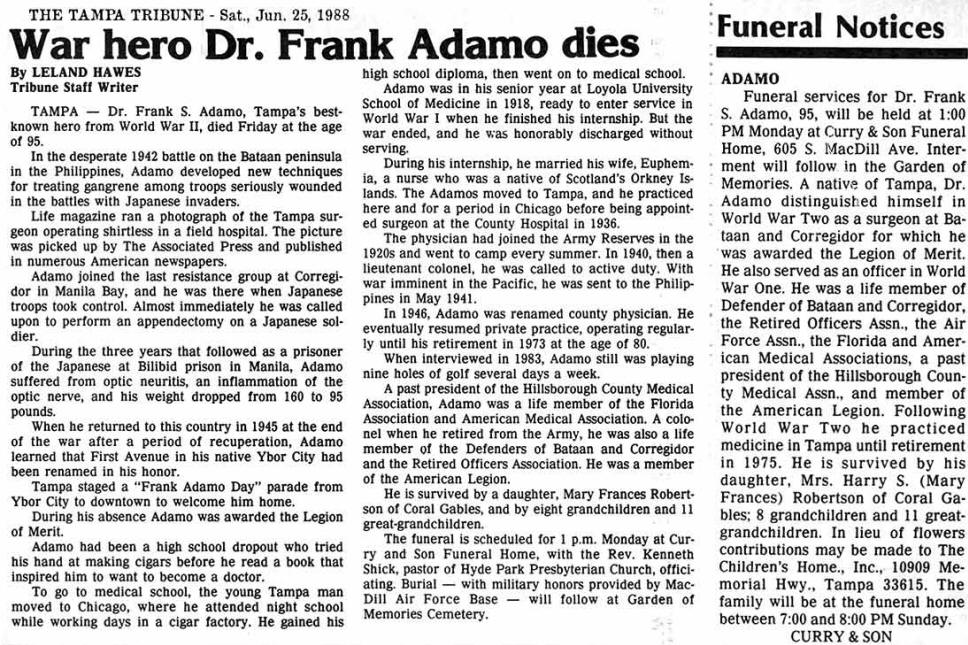
A World War II prisoner of war hailed by
Life Magazine as "Bataan's medical hero," he
earned a huge welcome when he finally came
home in 1945. Tampa celebrated Frank Adamo
Day with a parade through the streets of the
city. His courage and sacrifice as a
prison-camp physician, and the many lives he
saved with his innovative treatment for
gangrene, earned him a Legion of Merit
medal.
He went on to become a respected and beloved
hometown doctor, one of the greatest of "the
greatest generation."
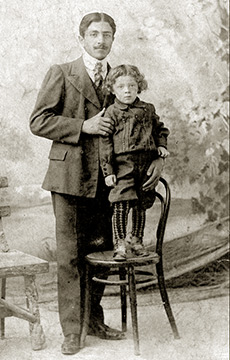 |
|
Dr. Adamo's
father, Giuseppe Scozzari with his son
Philip.
Photo provided by Barbara Lewis, Dr. Adamo's granddaughter. |
Frank Scozzari Adamo was born in Tampa in
1893 as Francesco Scozzari, the 2nd child of
Sicilian immigrants Giuseppe Scozzari and
Maria Leto. Frank had sisters Francesca
(b.1888) and Angelina (b. 1897) and a
brother Filippo (b.1901). All were born with
the Scozzari surname. Nobody in the family
now knows why the family surname was changed
to Adamo. A son of Philip Adamo, also named
Frank S. Adamo, says it was his uncle Dr.
Frank Scozzari Adamo who had the family
surname changed when he found out the middle
name was Adamo, but he doesn't give any more
details of this.
Nothing in Frank's youth suggested future
success: He attended school for only a few
years, suffered from terrible headaches and
went to work rolling cigars as a pre-teen.
He spoke little English.
During the turbulent cigar strike of 1910,
Frank left Tampa. He eventually traveled to
Chicago, where he attended night classes to
finish grammar school - as an 18-year-old.
He quickly worked through the high school
curriculum and finished a year of college
before enrolling at the Chicago College of
Medicine and Surgery.
While in Chicago, Adamo fell in love with Euphemia
H. Stevenson, a young nurse from Scotland's
Orkney Islands. They married in Chicago on
Jan. 2, 1919.
(There is a photo circulating the internet
as a photo of a young Dr. Adamo, possibly as
he graduated from medical school. That photo
is of Dr.
Adamo, but not the WW2 hero Dr. Adamo.
It is
of his cousin, Frank S. Adamo who attended
medical school in New York and worked as an
intern at St. Vincent's hospital in
Manhattan in 1930. That Dr. Adamo was our
Dr. Adamo's cousin, and was 12 years younger
than our Dr. Adamo.)
Tampa's Frank S.
Adamo began his internship in Tampa in
September 1919. where he was a
physician in his office at 1922½ 7th
Avenue. He and his wife lived on the
2nd floor above the office. "Upon returning (to
Tampa), I almost died of the heat," he
recalled in a 1980 interview. "You could not
open your mouth or you would get a mouthful
of mosquitoes."
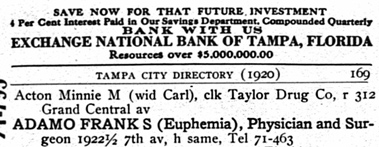
Later in 1920, Dr. Adamo bought a home at
816 S. Edison and moved his family there. Between 1926
and 1930, they moved to Chicago with their
daughters Mary and Vivian where they are
listed on the 1930 census.
World War II
In 1923, Adamo joined the Army Reserve,
rising to the rank of lieutenant colonel in
1939. On Nov. 5, 1940, he was called up to
active duty, and the following spring he was
sent to Fort McKinley Hospital in the
Philippines as an Army surgeon.
Sounds of Japanese planes and bombs awakened
him there the morning of Dec. 8, 1941.
Japanese troops attacked the Philippines,
and Adamo and other soldiers and civilians
fled to the island of Corregidor, called
"The Rock," in Manila Bay. There, Adamo
worked tirelessly to treat wounded soldiers
and civilians.
In a Feb. 16, 1942 issue of Life Magazine,
he was called "Bataan's medical hero" and
described as "slight, grayish, calm."
Confronted by mounting numbers of patients
suffering from gangrene, Adamo experimented
with a new procedure. Amputation of the limb
was the accepted treatment for gangrene, but
Adamo knew that the gangrene bacillus could
not survive if exposed to oxygen. He tried
opening the wounds and applying sulfa drugs,
irrigating every hour with hydrogen
peroxide. The treatment proved effective,
and the surgeon was lauded for the many
lives - and limbs - he saved.
Taken prisoner
Corregidor fell on April 9. Adamo was taken
prisoner and began the infamous Bataan Death
March, a harrowing 60-mile trek.
Seventy-five thousand captives began the
march; as many as 20,000 died or were killed
along the way. At the prison camp, though he
too suffered from beriberi and other
ailments, he treated men stricken with
dysentery, beriberi, malaria, dengue fever,
and malnutrition. In the book "P.O.W. in the
Pacific," William Donovan credits Adamo with
saving his life.
He also treated the enemy. He saved the life
of a young Japanese soldier by performing an
emergency appendectomy and was rewarded with
a precious can of peaches.
Life in a Japanese prison camp was
torturous, he remembered. "Mainly for
breakfast there was rice, for lunch was rice
and for supper was more rice. We also had a
few greens we called whisperweed because you
could blow through it, soy beans, and once
in a while dried salty fish that we mixed
with water.
"About the only thing we had to do was
think. And about all we could think about
was getting something to eat." Adamo would
daydream about the meals he used to have. "I
could almost taste sometimes the spaghetti
and veal and chicken. And then sometimes I'd
think about how nice it would be to have one
more steak before I died." His only
communication with his wife in Tampa was a
three-word Red Cross telegram: "I am well."
Rescue
In January 1945, American planes appeared.
On the morning of Feb. 4, 1945, the Japanese
guards vanished. Soon, U.S. troops liberated
the camp. Adamo, like many of the prisoners,
was so ravenously hungry - he weighed 95
pounds - that he became sick eating cans of
pork.
By the time he made it home to Tampa, First
Avenue had been renamed Frank Adamo Drive.
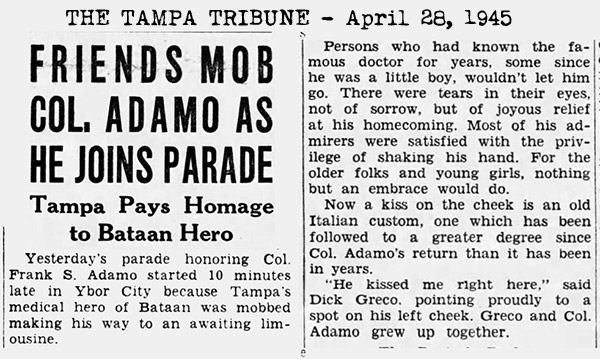
April 27, 1945 was declared Frank Adamo Day,
and a large parade celebrated the colonel's
homecoming with thousands attending. "Persons who had known the
famous doctor for years, some since he was a
little boy, wouldn't let him go," the
Tribune reported. "There were tears in their
eyes." Dick Greco (uncle to the future
mayor) proudly pointed to his cheek,
gushing, "He kissed me right here."
Eventually, Adamo resumed his private
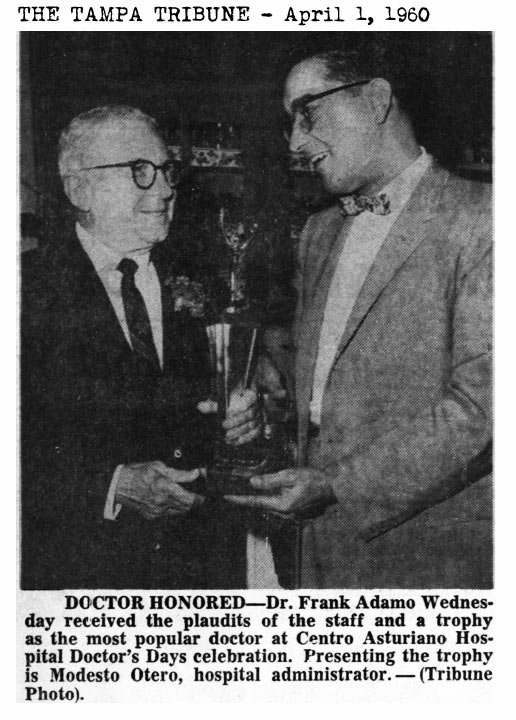
surgical practice. In 1960, he received a
trophy for being "Most Popular Doctor" at
Centro Asturiano Hospital. He also served as
a president of the Hillsborough Medical
Association
He retired at age 80 in 1973 and, a decade
later, was still playing golf several times
a week. Adamo died on Jun. 24, 1988.
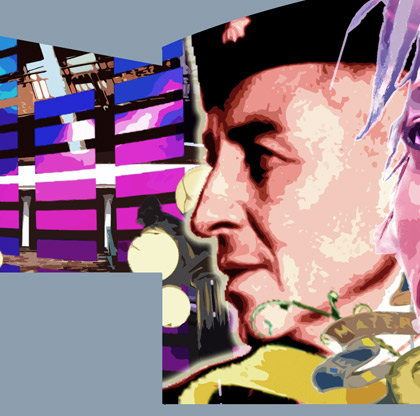
Dr. Adamo is one of the persons honored on
the mural displayed on buildings along Adamo
Drive in Tampa.
See the whole mural here.
The Sunland Tribune. Vol. 8, no. 1 (November
1982)
See newspaper clippings of articles
about Dr. Adamo during his service and
capture in WW2.
Special thanks
to Barbara Lewis, Dr. Adamo's granddaughter, for correction to photos
previously displayed here and for her contribution
of Dr. Adamo portrait.
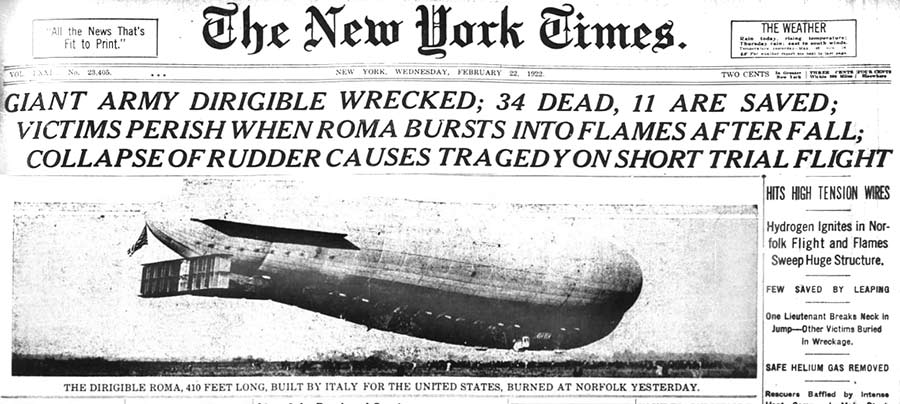
MORE ABOUT DR. ADAMO AFTER THE NY TIMES ROMA
DISASTER HEADLINE AND YOUTUBE VIDEO BELOW
|
|
COL. FRANK ADAMO Continued From Above |
|
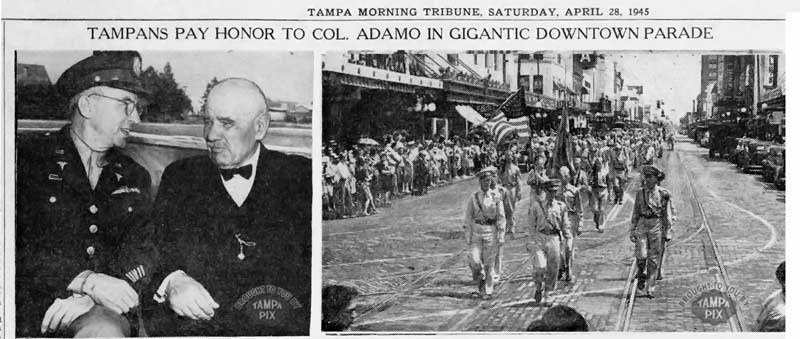
(L) Col. Adamo talking with Castengio
Ferlita, an old friend with whom Adamo had
often enjoyed spaghetti and veal dinners
before he left, and with whom the colonel
once more feasted after his return.
(R) The Plant High School ROTC unit marching
proudly to welcome Adamo. |
|
|
|
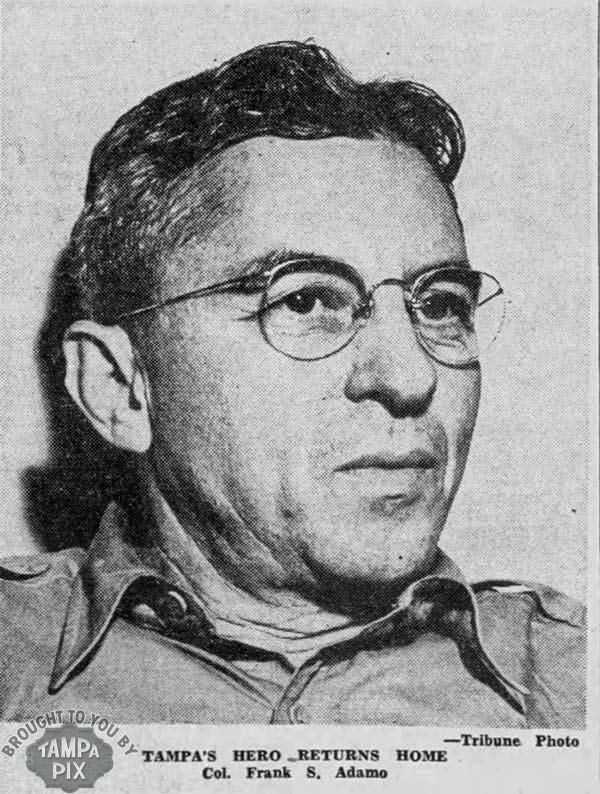
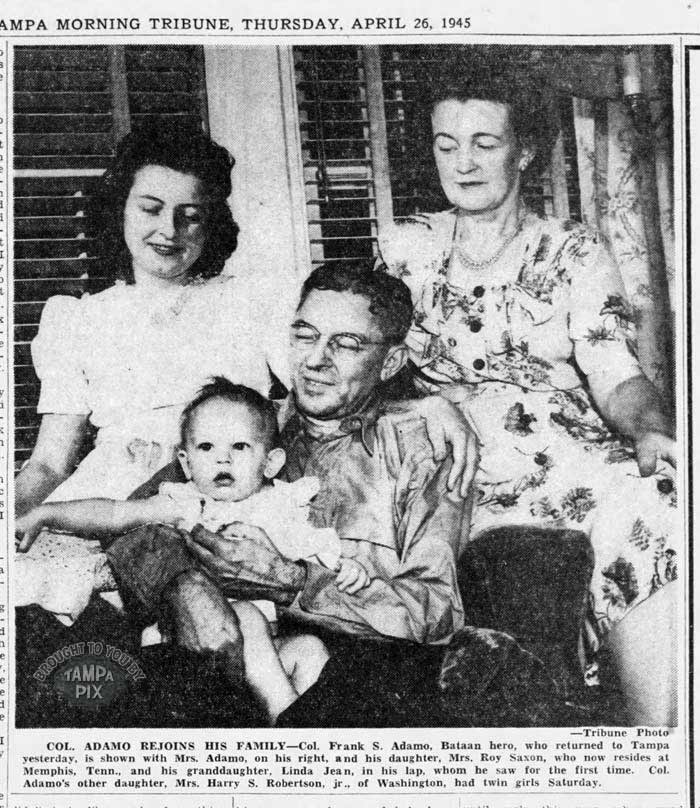

THE TAMPA TRIBUNE, APRIL 26, 1945 |
|
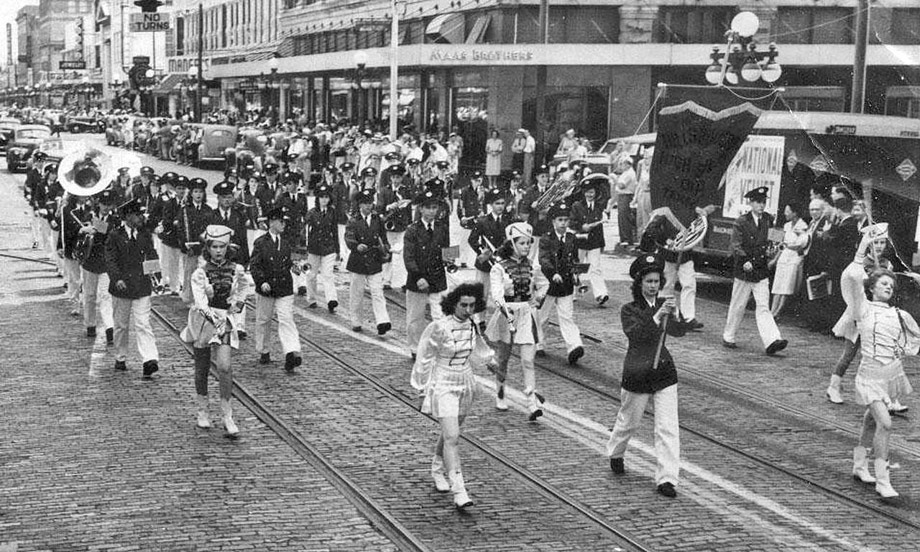
 April 27, 1945, Franklin Street
and Zack - A Frank Adamo Day parade celebrated the physician
following his release from a World War II prisoner of war
camp. He was hailed as a hero for courageous service and
saving lives. This is the Hillsborough High School
marching band. Notice Maas Bros. department store in the
background. April 27, 1945, Franklin Street
and Zack - A Frank Adamo Day parade celebrated the physician
following his release from a World War II prisoner of war
camp. He was hailed as a hero for courageous service and
saving lives. This is the Hillsborough High School
marching band. Notice Maas Bros. department store in the
background.
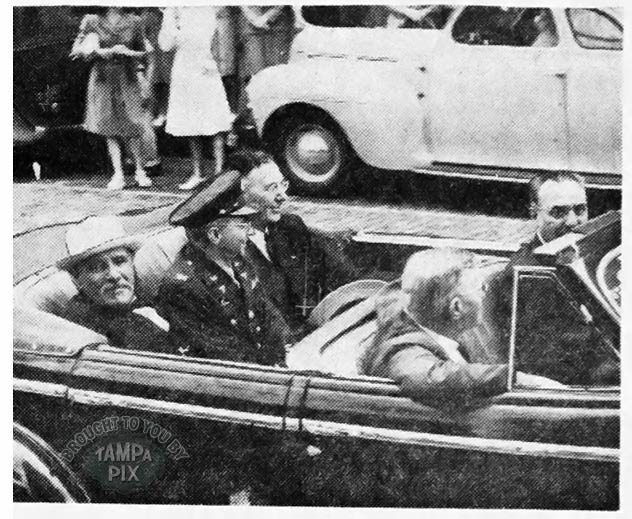
L
to R in back seat: The lead car in the parade, with old friend
Castengio Ferlita, Col. Adamo, and Asst City Attorney W.E.
Thompson. Front seat: speaker at the Phillips Field
ceremony Henry C. Tillman, and driver Gene Anzalone.
SO WHY DID DR.
ADAMO CHANGE HIS NAME AND THE FAMILY NAME TO ADAMO FROM
SCOZZARI?
It may have
been because of a possible mistake on his father's death
certificate. In 1904 Dr. Adamo's father, Giuseppi SCOZZARO,
applied for a passport. He gave concise, specific
information about himself and his family. |
|
|
 |
|
|
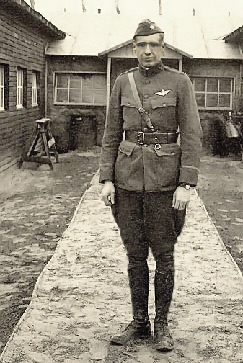
Col. Leslie MacDill,
1918
|
|
 MACDILL
AIRFIELD AND AVENUE MACDILL
AIRFIELD AND AVENUE
The
land for what we now call MacDill AFB was
chosen in April, 1938, and it was to be
named Southeast Air Base. Army Air Corp
pilots had been impressed with the flat,
sandy, snake-ridden stretch of land on
Tampa’s Interbay peninsula called Catfish
Point. It was far enough from the city that
no one complained of the aircraft noise.
Also the base would be strategically located
near the Caribbean and would have nearly
year-round good flying weather. Initial
clearance of the brush and swampland began
on November 28, 1939, when the Works
Progress Administration (WPA) assigned 100
men to clear the nearly 5,800 acres.
Almost
simultaneously with the onset of work on the
airfield, Secretary of War Harry H. Woodring
announced a change of name for the future
base on November 30, 1939. It was to be
named after Colonel Leslie MacDill, who had
died test-flying a BC-1 aircraft, along with
the mechanic, in a
crash on the outskirts of Washington, D.C.,
on November 9, 1938. Lisbon
Avenue, which was located at the entrance to
the base, and northward as Roosevelt Ave.,
were renamed MacDill Ave.

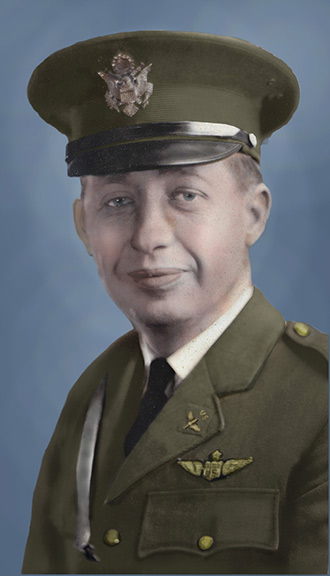
MacDill had been a very
popular figure with the Air Staff. During
World War I he had been the commander of an
Aerial Gunnery Training School at St. Jean
de Monte, France. In June 1922 he earned a
Doctor of Science degree in aeronautical
engineering from the Massachusetts Institute
of Technology. MacDill was a rising star in
the Army Air Corps when he suffered the
fatal accident at age forty-eight.
At the time of the official dedication
of MacDill airfield on April 15, 1941 there
were three runways (5,000 feet long and 250
feet wide) and a few two-story buildings.
Brigadier General Tinker landed the first
aircraft on the newly completed runways to
commemorate the opening.
There were three airfields in Tampa during
World War II. Drew Field, where present day
Tampa International Airport is located,
Henderson Field where Busch Gardens is
situated (originally envisioned as the place
for Tampa’s main airport), and MacDill
Field. Henderson and Drew fields were
designated as auxiliary operational
(support) bases for MacDill, as well as a
number of other fields around the state.
See
MacDill AFB Air Show 1976 here at
Tampapix for more detail on the history of
MacDill AFB and photos of MacDill Park at
downtown Tampa's Riverwalk.
|
|
|
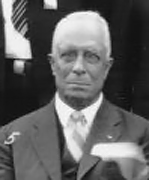 This road is named after
Hillsborough County commissioner John Thomas
Gunn, a former Tampa City Council member from 1886 to 1887 and 1904 to
1910, who also served on the County Board of Public Instruction in
District 2 in 1907-08. From 1922 into the 1930s he served on the County
Commissioners office of Hillsborough County. This road is named after
Hillsborough County commissioner John Thomas
Gunn, a former Tampa City Council member from 1886 to 1887 and 1904 to
1910, who also served on the County Board of Public Instruction in
District 2 in 1907-08. From 1922 into the 1930s he served on the County
Commissioners office of Hillsborough County.
Photo at right is a
crop of a larger photo titled "Members of Tampa's oldest
Masonic lodge, Hillsborough Lodge No. 25, assembled for a group
photograph April 14, 1928." Provided by David Parsons, Librarian.
Courtesy of Tampa-Hillsborough County Public Library System.
See full size uncropped photo of
all lodge members.
The thoroughfare began as a sand
road with two ruts and was built with convict labor in the 1920s.
It was completed in 1925 from Tampa through Odessa and Elfers to New
Port Richey and was considered to be one of the finest roads in the
state at the time. The road was maintained by the people who
lived along it. It was paved in the 1930s due much to the
efforts of Gunn while he was a county commissioner. In 1976, it was
resurfaced and widened by four feet.
1922 newspaper article on the slickness of Memorial
Hwy mentions John T. Gunn
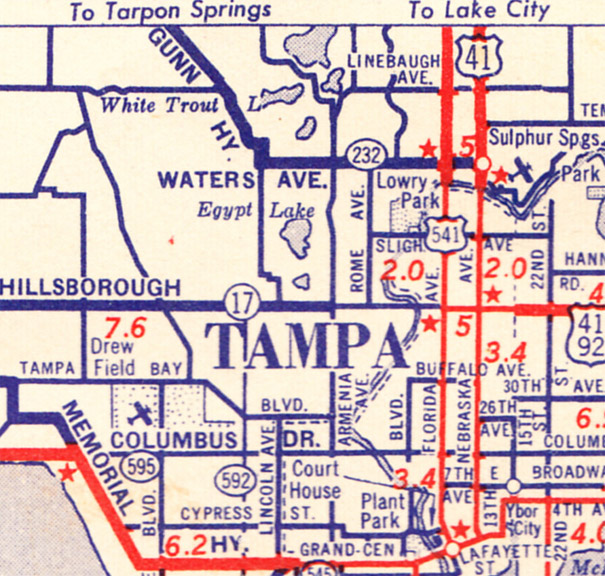
1946 Tampa street
map
This map shows how Gunn
Highway connected to Tampa's main thoroughfares in 1946.
Place
your cursor on the map to see some present-day streets marked.
Notice at upper right
(at "Sulphur Springs") that Temple Terrace Highway (now Busch Blvd.)
ended at Nebraska Ave. and lack of interstate highway.
You took Florida or
Nebraska Ave. out of town to Waters Ave. and turned left, then took
a right around what is now Himes Ave. where Waters apparently ended,
then a short jog to the left to Gunn Hwy. This part of Gunn Hwy.
south of Busch is today's Lazy Lane.
Dale Mabry ended at
Hillsborough Ave. From this area of Tampa, you took
Hillsborough Ave. to around what is now Lincoln, turned north a bit,
did some zig zags, picked up what is now Himes and took this to
Waters Ave.
Notice Tampa Bay Blvd. took a turn to the northwest at Dale Mabry,
through Drew Field, then back to the west at what is now MLK Blvd
but previously was Buffalo Ave. To the right of the last "A" in
Tampa, Buffalo Ave. stopped at the river--no bridge yet.
It was built in 1959
Columbus Drive continued straight westward west of Dale Mabry, all
the way to the causeway.
John T. Gunn was an Englishman who
was born on Dec. 11, 1858 and came to the U.S. in 1870 at the age of 11 with
his parents and two sisters (Mary and Elizabeth). The
family first settled in Syracuse, Onondaga County, NY, where John's father,
Thomas, worked as a gardener & florist. By 1880, the family settled in Fernandina, Nassau
County, Florida, where John worked as a grocery clerk and his
father was a laborer. In the late 1880s, John, his
mother Anna and sisters came to Tampa. Thomas went back to
Syracuse where he continued his florist business and lived with his
widowed sister, Elizabeth Pycroft. In 1900, John's mother,
Anna, lived with her daughter Mary and her husband Arthur Whaley in
Tampa.
|
|
On
Dec. 29, 1887, John married Henrietta Krause, a daughter of
John Henry Krause and Mary Elizabeth Daegenhardt. Henry
Krause was the first blacksmith in Tampa and became a prominent
businessman, financed the ship building industry, and owned much of
the Sulphur Springs area where the family had a second home.
John T. Gunn and Henrietta had children John Krause Gunn, Helen
Marie Gunn (married Paul C. Lindley) and Jack Arvid Gunn from 1888
through 1900.
John owned a successful wholesale grocery
business, Gunn & Seckinger, at 408 Franklin St.
and and was an agent for Benner Schooner Line at 102 Ashley
(then Water Street),
before he became a county commissioner. He and his family
lived at 202 Hyde Park Ave. for over 35 years.
John and Henrietta's son,
John K. Gunn, was a marine engineer, truck driver and paver for the
county. He married Ruth Hoyt around 1924 and lived at 305 N.
Arrawana Avenue in the 1920s to early 1940s, next to Ruth's
parents. John and Ruth had a daughter, Ruth, who died at
age 2 in Nov. 1926.
Jack Arvid Gunn married Elizabeth Josephine Range in Tampa in
1941; they lived with Henrietta at 202 Hyde Park Ave.
Jack was first a clerk in the county road department office
and later a county civil engineer on road construction.
He and Elizabeth apparently had no children.
Helen Marie Gunn married Paul C.
Lindley in 1913 and had sons John, Paul Jr., Turner and Thomas
from 1909 to 1924. The family lived in Greensboro,
Guilford Co., NC.
Helen died Oct. 6, 1978.
John T. Gunn
died on Jul. 21, 1939.
Henrietta died Apr. 27, 1953.
John K. Gunn died Nov. 12, 1967.
Jack Arvid Gunn died Apr. 12, 1977
Elizabeth Range Gunn died Dec. 6, 1989
|
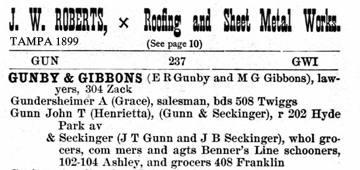
The 1899 Tampa
city directory above lists the wholesale and commercial agents
business at 102-104 Ashley, and the grocery store at 408
Franklin. The next available directory, 1903, and those
afterward, do not list the grocery store on Franklin.
Only the commercial wholesale business is listed, on 102-104
Water St.
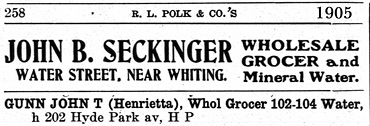

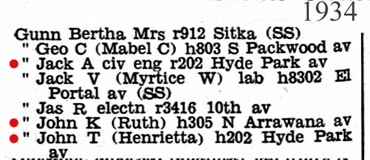
|
|
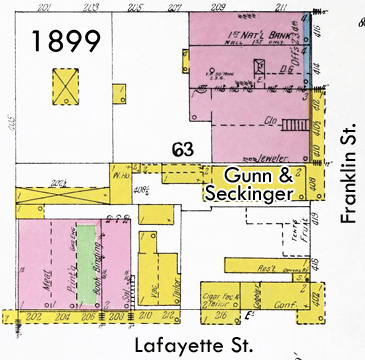
The 1899 map above shows the location of Gunn & Seckinger
Grocery, on the
west side of Franklin St. between Lafayette St. and Madison.
Across Franklin St. was the Hillsborough County Courthouse.
Yellow indicates this was a wooden structure. Notice the
newly built brick structure to the north of it where the 1st
National Bank building was located.
Place your cursor on the map to see this block in 1887.
|
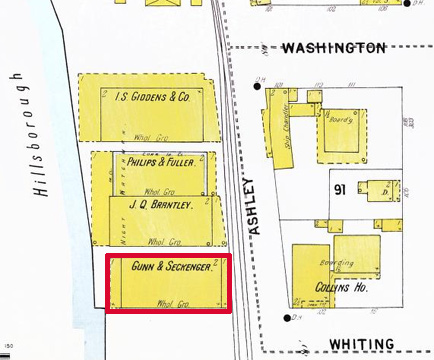
The 1899 map above shows the location of Gunn & Seckinger
Wholesale Company at 102-104 Ashley. |
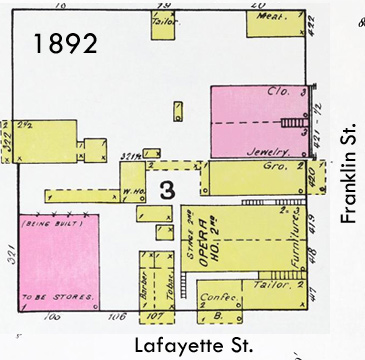
On the 1892 map at right,
Gunn & Seckinger occupied the building where formerly, on the
ground floor, Mrs. Fannie C. Binkley operated her dry goods
store in the 1870s and on the 2nd floor was the office of
Tampa Real Estate & Loan association operated by Frederick A.
Salomonson and John H. Fessenden. The tailor shop on the
corner was Emery, Simms & Emery's Boots and Shoes store in the
1870s.
The
large three-story building in the center held the Branch Opera
House on the second floor, owned by attorney Henry L. Branch.
It served as Tampa's primary place for social, political, and
civil affairs. Hillsborough County High School held their
graduation ceremony in the opera house in 1887. The ground
floor of the opera house building housed the Wm. A. Morrison &
George H. Packwood hardware store.
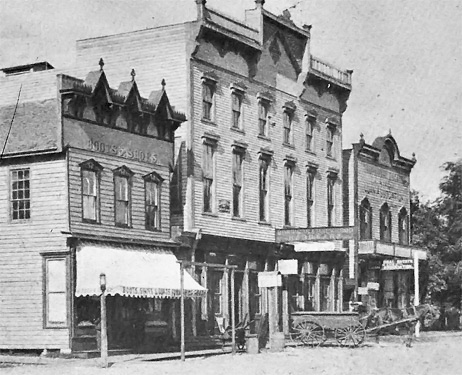
The 1880s photo
at left shows the wood structures (yellow) you see on the 1892
map above. The building at far left was a shoe & boot
store. In the middle was the opera house, and on the
right was Mrs. Binkley's grocery store, which became the
location of Gunn & Seckinger's grocery. The brick
jewelry and clothing store building on the map had not yet
been built.
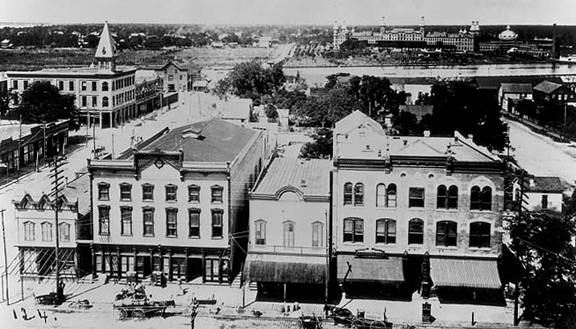
At right, the
west side of the 400 block of Franklin St. in 1890, looking
west toward the Hillsborough River, with the Tampa Bay Hotel
at upper right and the Knight & Wall building at upper left.
This photo shows
the scene from the 1892 map above. Left to right are the
tailor shop, the opera house, the grocery store, and the new
brick building housing the jewelry and clothing store.
To the right of the brick building is the property where the
First National Bank tower was built. |
|
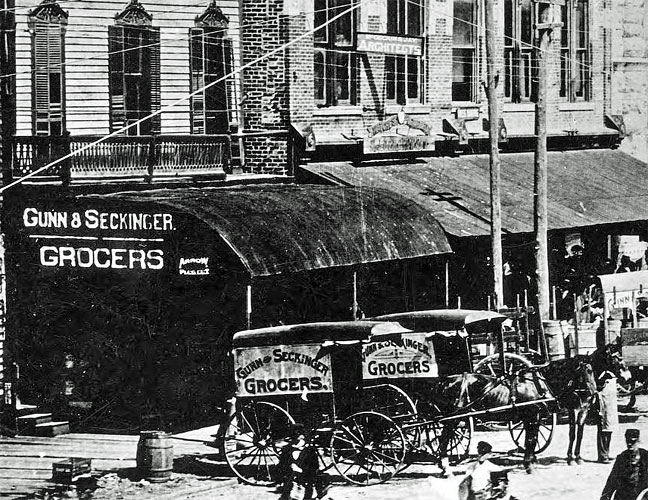
Gunn & Seckinger, 1897
408 Franklin St.
This photo is a small portion
of the large photo shown below.
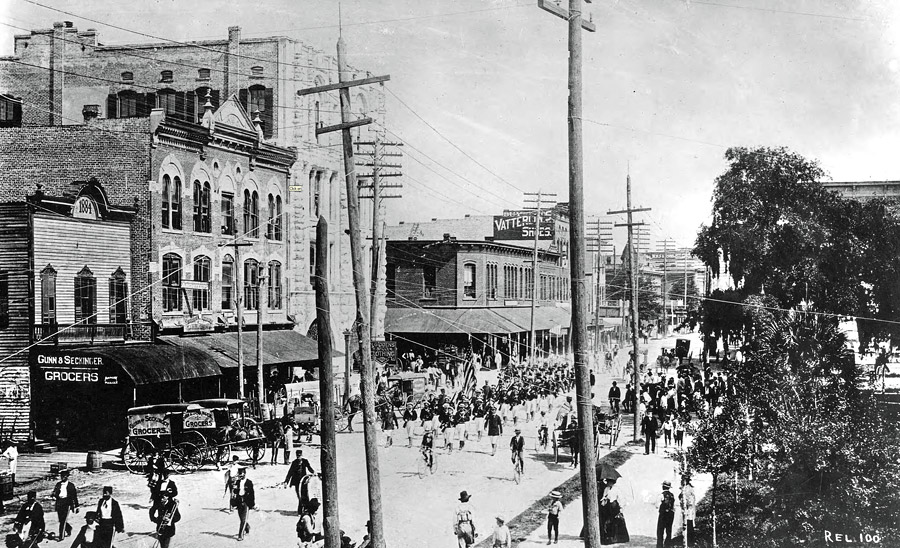
The Port Tampa
Naval Reserve Parade on Franklin Street looking north from
Lafayette Street in 1897.
Courtesy of
University of Florida Digital Collections George Smathers
Library
This photo is greatly reduced, see full size.
Notice the year "1884" at the top of the Gunn & Seckinger
building. To the right of Gunn & Seckinger is Beckwith Jewelry
Store and H. Giddens Clothing store. See the H. Giddens
storefront in 1899. In the 1910s, Giddens moved into a newly
built brick structure on the south end of this block. See 1925
photo. The tall, white building on the corner of Franklin and
Madison was the First National Bank. See the bank in 1900 and
1920. See the First National Bank skyscraper built in 1926 at the same
location which
stood into the 1980s. The entire block has been
razed and is now known as
Lykes Gaslight Park. The building on the north side
of Madison St. under the Vatterlin's Shoes sign was known as "Drawdy's
Corner" and became the offices of D.P. Davis' land sales for
Davis Islands in 1925.
See photo. On the right side of the
photo can be seen the trees that were in front of the
Hillsborough County Courthouse.
|
|
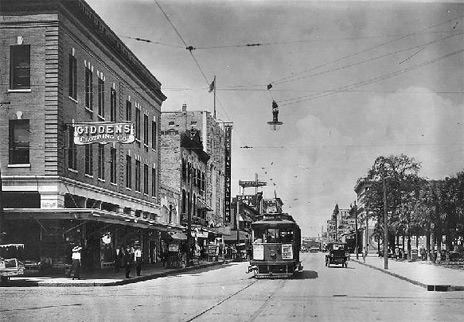
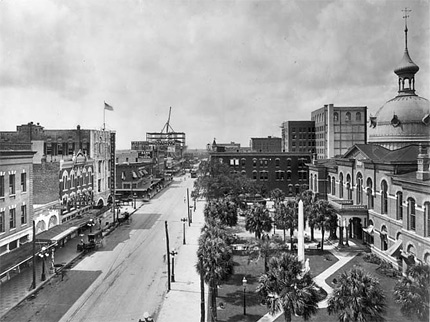
Above
are two views of the same block, "Giddens Corner" in 1911.
In the right side photo, the building seen under construction
in the background is the Citizens & Southern (C & S) Bank
building at Zack & Franklin St.
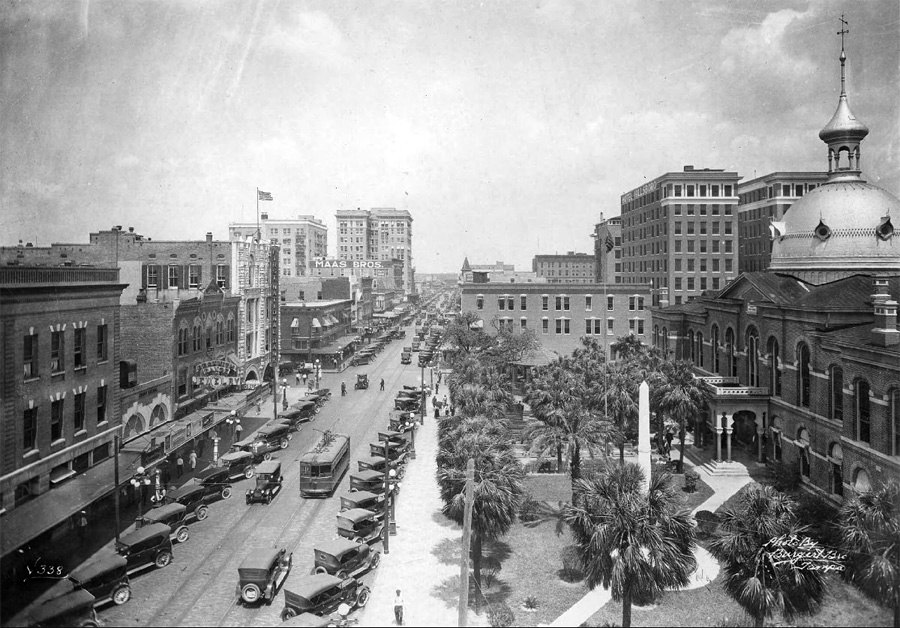
Same block in 1922.
The C & S Bank building can be seen in the distance--tallest
building at center behind Maas Brothers. |
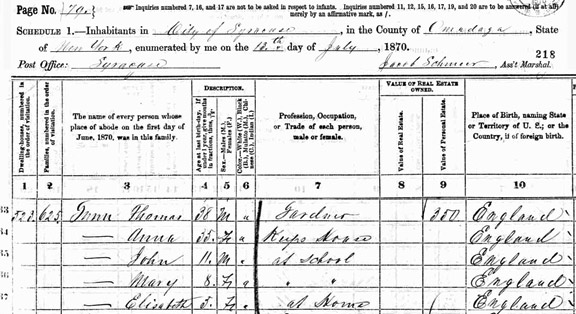
1870 Federal
Census, Onondaga County
Syracuse, NY
Gunn,
Thomas 38
------- Anna 35
------- John 11
------- Mary 8
----Elizabeth 5
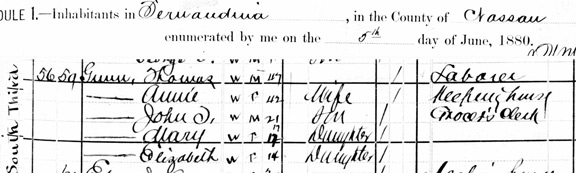
1880 Federal Census, Nassau County
Fernandina, FL
Gunn,
Thomas 47
------- Anna 42
------- John 21
------- Mary 17
----Elizabeth 14
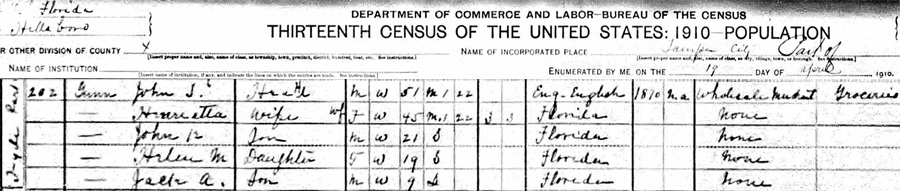
John T. Gunn, wife Henrietta Krause
and children John Krause Gunn, Helen Marie Gunn and Jack Arvid Gunn
at 202 Hyde Park Avenue, 1910.
The record indicates they were married for 22 years. "3 | 3"
indicates Henrietta was the mother of 3 children, 3 still living.
John's business was "Wholesale Market, Groceries."

The 1930 census shows 70 year old John T. Gunn owned
his home at 202 Hyde Park Avenue, valued at $20,000, occupation:
County Commissioner. Son Jack was a Civil Engineer, Road
Construction.
Dale Mabry
Highway was not extended north of
Hillsborough Ave. until around 1955. Not only did they have to
build the overpass, but the entire new highway to the north had to
be cut through the cow pastures to its new northern terminus
(probably the junction with US41 at Land O’Lakes).
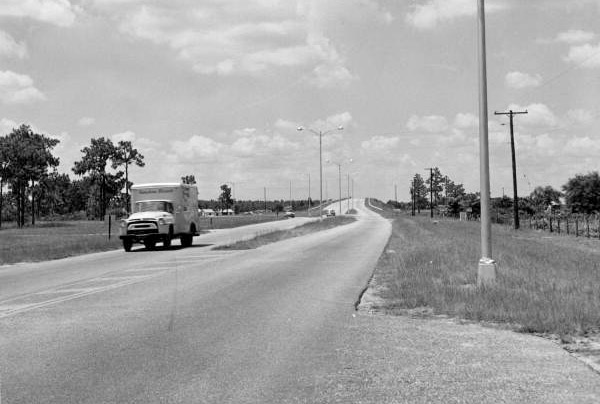
N. Dale Mabry Hwy. looking north
toward the overpass at the railroad tracks, with car merging onto
Dale Mabry from Gunn Highway on the left, 1959. At this
time, Temple Terrace Highway, which became Busch Blvd in the 1960s,
had not yet been completed westward to Dale Mabry Highway.
State Archives of Florida, Florida Memory,
http://floridamemory.com/items/show/103925
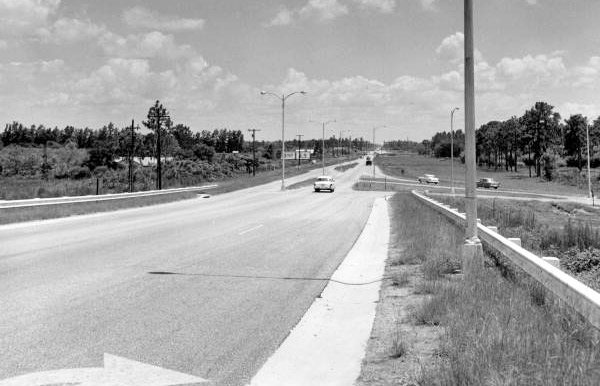
Looking south on Dale Mabry Hwy. just
after passing southbound over the railroad overpass, 1959.
Traffic on the right merging
southbound onto Dale
Mabry from Gunn Hwy. Temple Terrace Hwy (Busch Blvd.) had not
yet been extended to Dale Mabry.
State Archives of
Florida, Florida Memory,
http://floridamemory.com/items/show/103927
|
 |
 |
|
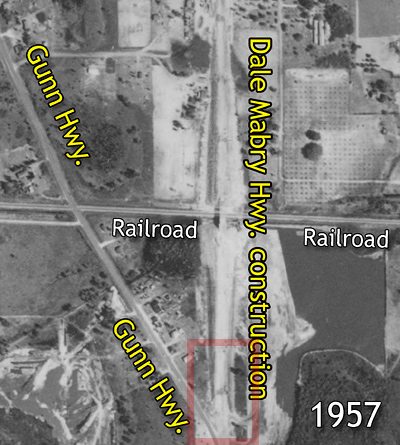
1957
construction of the Dale Mabry extension and overpass over the
railroad tracks. Temple Terrace Hwy. (today's Busch
Blvd.) had not yet been extended this far west from Florida
Avenue. The red rectangle marks the intersection seen in
the above photo, travelling southbound. |
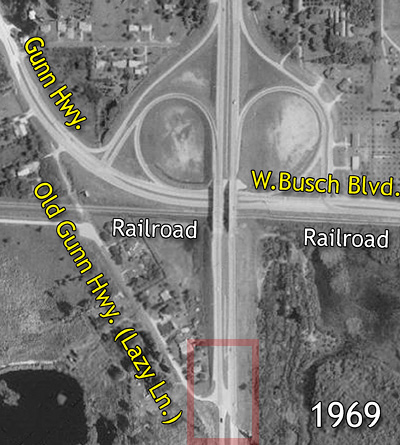
This 1969
photo shows Gunn Hwy. has been rerouted to join with the newer
W. Busch Blvd. and cloverleaf exits/entrance ramps. The
overpass at the railroad tracks has been improved by widening
and lengthening to span Busch Blvd. along with construction of
a second overpass to accommodate a divided Dale Mabry Highway.
The red rectangle marks the intersection seen in the above
photo, travelling southbound. Today, Lazy Ln. runs along the
old Gunn Hwy. |
Citrus Park Historical Trails
City of Tampa Archives
Genealogy Trails
Gunn Hwy completed in 1925
The Pioneeers of Tampa
|
BRUCE B. DOWNS BLVD.
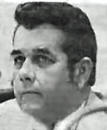 Bruce Barkley Downs, Sr. was born April 17, 1930 in Memphis,
TN, son of Lewis Cass Downs and Jimmie Ann McCann. He joined
the Florida Department of Transportation (FDOT) in 1950,
shortly after graduating from Hernando High School in
Brooksville. In 1951 he married Patsy Ruth Spencer in
Brooksville. Bruce Barkley Downs, Sr. was born April 17, 1930 in Memphis,
TN, son of Lewis Cass Downs and Jimmie Ann McCann. He joined
the Florida Department of Transportation (FDOT) in 1950,
shortly after graduating from Hernando High School in
Brooksville. In 1951 he married Patsy Ruth Spencer in
Brooksville.
At the FDOT, Downs became head of traffic operations and
designed traffic layout, signals, signage and traffic flow for
14 counties. Downs was an engineer who worked 29 years for the
state Transportation Department, and was responsible for
improving local infrastructure. During his time with FDOT he
was named "Jaycee Boss of the Year."
After retiring from FDOT as director of transportation and
safety, he became Hillsborough County’s director of Public
Works and Safety and the deputy county administrator. He was
instrumental in passing a penny gas tax, designing the "G"
canal and passing a moratorium for a $30 million revenue bond
amendment. He was in charge of 2,100 miles of roads, bridges,
and animal control.
Downs was often asked to speak at Mothers Against Drunk
Driving meetings and served as an expert witness during
accident trials. It was a stressful time in Hillsborough
County politics, when Bruce Downs worked as a deputy public
works administrator. The county was in bad shape. According to
his widow, Patsy, many people loved Bruce because he got them
out of a hole. He was very personable and wasn't one to brag.
He had a staff of about 40 and a photographic memory, Patsy
said. He could retrieve people's names and faces after meeting
them only once.
On May 21, 1983, a local newspaper ran a story about how
Downs' job was one of the most stressful in the county. Downs,
who had high blood pressure most of his life, was scheduled to
go the doctor a few days later to get a physical and a stress
test. The day the story came out, Downs collapsed in a
restaurant while eating lunch with co-workers. He was rushed
to a hospital, where doctors tried to revive him from a
massive heart attack. He died before his family could get to
the hospital. He was 53.
Over 500 people attended the funeral, and county employees
were so distraught, they asked that his county car be removed
so they didn't have to see it every day.
On April 17, 1986, Downs' birthday, the county renamed a
little-used 30th Street as "Bruce B. Downs Boulevard," in
memory of a man who loved roads. "This would have been a shock
to him," Patsy Downs said. "He would have felt so humble."
He was chosen by the Governor in 2000 as a Great Floridian;
his Great Floridian plaque is located at his home at 2160 De
Las Flores, Bartow.
Bruce and Patsy's son, Bruce B. Downs Jr., goes by "Barkley"
and has two sons, Bruce B. Downs III and Justin Sheridan
Downs. Bruce III is a medical assistant who lives in Bartow.
Portions of this obtained from
St. Pete Times article by Emily Nipps, Feb. 2007.
|
|
|
BEARSS AVENUE
[Correct pronunciation rhymes with FIERCE]
In 1894, 51-year-old New York
born Rev. Isaac Ward Bearss visited Magdalene, Florida, from his
home in Trenton, Missouri, looking for a new home. Searching
for a more hospitable climate for health reasons, Rev. Bearss
found 600 acres of suitable property on the northwest shore of
Lake Magdalene, an area known as "Horse Pond" in 1900.
Trading land in Missouri for
his land in Florida, he went back home to move his wife Amanda
Jeffries Bearss and eight children to their new home.
Their son Charles was also a preacher. Rev. Bearss also
convinced eleven church members to make the 11-week covered
wagon trip to Florida. Consisting of 20 horses, 20 mules, and
six wagons, it took only eight weeks to reach the Florida
border, but an additional three weeks to reach Lake Magdalene.
Surviving the perilous journey, they arrived on December 20,
1894.
Hoping to establish a United
Brethren Church in the community, the newly arrived families
planned to survive economically off the area’s orange laden
trees. However, the group arrived on the eve of two freezes
that would wipe out most of the state’s orange production.
Not deterred, Rev. Bearss and
eight followers founded a church in May 1895. The church held
services in a building then known as the Lake Carroll school
house. A year later, the church relocated to Gant School, near
present day Citrus Park. By 1897, the congregation grew to 21,
and in response, nine members began to build a church with
Rev. Bearss serving as foreman. Completed in February 1898,
the new 36-by-24 foot building could hold 200 people. Eight
years after its dedication, the 42 member congregation voted
to move the church back to the Magdalene community. Taking
several weeks to move by rolling the entire structure on wood
logs, pulled by a team of mules, the church was relocated to the intersection of present
day Lake Magdalene Boulevard and Paddock Street, on land
donated by B.E. Stall (the family for whom Stall Rd. is named), Rev. Bearss’ son-in-law.
It was replaced by a two-story brick sanctuary in 1924 and
then the most recent building in 1960.
As the Bearss family rooted
itself in Lake Magdalene, they expanded a 40-acre property
that had orange trees on it to cultivate a grove. The property
is bordered by Lake Magdalene Boulevard, Smitter Road and
Bearss Avenue. The children and grandchildren of I.W.
Bearss gave the right of way through their property to build
an east-west road, and so was it was named for the family.
Originally, it was a short section of road that curved and
merged to the north into Lake Magdalene Blvd. When the
road was straightened and widened, it became a major
thoroughfare.
Rev. Isaac W. Bearss died in
1932 at age 87 at the home of his daughter, E.V. Mendenhall.
He was a retired minister for the United Brethren church
and was buried in Lake Carroll cemetery.
Many of his descendants still
live in the area. His great-grandson, Martin Bearss,
owner of Bearss Groves at the southwest corner of Bearss
Avenue and Lake Magdalene Boulevard, has lived most of his 56
years in Lake Magdalene. He has run a produce market at Bearss
Groves since 1990.
Hillsb. Co. Historic Resources
Taking a Stand on Produce
|
| |
HOWARD AVENUE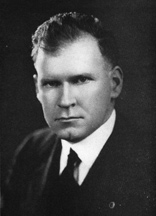
Howard Avenue was named by Hugh
Macfarlane after his son, Howard Pettingill Macfarlane. Howard
was born in Tampa in 1888. He graduated from Princeton
University in 1911 and Washington and Lee University in 1913,
where he obtained his law degree. Immediately after
graduation, he joined his father in the practice of law at the
firm of MacFarlane Ferguson, a law firm started by his father.
He earned a reputation as a lawyer of ability and success and
was looked upon as leader among the younger members of the
bar. He married Carolyn Kenyon of Syracuse, NY in 1914
and had children Jean (1915), Hugh C., II (1918) and Anne P.
Macfarlane (1924). During WW1, he attended officers training
at Ft. Oglethorpe, Georgia. He was commissioned 2nd
Lieutenant in 1918 and served as an instructor in the Infantry
Replacement Camp at Camp Lee, VA. The armistice
intervened before his overseas service, and so he was
discharged at Camp Lee in Dec. of 1918. In 1921 he was
elected as the youngest president of the Hillsborough County
Bar Assn. Howard died in 1967.
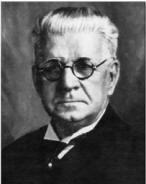 Hugh
C. Macfarlane was born in Grossmylouf, Scotland, in 1851 and
came to this country with his parents as a teenager. By the
time he moved to Tampa in 1884, he was an experienced lawyer
with a law degree from Boston University. Three years later he
was appointed city attorney, and in 1893 state attorney for
the 6th Judicial Circuit. Appointments to the Board of Public
Works and Board of Port Commissioners furthered his local
prominence. In 1892 Macfarlane offered free land and buildings
to cigar manufacturers a few miles northwest of Tampa proper.
In order to develop West Tampa as Hillsborough County’s second
cigar manufacturing area, Macfarlane and his partners financed
the first bridge across the Hillsborough River, the iron
Fortune Street drawbridge. In the fall of 1892, the Macfarlane
Investment Company helped start a streetcar route from
downtown Tampa into West Tampa. By 1900, good transportation
and communication between West Tampa and Tampa’s port
facilities were essential factors in making the new community
competitive with Ybor City and Tampa for new factories and
businesses. In 1895 West Tampa incorporated as its own
city and came to rival Ybor City in cigar production. In 1925,
West Tampa was annexed into greater Tampa. Macfarlane worked
for and formed several law firms until his death in 1935 at
age 83. Hugh
C. Macfarlane was born in Grossmylouf, Scotland, in 1851 and
came to this country with his parents as a teenager. By the
time he moved to Tampa in 1884, he was an experienced lawyer
with a law degree from Boston University. Three years later he
was appointed city attorney, and in 1893 state attorney for
the 6th Judicial Circuit. Appointments to the Board of Public
Works and Board of Port Commissioners furthered his local
prominence. In 1892 Macfarlane offered free land and buildings
to cigar manufacturers a few miles northwest of Tampa proper.
In order to develop West Tampa as Hillsborough County’s second
cigar manufacturing area, Macfarlane and his partners financed
the first bridge across the Hillsborough River, the iron
Fortune Street drawbridge. In the fall of 1892, the Macfarlane
Investment Company helped start a streetcar route from
downtown Tampa into West Tampa. By 1900, good transportation
and communication between West Tampa and Tampa’s port
facilities were essential factors in making the new community
competitive with Ybor City and Tampa for new factories and
businesses. In 1895 West Tampa incorporated as its own
city and came to rival Ybor City in cigar production. In 1925,
West Tampa was annexed into greater Tampa. Macfarlane worked
for and formed several law firms until his death in 1935 at
age 83.
|
| |
|
HANNA ROAD,
Lutz
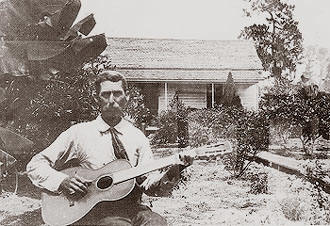
Joe Hanna,
Circa 1910
Around 1905 Joe Hanna bought
property at 50 cents an acre, near the lake that is now named
for him (in Lutz). He built his house in the middle of his
citrus grove in 1910. His land was on the west side of present
day Hanna Road in Lutz, which was named for him, about a 1/4
mile south of today's Sunset Lane. Hanna grew tropical fruit and citrus and
furnished fruit and vegetables for the North Tampa Land
Company exhibit at a 1911 land show in Chicago.
Joe's full name was Josiah C.
Hanna, Jr. He was born Apr. 1856 in Florida of Tennessee
native parents Josiah C. and Jane Hanna, who appear on the
1870 census as farmers in Tampa. Joe had sisters Eliza and
Laura Hanna and married Sarah E. Jackson in Tampa on Oct. 19,
1880 (See
marriage license). Joe and Sarah appear on the 1900 and
1910 censuses of Hillsborough Co, in the "College Hill" area
of Tampa. Their children were Leon C. Hanna b. July
1881, FL, Josiah D. Hanna b. Sept. 1883 FL, Ruby Hanna b.
Sept. 1889 FL and Fred A. Hanna b. May 1893 FL.
HANNA AVENUE & HANNA'S WHIRL
Hanna
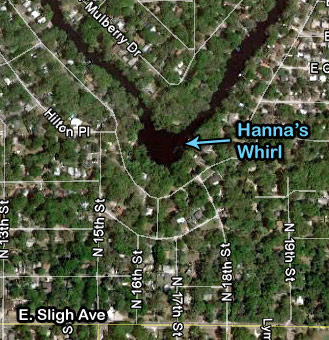
Ave. in old Seminole Heights in Tampa is named for Josiah
C. Hanna, Sr. He was born in Tennessee around 1810 and
had homesteaded land along the Hillsborough River by 1870 in
the area where the river takes a sharp turn at a circular area
formed by swirling currents. This part of the river became a
popular swimming spot in the old days, known as "Hanna's
Whirl" for Josiah, Sr. In 1874, Josiah Sr. built the
first bridge across the Hillsborough River near present-day
Van Dyke Place, just east of present-day Nebraska Ave. in
Sulphur Springs. This bridge was destroyed in a flood in
1880.
|
| |
ASHLEY DRIVE
Ashley
Drive in downtown Tampa is named for William Ashley, the first city clerk in
the early days of Tampa. Ashley was born in Virginia around
1803 and came to Tampa before 1850. He was in love with
his slave, Nancy, who carried William's last name but could
not marry him. They lived together as man and wife, faithful
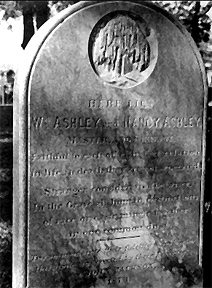
to each other. William died in 1873 and was buried at Oaklawn cemetery. Shortly after his death,
Nancy died. She was buried in the same grave with William.
Ashley’s executor, John Jackson erected a tombstone in 1878
"to commemorate their fidelity to each other." The
inscription reads: "Here lies Wm. Ashley and Nancy Ashley,
master and servant. Faithful to each other in that relation
in life, in death they are not separated. Stranger,
consider and be wiser. In the grave all human distinction of
race or caste mingle together in one common dust."
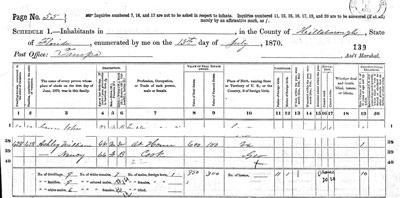
William and Nancy's 1870
Census record
Click to enlarge
|
| |
|
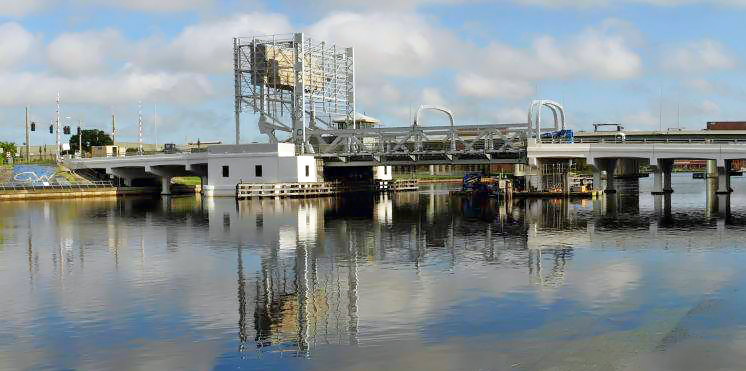
LAUREL STREET & BRIDGE
feature has been updated and moved to its own page.
See What's In A Name P.2 |
|
 |
|
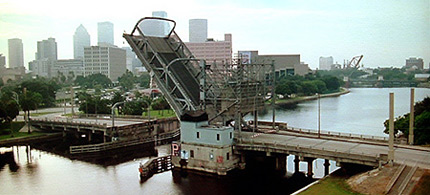
A scene from the movie, "The
Punisher" showing the Laurel St. Bridge, formerly known as
the Fortune St. Bridge. |
UPDATES:
Oct. 19,
2017
Tampa moves to put freed slave Fortune Taylor's name back
on historic bridge.
See more at Fortune
Street & Bridge.
Tampa bridge
will likely be renamed for female business woman who was a
freed slave. Fortune Taylor was by all accounts a
remarkable person at a time when people like her were
often overlooked.
See more at Fortune
Street & Bridge. |
|
|
| |
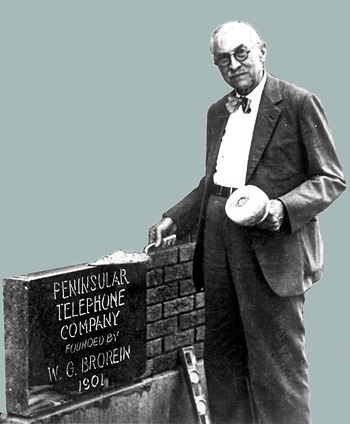
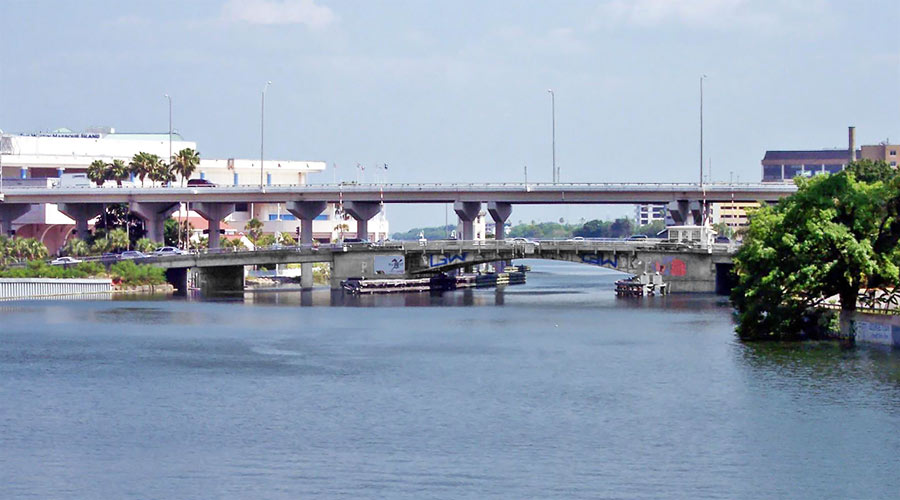
Brorein
St. and Bridge
Read
about William Brorein and his nephew, Carl D. Brorein, and
how their contribution to the
development of telephone communications in the early 20th
century in Tampa moved the city into the fast lane.
|
|
|
FOWLER AVENUE
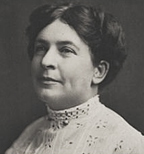 Fowler
Avenue in Tampa was named for one of the foremost women in
real estate, Maude Cody Fowler. Maude Cody was born
in 1875 in Memphis, TN, the daughter of Joseph L. Cody (a
relative of the famous scout and showman, "Buffalo Bill"
Cody,) and Harriet Cody. While quite young, she
relocated to Kansas City where she became one of the most
successful women of the business world in that city,
becoming the Vice President of the Security Underwriters
Corp. of Kansas City and head of the the Kansas City
Women's Athletic Club. Operating out of Kansas City,
she became one of the leading developers of real
estate in Florida, responsible for bringing many of
Florida's leading citizens to this state. Mrs.
Fowler was married to Orin Scott Fowler and their son was
the prominent Tampa attorney Cody Fowler of Fowler, White.
Mrs. Fowler moved to Tampa around 1921 and became one of
the founding developers of Temple Terrace. The
original town plan for Temple Terrace, created in 1922,
was a model of town planning in its day. Between 1923 and
1925 during the land boom, streets were paved, storm
sewers installed, and a well was drilled to tap spring
water. On May 25, 1925, the City was incorporated, with D.
Collins Gillette, one of the founding developers, serving
as the first mayor, and Maude Fowler, serving as vice
mayor. Maude Fowler died suddenly in Tampa on April
7, 1942. Fowler
Avenue in Tampa was named for one of the foremost women in
real estate, Maude Cody Fowler. Maude Cody was born
in 1875 in Memphis, TN, the daughter of Joseph L. Cody (a
relative of the famous scout and showman, "Buffalo Bill"
Cody,) and Harriet Cody. While quite young, she
relocated to Kansas City where she became one of the most
successful women of the business world in that city,
becoming the Vice President of the Security Underwriters
Corp. of Kansas City and head of the the Kansas City
Women's Athletic Club. Operating out of Kansas City,
she became one of the leading developers of real
estate in Florida, responsible for bringing many of
Florida's leading citizens to this state. Mrs.
Fowler was married to Orin Scott Fowler and their son was
the prominent Tampa attorney Cody Fowler of Fowler, White.
Mrs. Fowler moved to Tampa around 1921 and became one of
the founding developers of Temple Terrace. The
original town plan for Temple Terrace, created in 1922,
was a model of town planning in its day. Between 1923 and
1925 during the land boom, streets were paved, storm
sewers installed, and a well was drilled to tap spring
water. On May 25, 1925, the City was incorporated, with D.
Collins Gillette, one of the founding developers, serving
as the first mayor, and Maude Fowler, serving as vice
mayor. Maude Fowler died suddenly in Tampa on April
7, 1942.
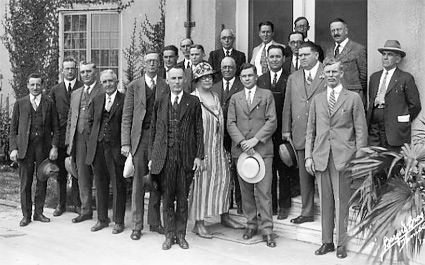
Maude Fowler
with many of the early developers of Temple Terrace.
The first mayor, D. Collins Gillette, is the large man to
the right of the man holding the hat.
See full size
See this blog, the author of which claims that Maude
Fowler's "success" before coming to Florida is nothing but
lies.
Article about South Tampa great-great-granddaughter of Maud Fowler raises money to start a
vocational school for women in Rwanda.
|
| |
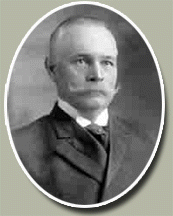
FLETCHER
AVENUE
In 1909,
Duncan U. Fletcher was elected to the U.S. Senate and was
re-elected for four consecutive terms. Fletcher was
also President of the Southern Commercial Congress from
1912 to 1918, delegate to the International High
Commission at Buenos Aires, Argentina in 1916 and
appointed by President Woodrow Wilson to the U.S.
commission investigating European banking.
In 1928,
Senator Fletcher introduced legislation to create the
Everglades National Park, which was signed into law by
President Franklin D. Roosevelt in 1934. Fletcher’s most
active role was on the Committee of Banking and Currency,
which was responsible for investigating the Wall Street
banking and stock exchange practices that contributed to
the Great Stock Market Crash of 1929. The investigation
began the reform of American financial practices and
resulted in the Banking Act of 1933 and the Securities Act
of 1933, the first major legislation to regulate the sale
of securities, and the Securities Exchange Act of 1934.
In
the 1920s, George S. Gandy won the support of the leading
business houses and banks of both St. Petersburg and Tampa
to build the first bridge across Tampa Bay. He also
obtained the backing of such public men as Senator Duncan
U. Fletcher.
In the 1930s,
Tampa was considering 17 sites to build an air field.
Mayor D. B. McKay’s hopes to include governmental
representatives on his nonpartisan site selection
committee were thwarted. None of the federal departments
wanted to be involved. Finally, through the efforts of
Florida’s Sen. Duncan Fletcher, he was able to line up two
 reservists,
Capt. George K. Perkins and Lt. Philip Pratt, both of
Washington, D.C. The site committee looked at the 17 sites
offered by various property-owners. The committee came up
with a selection that turned out to be more visionary than
immediate: Catfish Point, at the southeastern tip of the
Interbay peninsula. The airfield was built and was
named MacDill Air Field. reservists,
Capt. George K. Perkins and Lt. Philip Pratt, both of
Washington, D.C. The site committee looked at the 17 sites
offered by various property-owners. The committee came up
with a selection that turned out to be more visionary than
immediate: Catfish Point, at the southeastern tip of the
Interbay peninsula. The airfield was built and was
named MacDill Air Field.
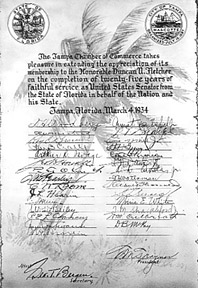
In 1934,
the Tampa Chamber of Commerce honored Sen. Fletcher with
this certificate of appreciation, stating: "The
Tampa Chamber of Commerce takes pleasure in extending the
appreciation of its membership to the Honorable Duncan U.
Fletcher on the completion of 25 years of faithful service
as a U.S. Senator from the State of Florida in behalf of
the Nation and his state. March 4, 1934. The
last 4 signatures are that of Morris White, Thomas
Shackleford, H. Culbreath and D.B. McKay.
Fletcher
spent more than 25 years serving the Senate until his
death in 1936. He was buried in Evergreen Cemetery in
Jacksonville, FL. |
| |
|
ZACK & TWIGGS
Zack
Street is named for Zachary Taylor.
Twiggs
Street is named for Gen. David
Emanuel Twiggs. A career soldier, he was known as
"Old Davy," "The Bengal Tiger," or "The Horse."
Twiggs was
born in 1790 on the "Good Hope" estate in Richmond County,
Georgia, son of Revolutionary War hero John Twiggs, a
general in the Georgia militia.
|
 |
|
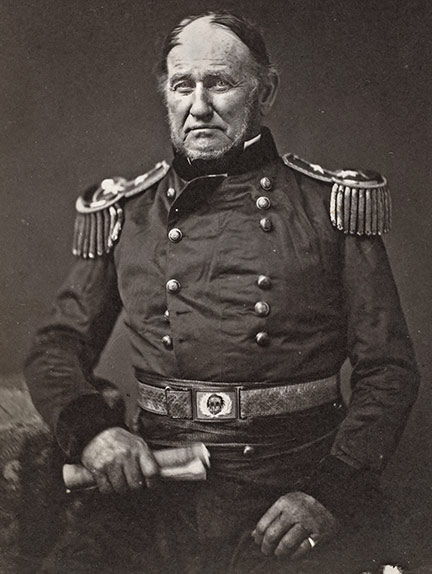
General
Twiggs, circa 1850 |
David E.
Twiggs, had served meritoriously in the U.S. Army for
almost 50 years before the start of the Civil War.
He was an officer in the War of 1812, and he fought in the
Black Hawk and the Seminole Wars. He was Colonel of the
2nd U.S. Dragoons at the outbreak of the Mexican-American
War and led a brigade in the Army of Occupation at the
battles of Palo Alto and Resaca de la Palma. He was
promoted to brigadier general and commanded a division at
the Battle of Monterrey. He joined Winfield Scott's
expedition, commanding its 2nd Division of Regulars and
led the division in all the battles from Veracruz through
Mexico City. He was wounded during the assault on
Chapultepec. After the fall of Mexico City, he was
appointed military governor of Veracruz. For gallant
service in the Mexican War Twiggs was brevetted a major
general and bestowed with a sword by the U.S. Congress.
In 1856,
at the age of 66, he was placed in command of the
Department of Texas with the duties of protecting the
settlers from Comanches and other marauding Indians.
Twiggs, whose headquarters was in San Antonio, sympathized
with the southern States during the secession crisis.
On
January 15, 1861, Twiggs wrote one of several letters to
his commanding officer, Gen. Winfield Scott:
"I am placed
in a most embarrassing situation. I am a southern man and
all these states will secede... As soon as I know Georgia
has separated from the Union I must, of course, follow
her. I most respectfully ask to be relieved in the command
of this department... All I have is in the South."
Though
Twiggs repeatedly asked Scott what should be done when
Texas seceded, he received no better answer than to
protect government property without waging war or acting
aggressively. Those instructions proved impossible to
follow when 1,000 armed Texans surrounded Twiggs' 160-man
garrison on February 18, 1861, and he was forced to
surrender.
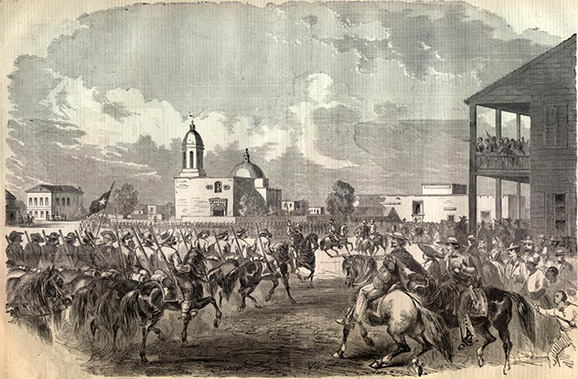
Surrender of
ex-General Twiggs, late of the United States Army, to the
Texan troops in the Gran Plaza, San Antonio, Texas.
Feb. 16,1861
Image from Harpers Weekly, March 23, 1861.
See also "March
2, 1861 General Twiggs, a traitor."
Twiggs made the best terms possible for
removing his men and equipment from the state and then
departed, leaving $1.6 million of government property to
be seized by the Confederacy. Twiggs was labeled a traitor
in the North for surrendering Texas, and he was
dishonorably dismissed from the U.S. army for "treachery
to the flag". Twiggs was promptly commissioned a major
general in the Confederate army, but never saw active
duty. The mental anguish caused by his dishonorable
discharge from the U.S. army led to the rapid decline of
his health. Suffering from ill health, he died in 1862.
|
THE DISGRACE OF
GEN. TWIGGS; GENERAL ORDERS NO. 5, WAR DEPARTMENT,
ADJUTANT-GENERAL'S OFFICE, Published: March 5, 1861
New
York Times - WASHINGTON, March 1, 1861. The
following order is published for the information of
the Army: WAR DEPARTMENT, March 1, 1861. By the
direction of the President of the United States, it is
ordered that Brigadier-General DAVID E. TWIGGS be and
is hereby dismissed from the Army of the United
States, for his treachery to the flag of his country,
in having surrendered, on the 18th of February, 1861,
on the demand of the authorities of Texas, the
military posts and other property of the United States
in his Department and under his charge. J. HOLT,
Secretary of War. By order of the Secretary of War. S.
COOPER, Adjutant General. |
|
| |
| |
| |
|
BUFFALO
AVENUE (Now Dr. Martin Luther King, Jr. Blvd.)
The naming of
Buffalo Avenue is WAS unconfirmed, but TampaPix discovered
the smoking gun on Oct. 5, 2024. Everywhere the naming
of this thoroughfare's history was found, it was thought to
be named for the city in New York, or the animal (because
"they may have once roamed there"). But some long-time Tampa residents claimed that it was named for
an Italian family who owned the land where the street was
built; Bufalo, with accent on the 2nd
syllable <Boo-FA-lo>.
The 1920
Census of Tampa shows a widowed Domenico Bufalo living at
408 Main Street in West Tampa with his three daughters.
It shows he immigrated in 1900 from Italy, probably to
Colorado where his next two daughters were born. This
was the only Bufalo family in Tampa up until this census.
They were living in WEST TAMPA.

Buffalo
Avenue was around as early as the 1880s, it was north of the
Tampa city limits and was listed in the
1886 Tampa City Directory, so
it's not named for the family.
ENTER B.R.
COLE and his hotel
On
Feb. 26, 1881, the Sunland Tribune (predecessor to the Tampa
Tribune) published a lengthy article which among the various
topics was a reprint of article published in a Jan. 28, 1881
Buffalo, NY, newspaper by a visitor to Tampa from Buffalo.
The visitor stayed at a hotel about two miles up the
Hillsborough river from Tampa, which back then Tampa was
limited to our current downtown. The hotel of Mr. B.R.
Cole, of Buffalo, NY, was a "handsome hotel...A lovely spot"
and one that "would charm a man without a bit of poetry in
his soul..." This is proof that the street was named
for the city, and very likely because of the presence of B.
R. Cole and his hotel.
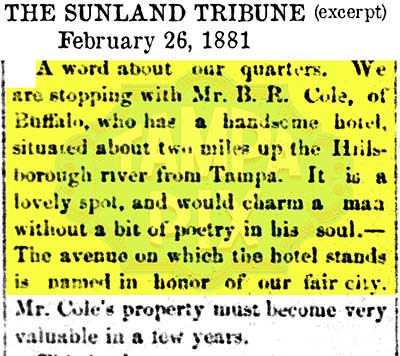
Read the whole article
|
| |
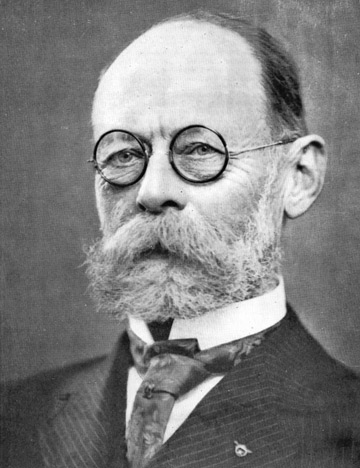 GANDY
BRIDGE & BOULEVARD GANDY
BRIDGE & BOULEVARD
When George
Gandy's colossus opened for traffic in 1924, it was the
feat of its day. One of the longest toll span bridges of
the world in its time, it was a financial and engineering
marvel that instantly accelerated the residential and
commercial development of the entire Tampa Bay area.
Visit an entire page dedicated to
George S. Gandy and his bridge
|
| |
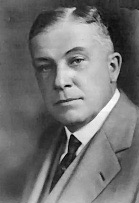
LAMBRIGHT
STREET
Edwin Dart
Lambright was a key figure in Tampa journalism. Born in
Brunswick, Georgia in 1874, he was the son of Joseph F.
Lambright and Julia S. Dart. Edwin grew up in
Brunswick and attended its public schools. He
subsequently took a course at Emory College, then located
in Oxford, but then located at Atlanta.
In 1893, he entered the newspaper business at Brunswick as
a reporter on a local paper, and displayed such ability
that when only 22 years of age he was made editor of the
Brunswick Times, and remained with that journal until he
came to Tampa in 1899, when he accepted an offer from Col.
W. F. Stovall to join the Tampa Tribune.
Lambright
fit in nicely in his new community and new opportunity.
He stepped up rapidly to city editor, managing editor and
editor. He held the post of editor for almost 60 years,
the only break being six years when he was Postmaster of
Tampa, under appointment by President Wilson, starting in
1917.
In 1903 he
married Miss Cannie Finch of Georgia. They had one
daughter, Mary Wallace Lambright in 1905. She
married J. Frank Davies of Tampa.
In 1936,
Lambright published "The Life and Exploits of Gasparilla:
Last of the Buccaneers, with the History of Ye Mystic
Krewe of Gasparilla" a biography he said was based on the
diary of Jose Gaspar, which was found in an attack on the
American Embassy in Madrid, Spain. In his book,
Lambright contended that Jose Gaspar was born in 1756,
served in the Spanish Navy, and turned pirate in 1783. Ed
Lambright died in 1959 at the age of 85. He was
active in many community affairs, including being a
charter member of Tampa Lodge No. 708, B.P.O.E. and
serving as president of the Tampa Rotary Club. In 1945, he
was given the Civitan Award for Outstanding Citizenship. |
| |
|
NEBRASKA AVENUE
Rather
simple; Nebraska Avenue was named for the state...but why?
In the 1870s Tampa was in the doldrums. Times were bad,
Tampa had shrunk in population. The 1870s were probably
the worst years for Tampa. There was nothing going on
here; it was an isolated community. Progress was at a
standstill.
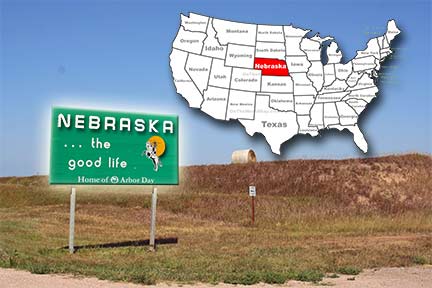
But the people who lived here seemed to have
enjoyed it. There was a lot of game, and fishing was
excellent. It was quiet. The weather was beautiful. There
were those who really loved it. But there were those who
didn’t see much prosperity for the future. Tampa had an
influx of people from the state of Nebraska in the 1870s. It's not known why exactly. They started developing orange
groves along what became Nebraska Avenue, from present-day
7th Avenue to present-day Columbus Drive. Nebraska
Avenue was a dirt road with orange groves on both sides.
Most of downtown and the surrounding area was orange
groves in those days. (Story from an
interview with Tony Pizzo.)
|
|
Lafayette Street / Kennedy Blvd. Bridge
When John Jackson laid out the first plan for Tampa,
he named the streets for
U.S. Presidents and military leaders.
Lafayette Street was named for the
Marquis de La Fayette.
During the
American Revolution, Lafayette served as a
major-general in the Continental Army
under George Washington. In December 1963, Tampa City Council voted to rename Lafayette
Street to Kennedy Boulelvard
honoring assassinated President
John F. Kennedy,
who had visited Tampa just a week before his death.
|
|
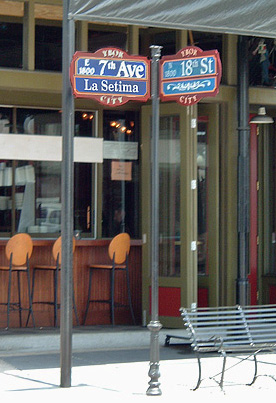
"La Setima,"Seventh Ave.
Ybor City and the missing "P"
Spanish-speaking visitors
have questioned why the
signs on Seventh Avenue, the historic district's main thoroughfare,
misspelled the word for "seventh" as La Setima instead of
the correct spelling, La Septima.
The City of Tampa claims that
La Setima is a colloquialism from the early 20th
century, when waves of immigrants from Spain, Cuba and Italy flocked to Ybor
looking for work in the cigar factories. Back in the 1990s, Ybor City
historian Frank Lastra recommended using “La Setima” as a second name for 7th
Av., since that is how immigrants in the late 1800s pronounced the street’s
name. That's their story and their sticking to it.
Read about the dispute
May 10, 2012
- Tampa City Council Votes to Correct Spelling
Visit Ybor City at
Tampapix |
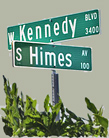 HIMES
AVENUE and GRAY GABLES HIMES
AVENUE and GRAY GABLES
Himes Avenue, that alternate route you sometimes take when Dale Mabry
is backed up bumper to bumper, was once a small stretch of
a street in an area of Tampa known as "Gray Gables." Himes Avenue is now one of
the main thoroughfares of Tampa and its naming is closely related to the
development of the Gray Gables community.
Read about the naming of Himes Avenue and Gray Gables on its own, separate page.
|
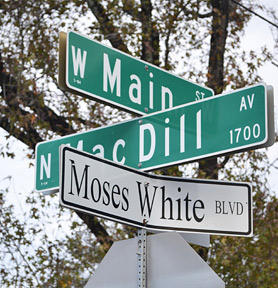 MOSES
WHITE BLVD. (MAIN ST. IN WEST TAMPA) MOSES
WHITE BLVD. (MAIN ST. IN WEST TAMPA)
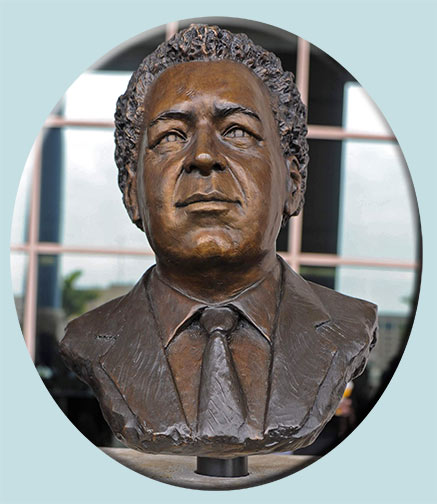
Moses White was an
African-American businessman who started four businesses
along Central Avenue in the 1930s through the 1950s and
thus helped establish the Central Avenue business
district. In those days, Central Avenue commerce centered
around White's establishments, which were the Cosey Corner,
Palm Dinette Restaurant, the Flamingo Rooming House, and
the Four Walls Club, which was a night club.
Moses White opened his
first restaurant in 1932, Deluxe Cosey Corner Sandwich
Shop, on Central Avenue in Tampa. It became one of the
city's most popular hangouts and the center of many civic
discussions. In addition to sandwiches and other fare,
they served up gizzards and rice, fried chicken, and three
hot dogs for twenty-five cents. Moses priced his fare with
the nearby Central Park Village housing development
residents in mind. The children that came over from the
Village loved the hot dogs, and so people would ask Moses,
“Why don't you raise the price?” He said “No, as long as
I'm here I'm always going to sell hot dogs at that price.”
He wanted everybody to feel welcome and not excluded.
Moses was a avid proponent of helping people. White's
businesses, particularly the a Cosey Corner, were gathering
places for politicians and just ordinary people who just
wanted to socialize. He was giving and caring, and not
only with respect to his customers but he was very
concerned about the community.
Moses and his brother
Chester White Sr. were partners in the Palm Dinette which
they opened in 1944. In the 1950s, Chester went to work
for the Tip Top Bread Company and left the business to
Moses and his wife. When you dined at the Palm Dinette you
did not eat on paper plates. There were crisp, white linen
tablecloths with matching napkins, and your food was
served on fine china. The Palm Dinette was a place to take
your family for dinner, a place to entertain out of town
guests, and a gathering spot to visit with friends after
the Easter parade.
The Palm Dinette was a favorite of the
soldiers from MacDill Air Force Base. The soldiers got
paid once a month and more often than not their desire for
a good time always outlasted their money. Moses was able
to negotiate a deal with MacDill's base commander to
establish a credit card system for the soldiers. Moses was
a forward thinker and this was an unprecedented act and
absolutely unheard of for a black man parlaying such a
deal with any branch of the military then or anytime since
then.
Moses displayed the food
in the windows. They had jumbo shrimp, French fries, fried
chicken and all kinds of soul food, with the steam tables
right in front of the windows, so as people walked by not
only could they see it but they could smell it. The menu
was posted outside and the dining area could seat about
150 people. There were tables with linens along the wall,
and along the north wall there were big booths that could
hold about six people each. There was a "piccolo"--a juke
box, and the music was always going. On Sunday, Moses
played religious music but otherwise they were popular
tunes of the day. Then it was very common to see some of
the people who actually were on the juke box walking down
Central Avenue. Like a Sam Cooke, or Ray Charles, or a
just any of the entertainers.
Moses also owned the
Flamingo Rooming House. Because of segregation, the
entertainers couldn't go to the fine hotels downtown or
the restaurants, so they stayed at the Flamingo, and Moses
would have them performing in the Club. It was a good deal
for Moses and also for the entertainers that performed at
what was then called the Chipman circuit. Ray Charles used
to drop in often.
|
 |
 |
|
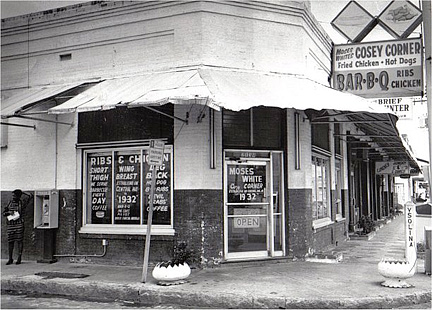
Cosey Corner on Main St. and Ysolina, West Tampa, 1984
|
Moses also helped restore
peace during the race riots of 1967. "During his first
term, Mayor Dick Greco used to come eat," his grandson
Gerald, Jr. says. "He was always asking my grandpa for
advice." In 1977, Moses moved the Cosey Corner to Main
Street in West Tampa. Gerald White Jr. was
brought up on barbecue. Gerald would come by after school,
grab something to eat and talk to his dad and granddad,
who both worked at the Cosey Corner on Main St. Moses White
died in 1984. Gerald and his dad tried to carry on the
business for a while, but Gerald was busy playing
basketball at the University of South Florida and got an
offer to play professionally in South America. Gerald
moved away, and his dad couldn't run the business alone.
In 1987, the barbecue closed.
When Gerald White, Jr.
came back with a little money, he wanted to get back into
the BBQ business. Moses White & Sons Bar-B-Q opened in
1997 and is located at 1815 E. Seventh Avenue in Ybor
City. It was his dad's idea, but Gerald Jr. runs the place
and his family works there. So once again, everyone from
partiers to politicians can meet and socialize over good
southern BBQ.
Sources (recommended
reading)
Interview with Bernadine White-King, daughter of Moses
White
Moses White & Sons Barbeque
Interview with Claretha Johnson
|
|
|
ORIGIN OF HYDE PARK
AND PLATT STREET
| |
 |
| |
Levi Coller
circa 1850 |
In the early 1800s, Levi
Coller and his father-in-law John Dixon lived on Spanish
grant land in the area of St. Augustine, in territorial
Florida. In 1815 there was an Indian uprising and John
Dixon was killed; Levi took his family and fled to Alachua
County, which at the time encompassed all of the Tampa Bay
area.
Levi came to the bay area a short
time later for the salt air for his health (family
tradition) and to set out his stake. He selected 160 acres
on the bay front extending east from the mouth of the
river and returned home to gather his crops and move his
family. He returned with his family in 1826 and was astounded to find that during his
absence the government had set aside the land he had
selected for his homestead as a military reservation and
had troops encamped on it. He had neglected to file notice
of his intention at the land office and therefore had no
claim on the land.
His next selection was a tract on the
east shore of the bay at the mouth of what is now known as
Six Mile Creek, but which after his location there was
called Collar's Creek. Coller spoke the language of the
Indians and traded with them; often serving as a
translator for the army during peaceful times. Levi,
along with wife Nancy Dixon Coller and their five
children were the first civilian settler families in the wilderness
that would become Tampa at Ft. Brooke. By 1829, Levi
had farmed the area and was selling vegetables to the U.S.
Army outpost at Fort Brooke and to government vessels
which entered the port. Coller had a large farm where
he cultivated the first cotton planted
in South Florida. He developed a large herd of cattle
and hogs, and established trade with the island of Key
West, using the fishing smacks which occasionally entered
the bay to transport his farm products, beef and pork. He had many diversified interests and
acquired lands along the west bank of the Hillsborough
River to the area now known as Ballast Point.
|
Read an excellent detailed account of the
struggles of the Coller family with Indians, disease and
even a hurricane with tidal surge, by D. B. McKay, written
during the lifetime of Nancy Coller Jackson. "PIONEER
WOMEN IN TAMPA LIVED DANGEROUS LIVES DURING INDIAN WAR",
about three daughters of Levi Coller; Nancy Jackson,
Cordelia Huey and Jeanette Haskins.
1837 lithograph depicting Ft. Brooke barracks |
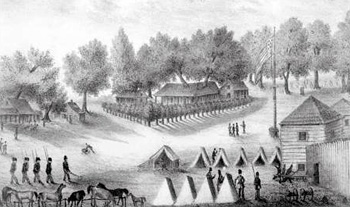 |
|
Levi
Coller's 1830 census shows one male and one female
under 5, one male and two females age 5 to 10, two
females age 10 to under 15, one female age 30 to
under 30 (which was his wife) one male age 40 to
under 50 (which would have been Levi himself), for a
total of 9 members in his household. Note that
in 1830, the county and the river had not been named
Hillsborough. The bay area was in Alachua
County, and the area was enumerated as Lochloosa
Creek, Coster Ponds, New River, and Sampson River.
|
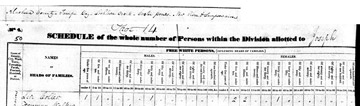
Click census image to enlarge, opens in new window, then
zoom to enlarge. |
In September of 1834,
Levi & Nancy's daughter, Nancy Coller, married Robert
Andrew Jackson, Jr. at the Fort
Brooke garrison. It was the first recorded wedding on Florida’s
West Coast. Jackson, who was born in Philadelphia in 1802,
was a son of Robert and Euphemia Parker Jackson.
Robert Jackson, Sr., also a native of Philadelphia, was a
civil engineer and was employed in some important
government work, among which was the construction of Fort
Moultrie on Sullivan's Island in Charleston harbor, the
fortification of which figured prominently in Revolutionary
War history, as well as in the history of the War Between the States.
Robert Jackson, Jr. was a student of West Point
and previous graduate of Rutgers College in New Jersey.
He was a compounder of medicines and the surgeon’s chief
steward while stationed at Ft. Brooke, where he arrived as
the fort's hospital steward in
1834. (The same year the territorial Florida legislature
organized and named the county of Hillsborough).
In 1838, Levi Coller's land passed to his daughters and
their husbands, Jeanette and W. T. Haskins (who returned
east of the river for lack of a bridge) and Nancy and
Robert Jackson.
|
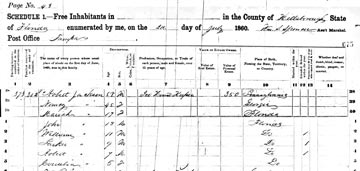 |
|
Robert &
Nancy Jackson's 1860 census in Tampa shows children
Mariah, John, William, Parker, Robert and Cornelia.
Robert Sr.'s occupation was "Ice house keeper."
The image has been edited so that the children
(which were listed on the next page) appear along
with their parents. Click Image to enlarge, opens in
new window, then zoom to enlarge.
|
|
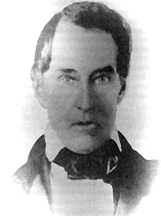 |
|
Dr. Jackson
|
After his military duty,
Robert and Nancy Jackson established their home on a
commanding 160-acre tract near the locale
known as Jackson’s Point, marking the junction of the
Hillsborough River and Bay.
Robert later became a judge of the probate court
of Hillsborough County. Disaster and tragedy pursued
the Jacksons when in Sept. of 1848 a terrible hurricane
and tidal surge swept away their home and all of its
contents, even the money they had accumulated, but Dr. and
Mrs. Jackson and their five children escaped and were
given shelter by friends who had erected their homes on
higher land.
|
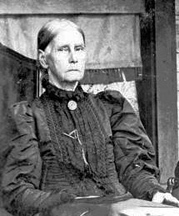 |
|
|
Nancy Coller Jackson
circa 1880s |
|
Later they built a new and more substantial
home fronting on what is now Platt St. This old home,
which had been repaired and added to, stood at present-day
205 Platt Street. Robert Jackson was highly esteemed as a
physician, and long as he lived, though not engaging in
active practice, was often consulted by other
practitioners. He was one of the foremost citizens of
antebellum Tampa and died just at the closing of the Civil
War, on March 2, 1865. Leaving Nancy with no legal claim to the
land where her home was built, Nancy attempted to secure
title to the land the family had been occupying and
developing; much of it planted with orange trees. She had
intended to homestead all 160 acres, but through the
unscrupulous dealings of men she had trusted, she had to
relinquish half of her acreage. After an appeal to
Washington, she finally secured her acreage. In
order to secure an independent life for herself and her
children (5 sons and 3 daughters), she sold a portion of her homestead to some
prospectors who wanted to expand the growth and
development of Tampa. One of these men was Obadiah H.
Platt, from Hyde Park, Illinois. Obadiah was born
around 1836 in New York; he was a
grandson of Obadiah H. Platt and Elizabeth Hawley of
Fairfield, Conn. and a nephew of U.S. Senator Orville H.
Platt.
From "Old Times in Huntington
(NY), a historical address by Hon. Henry C. Platt, Jul.
4, 1876.
Read about Nancy Jackson
in a narrative written by her great-granddaughter, using a
year 1900 interview with Nancy Jackson as one of her
sources.
| |
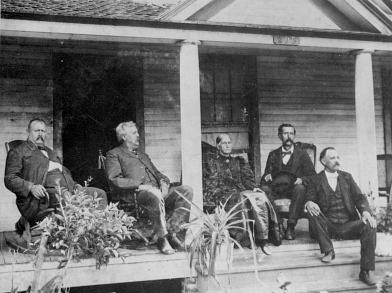 |
| |
Nancy Jackson's home at 205 Platt St. L to R:
Wm. Parker, Levi Oscar, Nancy, Robert Andrew III,
John Brown |
THE BIRTH OF HYDE
PARK IN TAMPA
In 1886 Obadiah H. Platt
purchased a portion of the Robert Jackson farm acreage in anticipation
of a bridge joining the west bank of the Hillsborough
River to downtown Tampa. He named this new 20-acre area
Hyde Park, after his hometown in Illinois.
Hyde Park Township was a civil township in Cook County,
Illinois, that existed as a separate municipality from
1861 until 1889 when it was annexed into the city of
Chicago. This region comprised much of what is now known
as the South Side of Chicago.
The completion
of the Lafayette Street Bridge in 1889, along with the
opening of railroad baron Henry B. Plant’s luxurious Tampa
Bay Hotel in 1891, brought new importance to Platt’s
vacant land. Soon prominent citizens built homes in Hyde
Park and the area flourished. Citrus groves covered much
of the area west of the river, until building in Tampa’s
first suburb prevailed. James M. Watrous, who built his
home at at present-day 1307 Morrison Avenue in 1882, and
William A. Morrison who established a residence at 850
Newport Avenue by 1885 were early citrus growers. Lots sold quickly
in Tampa's first subdivision, and a middle-class
residential community formed on the west side of the
river.
Nancy Coller Jackson died
in 1907 at age 92. By 1910 all the large citrus
groves had been subdivided encompassing nearly 100 acres
south of Swann Avenue between Magnolia and Orleans Avenue. The fortunes of Hyde Park
have fluctuated. Once known as an upper middle class
neighborhood, Hyde Park lost status after WWII as outlying
suburbs became more desirable. Eventually, however, the
area became one of Tampa’s most affluent districts.
Historic preservation had a prominent role in this change,
since it ensured the continuity of style in existing and
new structures.
The Platt Street and Cass
Street bridges were completed in 1926 using nearly
identical specifications. The Platt Street Bridge was
slightly longer to connect with Bayshore Boulevard.
|
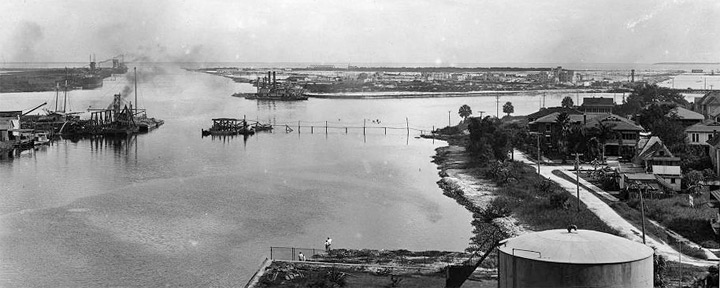 |
|
Platt St. bridge
construction, 1925 - Upper left is Seddon Island, to the
upper right is Davis Islands |
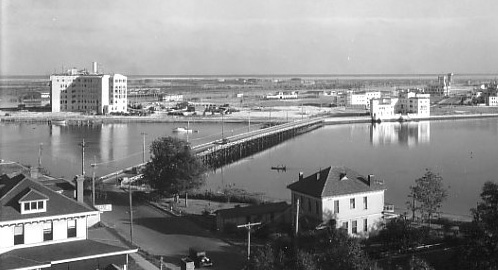 |
The
original wood bridge to Davis Islands from Hyde
Park, 1926 |
| |
|
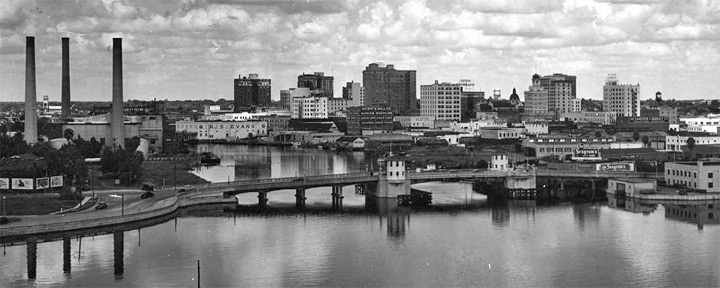 |
|
The Platt St. Bridge as seen
from Davis Islands, circa 1930s.
On the left is Bayshore Blvd., Platt St. and the Tampa
Electric power plant.
|
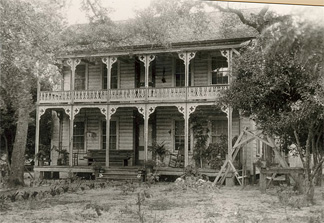 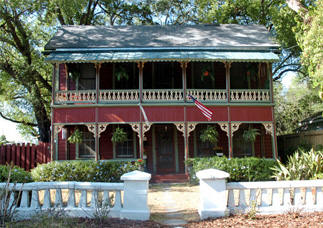 Robert and Nancy
Jackson's son, Capt. William Parker Jackson (b.1847)
married in 1874 to Louise Collins of Bainbridge, GA. He
retired from the sea in 1887 and became a farmer. On April
29th, 1890, he homesteaded 153 acres that ran between
present-day Hanna St. and Knollwood Avenues, and Nebraska
Avenue west to the Hillsborough River. The famous
Jackson home in Old Seminole Heights was theirs. Robert and Nancy
Jackson's son, Capt. William Parker Jackson (b.1847)
married in 1874 to Louise Collins of Bainbridge, GA. He
retired from the sea in 1887 and became a farmer. On April
29th, 1890, he homesteaded 153 acres that ran between
present-day Hanna St. and Knollwood Avenues, and Nebraska
Avenue west to the Hillsborough River. The famous
Jackson home in Old Seminole Heights was theirs.
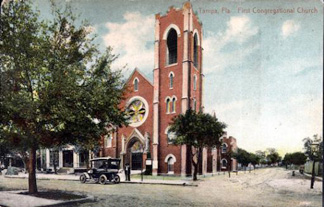 The First Congregational Church relocated from downtown
Tampa in 1885 and built a massive building at 2201 North
Florida Avenue. The building at 2201 Florida
Avenue is the First Congregational Church, built in 1906
when the block contained only an orange grove. Organized
in 1885 at the home of Mrs. Caroline Pettingill, the
congregation moved from a frame church in downtown Tampa
at the urging of pioneer Obadiah H. Platt, for whom the
church was dedicated in 1906. The First Congregational Church relocated from downtown
Tampa in 1885 and built a massive building at 2201 North
Florida Avenue. The building at 2201 Florida
Avenue is the First Congregational Church, built in 1906
when the block contained only an orange grove. Organized
in 1885 at the home of Mrs. Caroline Pettingill, the
congregation moved from a frame church in downtown Tampa
at the urging of pioneer Obadiah H. Platt, for whom the
church was dedicated in 1906.
Sources:
Early Tampa area settlement
The Jackson House-Old Seminole Heights
Historic Hyde Park
The Platt Lineage
Henry B. Plant Comes to Town
The Robert Jackson Family
|
|
|
MARION
STREET, Downtown Tampa
Brig. General Francis
Marion (c. 1732 – February 26, 1795) was a military
officer who served in the American Revolutionary War. Acting
with Continental Army and South Carolina militia
commissions, he was a persistent adversary of the British
in their occupation of South Carolina in 1780 and 1781.
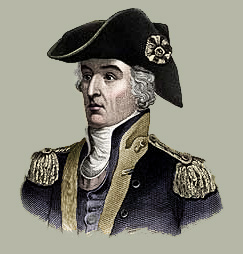 When
British forces captured Charleston in 1780, American
troops pulled out of South Carolina. Marion, however,
stayed and organized a small force of poorly equipped men,
training them in guerrilla tactics. Living off the land,
Marion and his men harassed British troops by staging
small surprise attacks in which they captured small groups
of British soldiers, sabotaged communication and supply
lines, and rescued American prisoners. After these attacks
Marion withdrew his men to swamp country unfamiliar to the
British. Colonel Banastre Tarleton, a British commander,
gave Marion his nickname when he complained that it was
impossible to catch the "Swamp Fox." Near the end
of the war, Marion and American General Nathanael Greene
joined forces. In 1781 they successfully fought at the
Battle of Eutaw Springs and forced the British retreat to
North Carolina. While still leader of his brigade, Marion
was elected to the senate of South Carolina in 1781. He
was reelected in 1782 and again in 1784, after the war had
ended. In appreciation for his military service, the state
legislature appointed Marion commander of Fort Johnson, in
Charleston. When
British forces captured Charleston in 1780, American
troops pulled out of South Carolina. Marion, however,
stayed and organized a small force of poorly equipped men,
training them in guerrilla tactics. Living off the land,
Marion and his men harassed British troops by staging
small surprise attacks in which they captured small groups
of British soldiers, sabotaged communication and supply
lines, and rescued American prisoners. After these attacks
Marion withdrew his men to swamp country unfamiliar to the
British. Colonel Banastre Tarleton, a British commander,
gave Marion his nickname when he complained that it was
impossible to catch the "Swamp Fox." Near the end
of the war, Marion and American General Nathanael Greene
joined forces. In 1781 they successfully fought at the
Battle of Eutaw Springs and forced the British retreat to
North Carolina. While still leader of his brigade, Marion
was elected to the senate of South Carolina in 1781. He
was reelected in 1782 and again in 1784, after the war had
ended. In appreciation for his military service, the state
legislature appointed Marion commander of Fort Johnson, in
Charleston.
Due to his irregular
methods of warfare, he is considered one of the fathers of
modern guerrilla warfare, and is credited in the lineage
of the United States Army Rangers.
Detailed military career
Brigadier General Francis Marion's gravesite |
|
MORGAN STREET, Downtown Tampa
Brig. General Daniel Morgan
(1736 – July 6, 1802) was an
American pioneer, soldier, and United States
Representative from Virginia. One of the most gifted
battlefield tacticians of the American Revolutionary War,
he later commanded the troops that suppressed the Whiskey
Rebellion.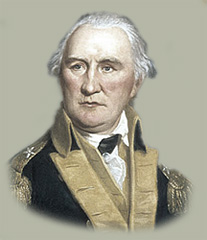
Morgan was the commander of a band of Virginia
sharpshooters in the American Revolution. At the outbreak
of the Revolution he was commissioned captain in the
Continental Army, and he went with Benedict Arnold on the
expedition (1775) against Québec, where he distinguished
himself as commander after Arnold was wounded. Taken
prisoner, he was exchanged in the fall of 1776 and
commissioned a colonel. He fought in the battles of
Saratoga in the fall of 1777. He and his frontier riflemen
played a major part in defeating the British at Freeman's
Farm and Bemis Heights. Dissatisfied and in ill health,
Morgan retired from the army in 1779 but reentered as
brigadier general in 1780. On January 17, 1781, promoted
to brigadier general, he won one of the most brilliant
victories of the war when he overcame a superior British
force (commanded by Col. Banastre Tarleton) by his
effective use of cavalry at the battle of Cowpens, South
Carolina.
In July of 1781 he
retired for good and lived out the rest of his life in
peace and prosperity at his home, "Soldier's Rest," near
Winchester. In 1794 he commanded a company charged with
putting down the short-lived Whiskey Rebellion, an
uprising of backcountry farmers incensed over a federal
tax on distilled grains. He served one term in Congress,
and one term was enough. A staunch Federalist like his
hero George Washington, he became disgusted with
Jeffersonian Democrats--"a parsall of egg-sucking dogs,"
as he termed them. He died in 1802 at the age of 66 (or
67).
Daniel Morgan by Janey B. Cheaney
Brigadier General Daniel Morgan |
|
|
|
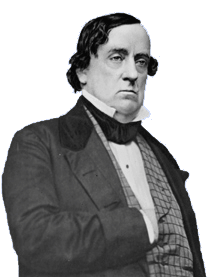 CASS
STREET & BRIDGE CASS
STREET & BRIDGE
Cass Street
and the Cass Street Bridge across the Hillsborough River
were named for General Lewis Cass (1782-1866).
Lewis Cass was born in
1782 in Exeter, New Hampshire. He was educated at
Phillips Exeter Academy and joined his father at Marietta,
Ohio, about 1799, where he studied law and was admitted to
the bar at the age of twenty. Four years later he became a
member of the Ohio legislature. During the War of 1812 he
served under General William Hull, whose surrender at
Detroit he strongly condemned, and under General William
Henry Harrison, and rose from the rank of colonel of
volunteers to be major-general of Ohio militia and finally
to be a brigadier-general in the regular United States
Army.
In 1813 he was appointed
governor of the territory of Michigan, the area of which
was much larger than that of the present state. Upon the
reorganization of President Andrew Jackson's cabinet in
1831 he became Secretary of War, and held this office
until 1836. In 1836 General Cass was appointed minister to
France, and became very popular with the French government
and people. Cass was a Democrat and in 1848 he
received the Democratic nomination for the Presidency, but
owing to the defection of the so-called "Barnburners" he
did not receive the united support of his party, and was
defeated by the Whig candidate, Zachary Taylor. His name
was again prominent before the Democratic convention of
1852, which, however, finally nominated Franklin Pierce.
President James Buchanan made him Secretary of State, and
in December 1860 he retired from the cabinet when the
president refused to take a firmer attitude against
secession by reinforcing Fort Sumter. He remained in
retirement until his death at Detroit, Michigan, on the
17th of June 1866.
In 1853, Tampa
surveyor John Jackson combined 3 surveys he had drawn from
1847 to 1853 into one, completing his plan of Tampa.
Cass Street is named on this original plan.
Completed in 1926, the 511-foot trunnion bascule Cass
Street bridge was built to serve the southern end of West
Tampa and cost $400,000. The same designers did the Platt
Street Bridge, which is almost identical. The adjacent
railroad bridge, built in 1915, provided access to the
Port of Tampa.
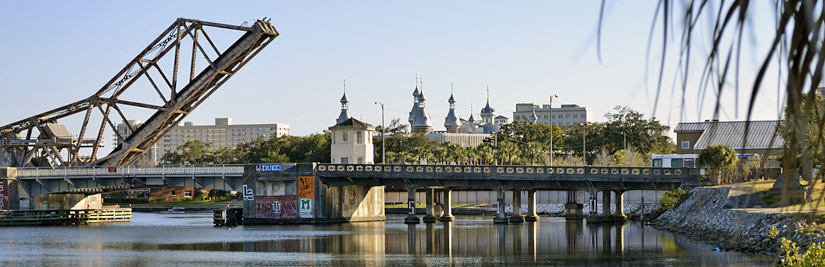
The Cass St. Bridge with
adjacent raised railroad bridge and University of Tampa
minarets in the background, Jan 2011
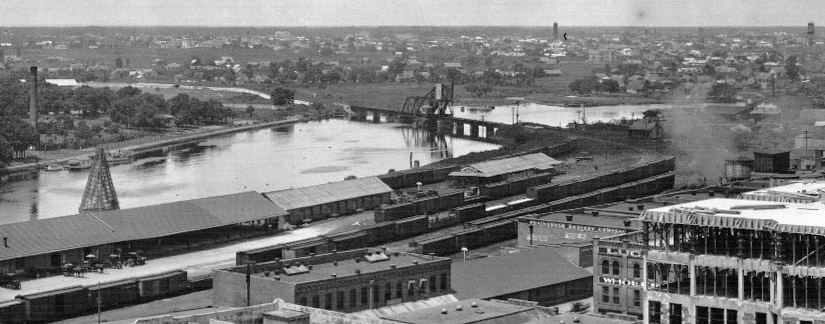
The railroad bridge before
the Cass St. bridge was built, with Roberts City and West
Tampa in the background, 1920
Photo taken from the top of the Bay View Hotel
Photos below are courtesy of the Tampa-Hillsborough County
Public Library, Burgert Brothers collection.
|
|
|
|
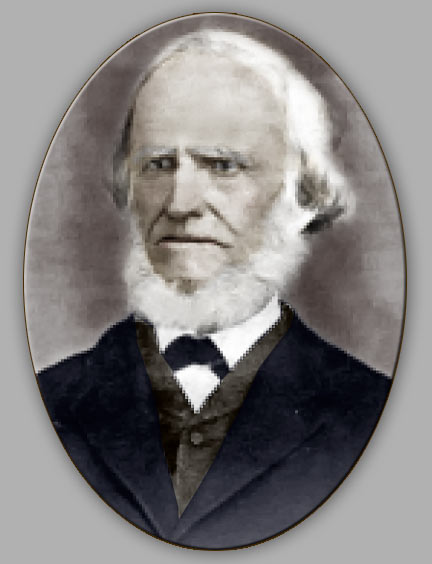 JACKSON
STREET JACKSON
STREET
John
James Jackson II was born in County Monaghan, Ireland and
immigrated to the United States with his brother in 1841.
The brothers traveled to New Orleans where John worked as
an Assistant City Engineer for two years. In 1843, the
federal government hired Jackson to survey a large land
grant in present-day Palmetto, Florida. He accepted this
appointment as federal surveyor and then moved to
Hillsborough County with his brother Thomas to begin work.
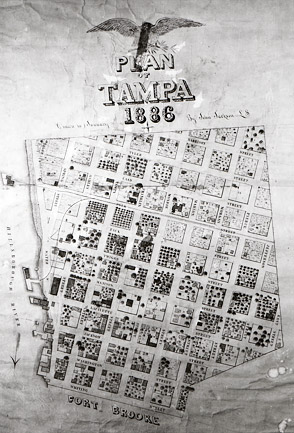
In addition to his
salary, the federal government gave Jackson a large land
grant in Hillsborough County. Jackson’s work also took him
throughout Florida and it was on an assignment in St.
Augustine that he met and married Ellen Maher in 1847 with
whom he had four children.
Several weeks later,
Hillsborough County hired Jackson to survey and map Tampa
which had been designated the county seat in 1846. Jackson
named the streets of Tampa after U.S. Presidents, military
figures and one, possibly two local individuals, William
Ashley and possibly himself (or Pres. Andrew Jackson.)
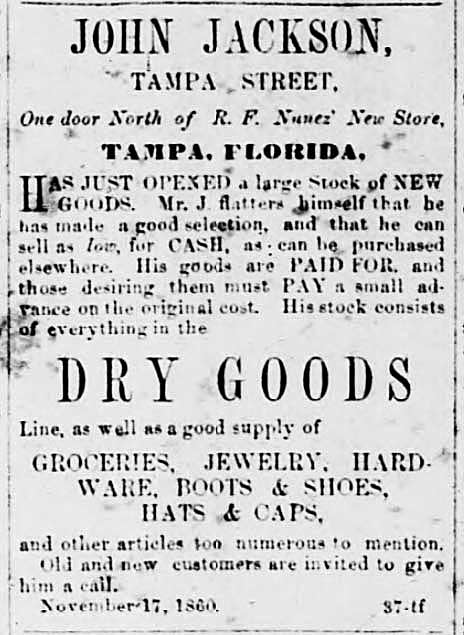 After completing his
assignment, Jackson returned to surveying but in 1849 he
and his wife decided to move to Tampa where he established
a general store on the corner of Washington and Tampa
Streets. Jackson also became involved in Tampa politics
and activities. After completing his
assignment, Jackson returned to surveying but in 1849 he
and his wife decided to move to Tampa where he established
a general store on the corner of Washington and Tampa
Streets. Jackson also became involved in Tampa politics
and activities.
On April 21, 1861, the
20th Florida Regiment took over the abandoned Fort Brooke
and the Confederate military commander declared Tampa
under marshal law, dismissed the mayor, city council and
other employees and essentially nullified the authority of
the town’s government. About three weeks later,
current mayor
Hamlin Valentine Snell hurriedly left Tampa after
selling his properties. Jackson took over as acting
mayor in May, 1861 and was elected as the 9th mayor of
Tampa on February 3, 1862 serving for 19 days, the
shortest in Tampa history. This event was a
formality since both the military authorities and
Hillsborough County had assumed the city’s activities the
previous year. After his dismissal, Jackson returned to
his general store and remained in Tampa for the remainder
of the Civil War.
During the war, life in
Tampa was incredibly harsh for the remaining residents who
primarily consisted of old men, women and children. The
Union naval bombardment of the city compelled some
residents to leave and facilitated the rapid decline of
the city until it resembled a ghost town. John Jackson and
his wife led a movement of residents to have a Catholic
priest brought to Tampa and his children were the first to
be baptized in the Catholic faith. John Jackson passed
away in Tampa on November 4, 1887. His wife, Ellen died in
January 1906 in Tampa.
|
|
|
|
WHITING STREET
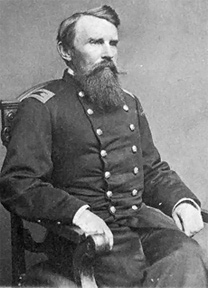 Whiting
Street marked
the south border of Tampa where it abutted at Fort Brooke. It
was a street on John Jackson's original plan for Tampa,
and it was named for Lt. Col. Charles Jarvis Whiting. Whiting
Street marked
the south border of Tampa where it abutted at Fort Brooke. It
was a street on John Jackson's original plan for Tampa,
and it was named for Lt. Col. Charles Jarvis Whiting.
Whiting was born in
Lancaster, Massachusetts on November 28, 1814 and was
raised in Castine, Maine. From the time of his
childhood, his overarching ambition was to become a West
Point cadet. When he received his appointment, he made the
trip to West Point and was turned away for being too
short. He spent the next year hanging from trees with a
brick tied to each foot, hoping to stretch himself enough
to meet the height requirement. He returned to the Academy
the next year and was admitted. He graduated fourth in the
Class of 1835.
He was commissioned as a
brevet second lieutenant in the 2nd U.S. Artillery and
served engineering duty during the Seminole War in
Florida. In 1837, Maj. Whiting served in the Micanopy to
Black Creek area, "directing inhabitants to be on the
alert in case partial aggression should be offered by
struggling Indians." In 1838, he served as the
assistant engineer for the survey of the Mississippi River
delta. He then settled in Maine, where he established, and
served as headmaster of, the Military and Classical
Academy in Ellsworth. He married in June 1841, and
had one daughter. His wife died in 1847, leaving Whiting a
33-year-old widower with an infant daughter, Anna Waterman
Whiting. His wife's family raised Anna, for the Army was
no place for an infant. After teaching for six years and
with his wife deceased, Whiting surveyed the boundary
between the United States and Mexico that was established
by the Treaty of Guadalupe-Hidalgo. Whiting then settled
in San Jose, California, where he farmed and surveyed. For
the years 1850-1851, he served as Surveyor-General of
California.
In March 1861, at the
height of the secession crisis, Whiting was stationed at
Fort Inge in Texas. When Texas left the Union, he and
other loyal officers were stranded there. Whiting and
Capts. George Stoneman and James Oakes pondered the
possibility of trying to escape to the Jefferson Barracks
via the Indian country. However, they had insufficient
supplies and no transportation, so they abandoned the
plan. Stoneman and Whiting eventually found their way back
to Washington, D. C. on a steamboat. (See similar
situation for Gen. Twiggs.) Whiting
was assigned to teach new recruits basic cavalry tactics
at the Carlisle Barracks in Pennsylvania. He also took a
brief furlough to return home to Maine to marry Phoebe
Whitney, the younger sister of his brother's wife.
Whiting went on to serve the
Union Army in the Civil War. Afterward, in 1870, he took
command of Fort Griffin in Abilene, Texas, which was
responsible for protecting travelers from raiding Kiowas
and Comanches. After five months there, he was transferred
to the supernumerary list on December 15, 1870. On January
1, 1871, at the age of 56, he was honorably mustered out
of the service. He packed his belongings and headed home
to Castine. He and his wife lived out the rest of their
lives there, supported by an Army pension. As he got
older, an old injury to his back at Gaine's Mill gave him
increasing trouble and pain. After 20 years of peaceful
retirement, Whiting died on New Year's Day 1890 at the age
of 75. He was buried in Castine. Whiting spent nearly 30
years in the Regular Army, all in the mounted service. His
service was honorable, and he was a good soldier.
Photo from Fine Military Americana at
The Horse Soldier.com |
|
|
|
SWANN AVENUE
 Alfred
Reuben Swann was born at Sandy Ridge, near Dandridge,
Tennessee, the son of John and Sarah (Austell) Swann. His
birth took place on the family plantation on September 24,
1843. Alfred Swann was attending Maurey Academy in
Dandridge when the War Between the States broke out. He
enlisted immediately and served with Wheeler’s Cavalry
until May 3, 1865, rising to the rank of colonel. He
participated in many of the important engagements of the
conflict, including Lookout Mountain, Missionary Ridge,
Chickamauga and Atlanta. For a time he was one of
Wheeler’s special couriers. Alfred
Reuben Swann was born at Sandy Ridge, near Dandridge,
Tennessee, the son of John and Sarah (Austell) Swann. His
birth took place on the family plantation on September 24,
1843. Alfred Swann was attending Maurey Academy in
Dandridge when the War Between the States broke out. He
enlisted immediately and served with Wheeler’s Cavalry
until May 3, 1865, rising to the rank of colonel. He
participated in many of the important engagements of the
conflict, including Lookout Mountain, Missionary Ridge,
Chickamauga and Atlanta. For a time he was one of
Wheeler’s special couriers.
The war had almost
destroyed the Swann plantation at Sandy Ridge. When
Colonel Swann returned to it, he found it in dire need of
rehabilitation. Numerous obstacles were in the way, for he
had to contend with the infamous problems of the
reconstruction period, such as carpet-baggers, bushwhackers
and the constant strife between those who sympathized with
the North and those whose sympathies remained with the
South. As he was rehabilitating the old Swann
plantation, Colonel Swann bought the Beaver Dam plantation
on credit. This was one of the finest in Tennessee. He
paid off his debt by raising livestock—a process which
took him five years. Gradually, he extended his interests
and eventually was connected with many important
enterprises throughout the South, some of them in Florida.
Some of these were banks, railroads and business
institutions.
Colonel Swann married
Sarah Frances Burnett on June 16, 1881. The wedding took
place at the ancestral home of the bride’s father, the
Reverend Jesse M. L. Burnett, at Del Rio, Cocke County,
Tennessee.
After wintering in Tampa,
he foresaw a bright future for the community. In 1905, he
began living in Tampa much of the year and became a major
figure in the city's residential and commercial
development. Swann and Eugene Holtsinger, a fellow
Tennessean, developed a large residential subdivision on
Hillsborough Bay named Suburb Beautiful. Their Bayshore
Boulevard development featured a seawall and a roadway
between the residences and the bay, giving Tampa its
beautiful scenic drive. Swann envisioned Tampa as a major
American city. Realizing that Tampa required more
extensive port facilities, he purchased the marshland
south of Ybor City known as the Estuary. In 1910, Congress
appropriated funds to develop Ybor Channel and other port
projects that contributed to Tampa's commercial growth.
His business, the Swann Terminal Company, played a vital
role in t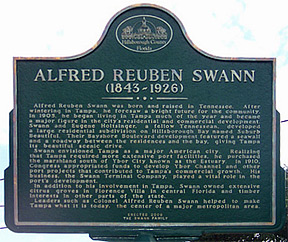 he port's development. In addition to his
involvement in Tampa, Swann owned extensive citrus groves
in Florence Villa in central Florida and timber interests
in other parts of the state. Leaders such as Colonel
Alfred Reuben Swann helped to make Tampa what it is today,
the center of a major metropolitan area.
Col. Swann died on April
9, 1926, on a visit to his plantation at Dandridge. he port's development. In addition to his
involvement in Tampa, Swann owned extensive citrus groves
in Florence Villa in central Florida and timber interests
in other parts of the state. Leaders such as Colonel
Alfred Reuben Swann helped to make Tampa what it is today,
the center of a major metropolitan area.
Col. Swann died on April
9, 1926, on a visit to his plantation at Dandridge.
|
|
 James
T. Swann, Sr., one of eight children of Alfred Reuben and
Sarah Frances Swann, received his early education at Swannsylvania Academy in Jefferson County, Tennessee,
after which he attended Carson Newman College in that
state. In 1910, James Swann graduated from Harvard
University with the degree of Bachelor of Arts. He
joined his family, which by then had settled in Tampa. For
a time he was active in the citrus business at Florence
Villa, but this was a short-lived interest. Then,
affiliating himself with his father’s realty firm, he
began to participate in the development of the Suburb
Beautiful. It is said that he sold virtually every lot on
Bayshore Boulevard himself. He and his family came to live
on that beautiful thoroughfare at No. 1801. James
T. Swann, Sr., one of eight children of Alfred Reuben and
Sarah Frances Swann, received his early education at Swannsylvania Academy in Jefferson County, Tennessee,
after which he attended Carson Newman College in that
state. In 1910, James Swann graduated from Harvard
University with the degree of Bachelor of Arts. He
joined his family, which by then had settled in Tampa. For
a time he was active in the citrus business at Florence
Villa, but this was a short-lived interest. Then,
affiliating himself with his father’s realty firm, he
began to participate in the development of the Suburb
Beautiful. It is said that he sold virtually every lot on
Bayshore Boulevard himself. He and his family came to live
on that beautiful thoroughfare at No. 1801.
James T. Swann, Sr.
married Mary Cotter Lucas, a native of Tampa, on November
4, 1914. She established a tradition in the Swann family:
she served as Queen of Gasparilla in 1914. Her daughter
was Queen in 1938 and her son and his wife were King and
Queen, together, in 1941.
In 1914, Mr. Swann took
over the management of the Interstate Investment Company,
of which his father was president and he vice president.
He remained in active charge of the company until his
death in May of 1953. James and Mary had children Mary
Frances, the wife of Lieutenant Colonel Jackson K. Judy of
the United States Army and James T. Swann, Jr.
James T. Swann, Sr. was
one of the most successful and active real estate
operators in Tampa and was outstanding in civic life. He
became president of Interstate Grove Properties, Inc.,
Swann Securities Corporation and J. T. Swann and Company.
In World War II, he became associate chairman of the
Division of Transportation and Communications of the
Florida State Defense Council and for many years served on
the board of trustees of the University of Tampa.
Mr. Swann worked vigorously on behalf of public
recreation. At first a vice president of the Florida
Amateur State Golf Association, he was its president from
1942 and for several years after this date president
emeritus. He had helped organize the association in 1926
and became vice president at that time.
One of the civic
promotions in Tampa in which he engaged vigorously was
that staged by Ye Mystic Krewe of Gasparilla, of which he
was an officer. He was also vice president of the Rotary
Club of Tampa (1922-1923); president of the Tampa Chamber
of Commerce (1928-1929); president of Palma Ceia Golf
Club; a director of the South Florida Fair Association,
and co-organizer and a director of the Florida Citrus
Growers Clearing Rouse Association, which he served as
chairman in the year 1932-1933. For hobby he
indulged in the making of motion pictures. He and his
family worshipped in the First Baptist Church of Tampa.
|
|
JAMES T. SWANN, JR.
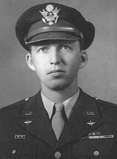 James
T. Swann, Jr. was born in Tampa on September 6, 1916. A
member of the cigar industry, and also active in the real
estate and citrus businesses, he had made a significant
contribution to the development of his native city.
Distinguished in school days, he was a decorated member of
the United States Army Air Forces in World War II and in
one of the civic promotions of Ye Mystic Krewe of
Gasparilla, the annual pirate festival, was King of
Gasparilla. His popularity was widespread. James
T. Swann, Jr. was born in Tampa on September 6, 1916. A
member of the cigar industry, and also active in the real
estate and citrus businesses, he had made a significant
contribution to the development of his native city.
Distinguished in school days, he was a decorated member of
the United States Army Air Forces in World War II and in
one of the civic promotions of Ye Mystic Krewe of
Gasparilla, the annual pirate festival, was King of
Gasparilla. His popularity was widespread.
Upon his return home
after the war, Mr. Swann became closely identified with
Swann Products, Inc., a cigar factory and mail order cigar
company founded by his father. When his father died in
1953, James Swann, Jr., assumed the presidency of the
company and he devoted himself to this firm, as well as to
his citrus and real estate interests.
 |
|
Ruth Binnicker Swann &
husband James T. Swann, Jr. as the retiring Queen
and King of Gasparilla, 1947. There were no
Gasparilla celebrations from 1942 through 1946. |
While reigning as King of
Gasparilla in 1941, Mr. Swann married Ruth Binnicker, who
was Queen of the festival at the same time. They had three
children; Kathleen, Terrell, and James T. Swann, III. The
family worshipped in the First Baptist Church of Tampa.
When on January 11, 1955, a heart attack swept away the
life of James T. Swann, Jr., at the age of thirty-eight,
the entire city of Tampa was shocked. It had followed with
approbation and eagerness the career of this young man, an
illustrious member of an illustrious family, and had
predicted that some day he would be one of the South’s
most noted citizens and one of the unforgettable builders
of Southwestern Florida.
James' widow, Ruth
Binnicker Swann, would later marry Jack Eckerd of Eckerd
Corporation fame. Ruth Eckerd Hall in Clearwater is
named for her.
Photos and portions of
this Swann family biography is from
J.T.
Swann & Co.
|
DAVIS BLVD., DAVIS
ISLANDS
The development of Davis
Islands by David Paul Davis made him nationally famous.
Read about his visionary quest, his struggles and
mysterious death, here at Tampapix contained on 4 pages at
D.P. Davis and his Islands. |
|
JETTON & DEKLE AVENUES
As one of
the developers of western Hyde Park, Matthew M. Jetton helped
expand the Tampa metropolitan area , today known as Historic
Hyde Park. Jetton came to Tampa from Murfreesboro,
TN, in the 1880s. His middle name was Murfree, after his
hometown, and he was often called "M.M.." He first settled
in Tampa Heights and worked in the hardware and lumber
businesses, establishing a lumber mill near Kennedy
Boulevard and Rome Avenue. Later he became a
contractor and co-founded the Jetton-Hudnall Lumber Co. He
also formed the Jetton-Dekle Lumber Co. with Lee Dekle,
another Historic Hyde Park developer whose name appears on
a local street. Jetton was a member of the Elks
Lodge and a founding member of the Tampa Board of Trade,
the forerunner to the Greater Tampa Chamber of Commerce.
Matthew Jetton died in 1931 at age 71. His grandson,
Matt Jetton, was the original developer of Carrollwood.
|
|
CARROLLWOOD DRIVE,
CARROLLWOOD AND LAKE CARROLL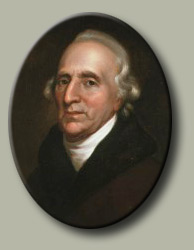
The community and the
street are named for Lake Carroll, which in turn was named
in the 1800s for Charles Carroll of Carrollton (the
name he used to distinguish himself from his father,
Charles Carroll of Annapolis). Charles was born in 1737 into a
wealthy Catholic family in Annapolis, Maryland. His
grandfather, Daniel Carroll, an Irish gentleman, emigrated
from England to America about the year 1659. He settled in
the province of Maryland, where, a few years after, he
received the appointment of judge, and register of the
land office, and became agent for Lord Baltimore. Charles
Carroll, the father of the subject of the present sketch,
was born in 1702. His son, Charles Carroll, surnamed "of
Carrollton", was born September 20, 1737. At the age
of 8 he was sent to France to receive his education.
Upon returning at age 28, he became involved in Maryland
politics and the issue of succession from England around
1755. He visited the Continental Congress in 1776, and was
enlisted in a diplomatic mission to Canada, along with Dr.
Benjamin Franklin and Samuel Chase. Shortly after his
return, the Maryland Convention decided to join in support
for the Revolutionary War. Carroll was elected to
represent Maryland on the 4th of July, and though he was
too late to vote for the Declaration, he did sign it.
He was the wealthiest man in the thirteen colonies, and
lived on a ten thousand acre plantation in Frederick
County, Maryland.
Carroll served in the
Continental Congress and on the Board of War,
through much of the War of Independence, and
simultaneously participated in the framing of a
constitution for Maryland. In 1778 he returned to
Maryland to participate in the formation of the
state government. He was elected to the Maryland
Senate in 1781, and to the first Federal Congress in
1788. He returned again to the State Senate in 1790
and served there for 10 years. He retired from that
post in 1800.
After both Thomas
Jefferson and John Adams died on July 4, 1826, he
became the only surviving signer of the Declaration
of Independence. He came out of retirement to help
create the Baltimore and Ohio Railroad in 1827. His
last public act, on July 4, 1828, was the laying of
the cornerstone of the railroad. In May 1832,
he was asked to appear at the first ever Democratic
Convention but did not attend on account of poor
health. He died on November 14, 1832, in Baltimore,
and is buried in his Doughoregan Manor Chapel at
Ellicott City, Maryland. His death left Egbert
Benson, John Marshall and James Madison as the only
surviving Founding Fathers of the United States.
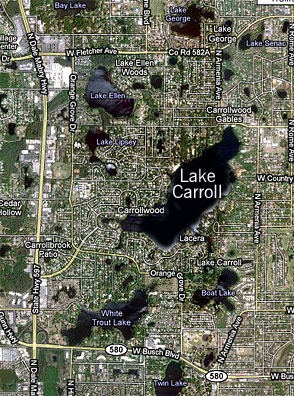 Lake Carroll's
Many Names Lake Carroll's
Many Names
Lake Carroll was named by
a family that lived on the north end of the lake in the
very early years. The family was friends of Charles
Carroll of Carrollton. In the days when cattle and
horses were allowed to roam at will, with no fence laws in
effect, Lake Carroll was one of the few lakes that had
plenty of water even in the dry years. So when the farmers
found their animals near Lake Carroll, the name became
Horse Pond. The residents around the lake didn't
like such a beautiful lake having a name like "Horse
Pond." Because they lived on the east side of the
lake, they enjoyed beautiful sunsets and therefore gave
the lake the name of Sunset Lake. In later years,
the Barclays opened a public swimming beach on the south
end of the lake. For a while the lake took on the name of
Horseshoe Lake because they called their place Horseshoe
Beach. Later, the Boy Scouts opened a camp on the Lake.
Because Carl Brorein was a big contributor to the Scouts,
the lake was Lake Brorein. Eventually, original
residents of the area pushed for the lake to be renamed
Lake Carroll, as it originally was, and remains to this
day.
Development of
Carrollwood
Matthew Murfree Jetton's
grandson, Matt Jetton, was a young man in 1959 when
he began building houses in the middle of nowhere, just
north of Busch Boulevard and east of N Dale Mabry Highway,
a two-lane road back then. In doing so, he soon
achieved local and national fame as the developer of
original Carrollwood. His company, Sunstate Builders,
purchased 325+ acres of citrus nursery land, just seven
miles north of the City of Tampa with a vision of creating
housing to relieve crowding in South Tampa. Jetton's
home designer chose the name for the community--a name his
advertising agency said had "too many double letters."
Jetton insisted on the name, chosen due to the area lake,
Lake Carroll. In a hurry to begin advertising and
get it out in the mail, the agency pressed Jetton for
street names. The first was easy, due to the
peacocks running rampant through the groves--Peacock Lane.
The only other names Jetton could think of at the time
were varieties of plywood popular in the 60s:
Samara, Nakora and Korina.
Sources:
How Lake Carroll Got Its Name
Carrollwood Developer Looks Back on 50 Years
The Man Who Built Carrollwood
Charles Carroll of Carrollton
|
|
|
|
SHELDON ROAD
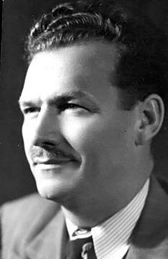 Sheldon
Road in northwest Tampa was
named for State Senator Raymond Sheldon. Sheldon
Road in northwest Tampa was
named for State Senator Raymond Sheldon.
Raymond Sheldon was born in Jan., 1907 in
Portage La Prairie, Manitoba, Canada, to British parents Charles Edwin Sheldon and Agnes
Teresa Mills.
On Oct. 24, 1920, Raymond's mother Agnes age 45 (born in Walsall, England), and 5 of her children,
Monica (15, born Walsall, Eng), James (11), Maurice (9), Helen (7), and Harold
(4) all born in Manitoba, Canada, crossed the Canada/US border at the Port of
Winnipeg with the intent of permanently moving to Tampa to join Agnes' son,
Alfred Sheldon.
On Nov. 24, 1920,
Raymond's father, 51-year-old Charles
E. Sheldon, a harness-maker and native of Walsall, England, along with his
13-year-old son Raymond, came to the US through the port of Winnipeg, with
the intent of permanently joining his wife Agnes in Tampa.
By 1930 the family had settled at
2308 North B Street in Tampa, in a home that they rented for $30 a month.
Charles was the manager of a filling station and his son Raymond, who was still
single, was the proprietor. Raymond's sister, Monica, was a nurse at a
hospital.
1930 Federal Census of
Tampa, Sheldon family at 2308 N. B Street.
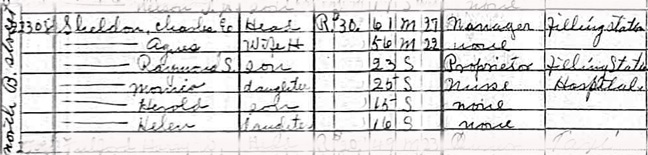
By 1935, Raymond, age 28, had
obtained his law degree and was married to Cathryn, age 28, with infant son
Raymond, Jr. They lived at Route 4 box 398. Raymond (Sr.) was a
lawyer.

Sheldon was an attorney for the Tampa
shipbuilding company unions which successfully fought State Atty. Gen. Tom
Watson's suit to outlaw the American Federation of Labor's closed shop contract
in shipyards. Sheldon was elected to three consecutive terms as a member of the
lower house, serving in the Florida House of Representatives from 1936 to 1941
and was speaker pro tem in 1941. He then served as a Florida State Senator
representing the 34th district, Hillsborough County from 1942 to 1950, when
Hillsborough County had only one senator.
On Jan. 22, 1944, Sheldon announced
his candidacy for governor of Florida, and at 38, was the youngest of 6
candidates for the office occupied at the time by Gov. Spessard L. Holland.
At the time, Sheldon was a Tampa attorney who had served 8 years n the state
legislature and he was of the opinion the people of Florida wanted to elect "a
young, progressive governor" and felt he was "assured of strong, active support
from employer groups, labor, old-age organizations, war veterans, and school
teachers." "I have found that in every part of the state I have visited,
that both old and young, worker and employer, are looking for leadership and I
believe I can furnish that leadership."
 On April 10, 1944, Sheldon spoke at
Williams Park in St. Pete, advocating a raise in teachers' salaries, a $50 a
month old age pension plan, distribution of state-owned lands to returning
veterans of war, an administration sympathetic to organized labor, and ambitious
post-war plan to provide employment. He said he would finish the Gulf
Coast Highway through Pinellas County, regardless of opposition from
Hillsborough, where some interests wanted the traffic main artery to pass
through the north through that county. On April 10, 1944, Sheldon spoke at
Williams Park in St. Pete, advocating a raise in teachers' salaries, a $50 a
month old age pension plan, distribution of state-owned lands to returning
veterans of war, an administration sympathetic to organized labor, and ambitious
post-war plan to provide employment. He said he would finish the Gulf
Coast Highway through Pinellas County, regardless of opposition from
Hillsborough, where some interests wanted the traffic main artery to pass
through the north through that county.
Sheldon was one of four candidates
eliminated in the first Democratic primary on May 2, 1944. The top two
candidates, Millard Caldwell of Tallahassee, had 116,110 votes and L.A. "Lex"
Greene of Starke had 113,300 votes, leading to a runoff. The four
eliminated were Ernest Graham of Miami, 91,174; Frank Upchurch of St. Augustine,
30,524; Raymond Sheldon of Tampa, 27,940, and J. Edwin Baker of Umatilla,
27,028. In 1944, Caldwell was elected governor of Florida, defeating Bert
Acker in the general election. He took office on Jan. 2, 1945.
In
1945, Raymond was 38 and still living at Route 4. Other homes enumerated
near the Sheldons were blocks of 923 Golfview, 3625 Azeele, 3600 Roland, 1000 &
1100 N. Lincoln, & 3300 Nassau. Along with his wife Cathryn, who was a
registered nurse, son Raymond Jr, age 10, and son Elias David Sheldon, age 7.
According to Hampton Dunn, Raymond Sheldon was a young attorney,
a Cumberland law graduate, a handsome and articulate fellow--a and very eloquent speaker.
He worked and
breathed politics. When Sheldon became a State Senator, he was sort of one of the
"white hats" there when he first went
in.
After his failed bid for governor,
Sheldon remained extremely active in Florida politics. In response to a
poll in 1945, Sheldon came out in favor of a lowered voting age from 21 to 18,
saying "If they're old enough to fight, they are old enough to vote." In
1947, Senator Sheldon described the Gandy bridge as "outmoded, too narrow and a
traffic bottleneck" and moved to have a new and wider bridge built.
Sheldon continued being involved in politics even after his term as Senator
ended in 1950, as well as continuing his private practice of law.
 As chairman of the county Democratic
committee, he headed the Kennedy-Johnson campaign in 1960 which carried
Hillsborough County. Sheldon was also an avid supporter of C. Farris
Bryant for governor of Florida in 1960. Bryant took the office of Governor
of Florida on Jan. 3, 1961, succeeding Gov. T. LeRoy Collins. As chairman of the county Democratic
committee, he headed the Kennedy-Johnson campaign in 1960 which carried
Hillsborough County. Sheldon was also an avid supporter of C. Farris
Bryant for governor of Florida in 1960. Bryant took the office of Governor
of Florida on Jan. 3, 1961, succeeding Gov. T. LeRoy Collins.
Raymond Sheldon died in a Tampa
hospital at age 69, on Oct. 14, 1970.
Sources and additional information:
Farris Bryant Papers at University of Florida Digital Collections -
Various correspondences between Sheldon and Bryant
|
|
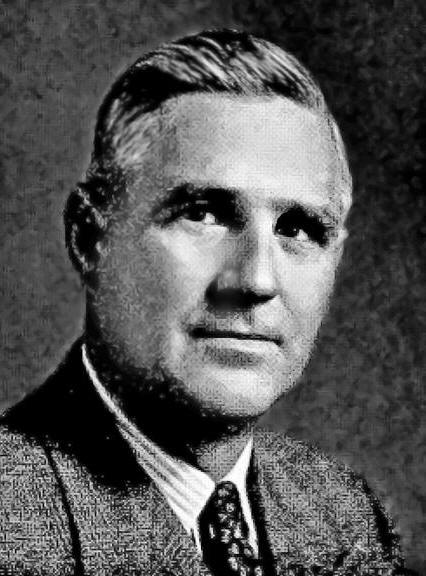 William Howard Frankland - The Man and the Bridge
- NEW! Sep. 17, 2014
William Howard Frankland - The Man and the Bridge
- NEW! Sep. 17, 2014

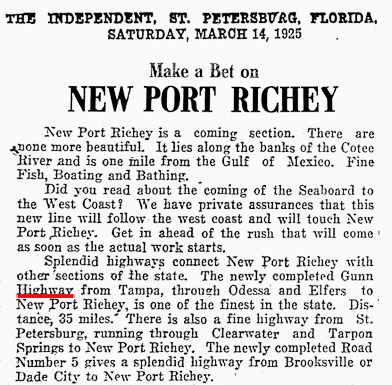
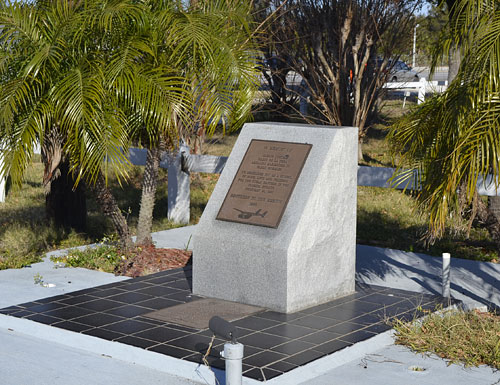
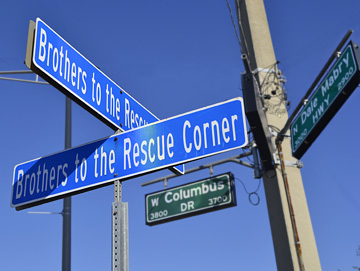
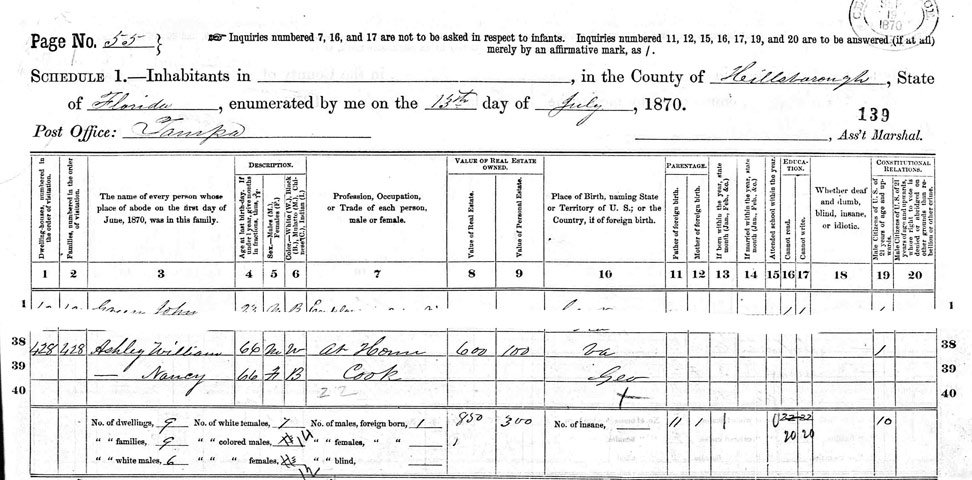
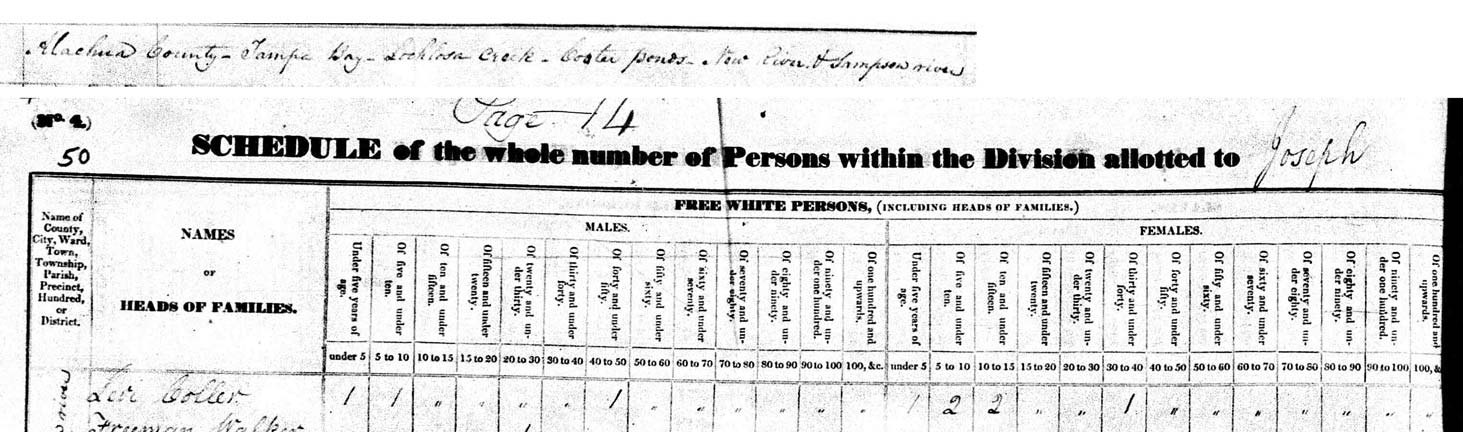
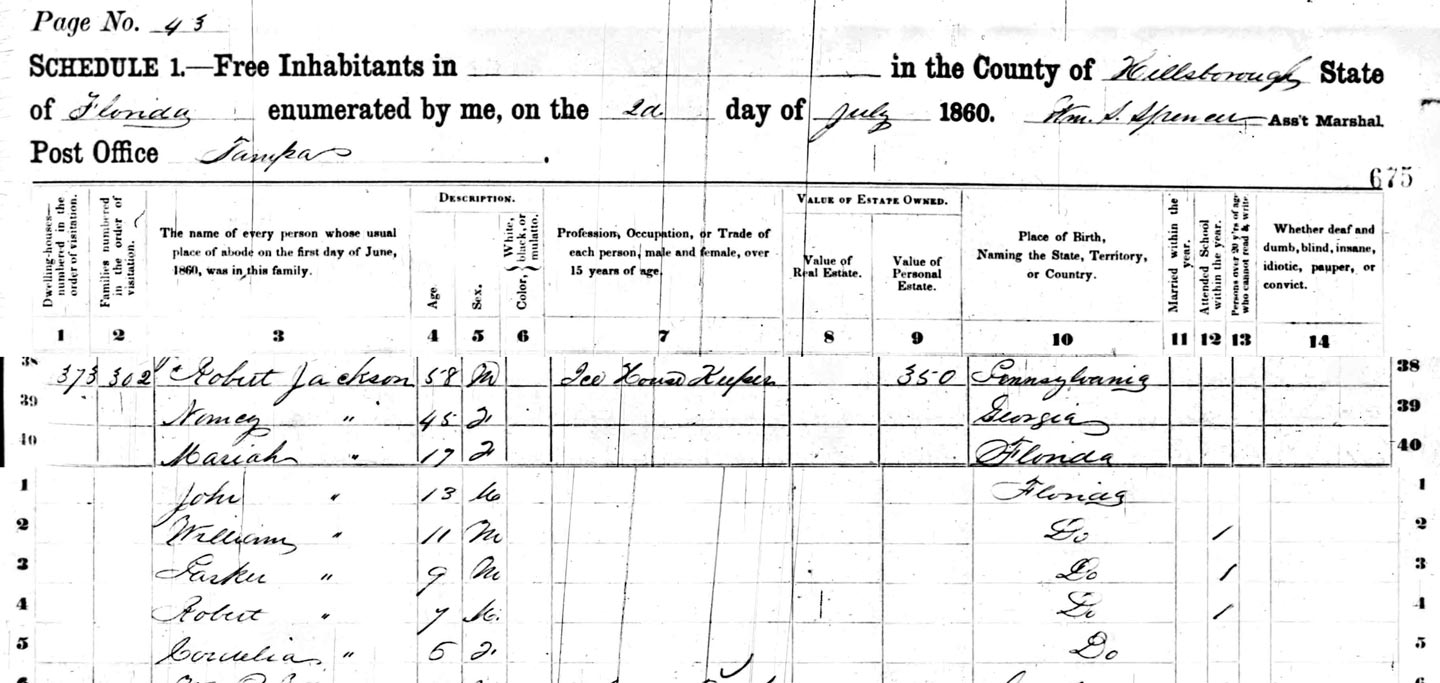
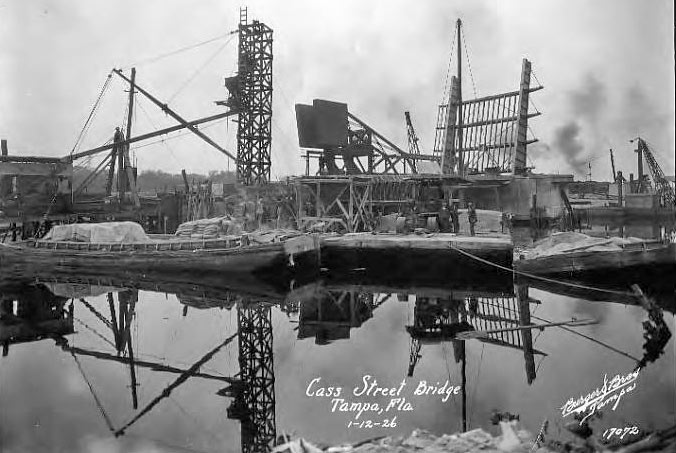
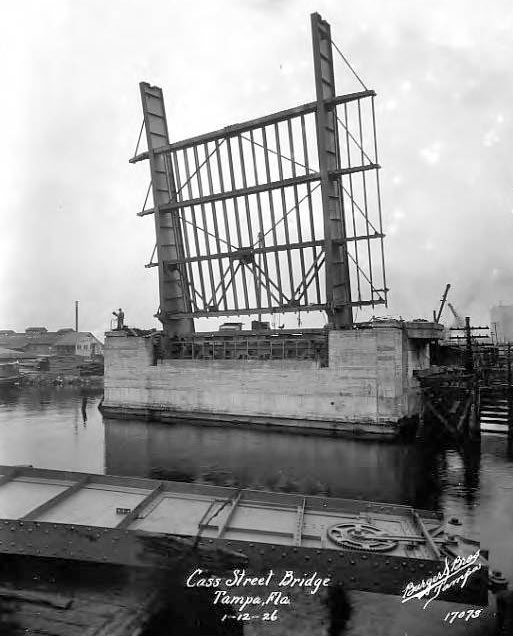
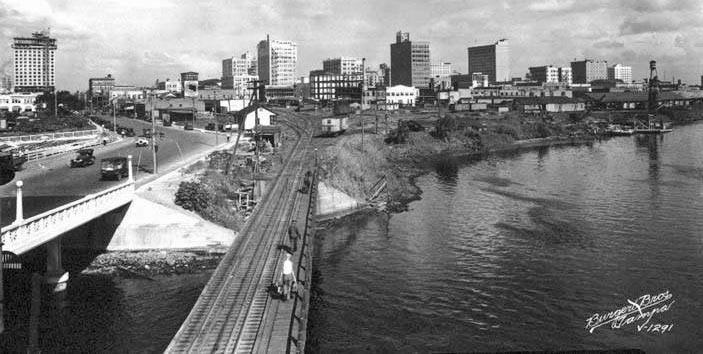
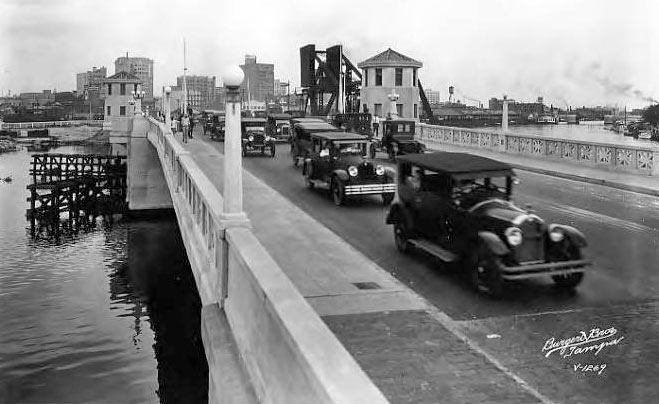
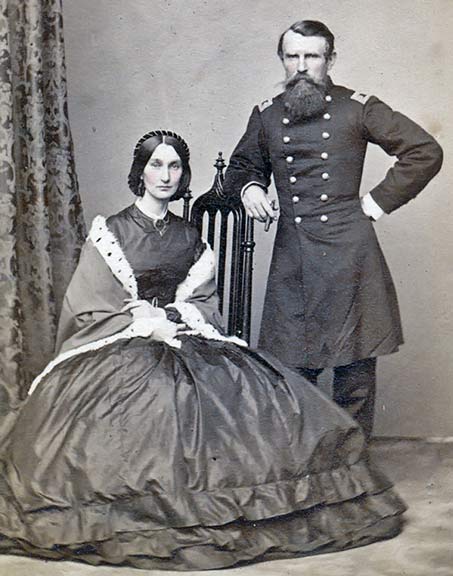
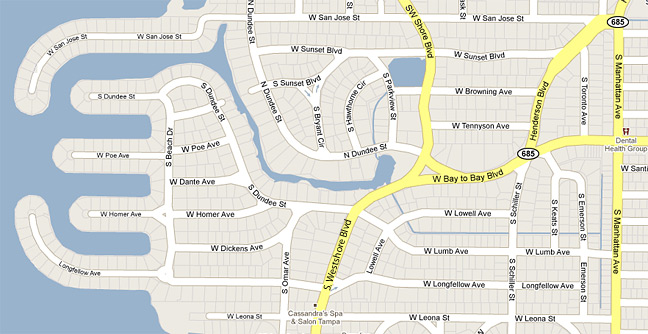
 After
exploring the Tampa Bay area, Hernando de Soto's 16th century
expedition was the first to document the discovery of the
Mississippi River and the vast plains of the Midwest. In
a multi-volume historical account of the history of Colorado,
historian Frank Hall describes the Native Americans' reaction
to their first encounter with the conquistadores' horses.
"We find in the narrative of Coronado's march that the natives
were astounded at the sight of horses, and were inclined to
worship them as gods. Like incidents occurred all along
the line of de Soto's expeditions from Tampa [Florida] to
Kansas."
After
exploring the Tampa Bay area, Hernando de Soto's 16th century
expedition was the first to document the discovery of the
Mississippi River and the vast plains of the Midwest. In
a multi-volume historical account of the history of Colorado,
historian Frank Hall describes the Native Americans' reaction
to their first encounter with the conquistadores' horses.
"We find in the narrative of Coronado's march that the natives
were astounded at the sight of horses, and were inclined to
worship them as gods. Like incidents occurred all along
the line of de Soto's expeditions from Tampa [Florida] to
Kansas."