|
|
|
|
|
|
|
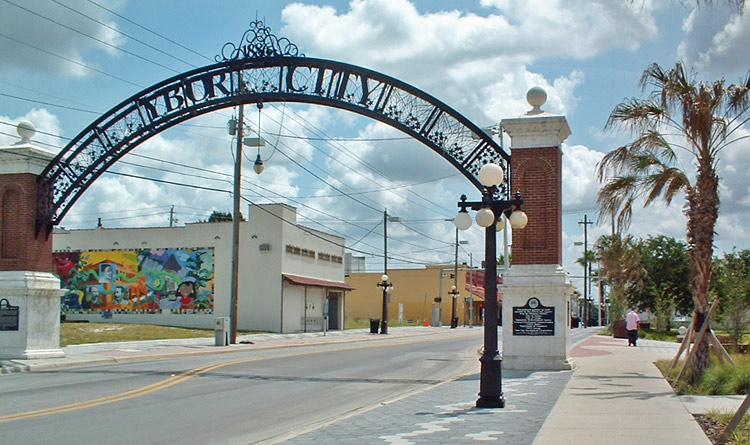
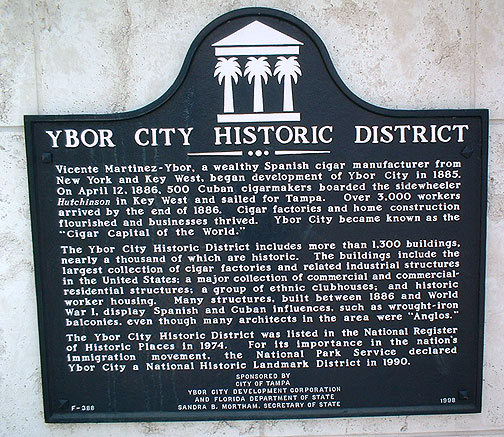
Looking east on East 7th Avenue from Nuccio Parkway This ornate archway was recently completed and marks one of the main entries into the Ybor City area, 7th Avenue which is known as "La Septima". Click to read the plaque on the arch |
|
| It started out as 40 acres of swamp and scrub northeast of Tampa. Don Gavino Gutiérrez, a Spanish civil engineer from New York, arrived in 1884. He came looking for guavas. He hoped to establish a tropical fruit preserving plant, but not enough guavas were available, so he abandoned the project. He decided to visit friends in Key West before returning to New York. The friends were Don Vicente Martínez Ybor and Don Ignacio Haya, who were Cuban exiles. They were two of the most prominent cigar makers of the time. | |
 In
the early 1880s, Tampa was an isolated village with a population of less
than 1000 and a struggling economy. However, its combination of a good
port, Henry Plant’s new railroad line, and humid climate attracted the
attention of Vicente Martinez-Ybor, a prominent Spanish-born cigar
manufacturer. In
the early 1880s, Tampa was an isolated village with a population of less
than 1000 and a struggling economy. However, its combination of a good
port, Henry Plant’s new railroad line, and humid climate attracted the
attention of Vicente Martinez-Ybor, a prominent Spanish-born cigar
manufacturer.Ybor had moved his cigar-making operation from Cuba to Key West in 1869 due to political turmoil in the then-Spanish colony. But labor unrest and the lack of room for expansion had him looking for another base of operations, preferably in his own company town. Gutiérrez described the Tampa Bay area and encouraged Ybor and Haya to check it out. |
They were pleased with what they found—a
railroad, a port, and a warm climate that was good for the tobacco leaf. Ybor
had considered several communities in the southern US and decided Tampa would be the best location. In 1885, the Tampa Board of
Trade helped broker an initial purchase of 40 acres of land, and Ybor
quickly bought more--starting development of Ybor City in 1885.
On April 12, 1886, five hundred Cuban cigar makers boarded the sidewheeler Hutchinson in Key West and headed for Tampa. Over 3000 workers arrived by the end of 1886. Cigar factories and home construction flourished and businesses thrived. Ybor City became known as the "Cigar Capital of the World." |
|
|
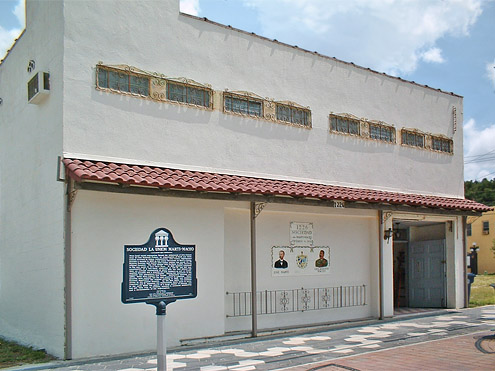
The Marti - Maceo Society 1226 7th Avenue
|
|
|
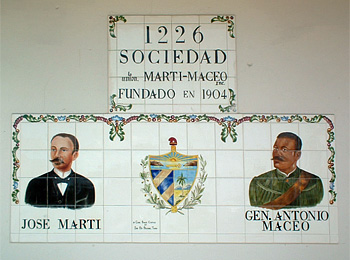 Read an excellent article about this society its history. |
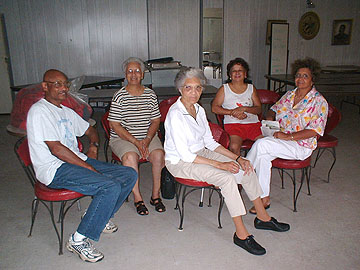
| Some of the children and grandchildren of the club's original founders who now attend to the society's affairs. |
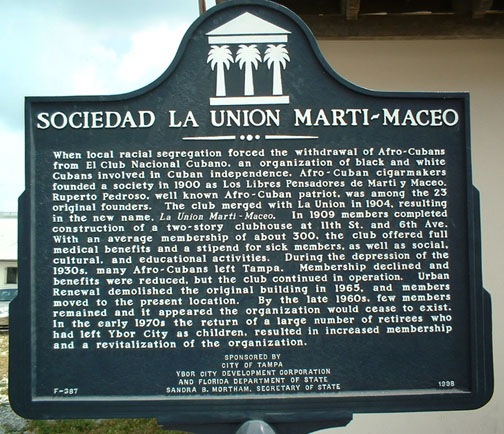 Click to read about the Click to read about the
Marti-Maceo Society |
|
VISIT CUBA FROM TAMPA, NO PLANE OR BOAT REQUIRED! Friends of José Martí Park This park is situated on land donated by the Pedroso family. On this property on the corner of 8th Ave. & 13th St. once stood their home. The land title to the park is owned by the Cuban government. The park contains soil from each of the provinces of Cuba. |
|
| José Julián Martí-Pérez (January 28, 1853–May 19, 1895) was a Cuban national hero and an important figure in Latin American literature. In his short life he was a poet, an essayist, a journalist, a revolutionary philosopher, a translator, a professor, a publisher, and a political theorist. Through his writings and political activity, he became a symbol for Cuba's bid for independence against Spain in the 19th century, and is referred to as the "Apostle of Cuban Independence". | |
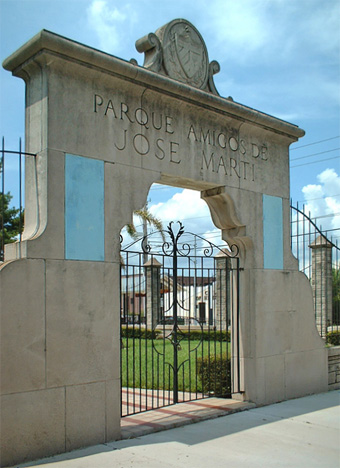 Most
visitors to Ybor City don't notice the 0.14-acre park at 1303 E Eighth
Ave. Most of those that do notice, don't realize that walking under
the arch puts them on Cuban property. Most
visitors to Ybor City don't notice the 0.14-acre park at 1303 E Eighth
Ave. Most of those that do notice, don't realize that walking under
the arch puts them on Cuban property.
University of South Florida historians proved it back in 1976. Hillsborough County property records reflect it. Tampa Parks and Recreation officials confirm it: The park, dedicated to late 19th century Cuban freedom fighter, poet and orator Jose Marti, has belonged to the Republic of Cuba since 1956. Here's what an International Studies team at USF found in a 1976 investigation, and published in the Tampa Historical Society's journal, The Sunland Tribune, in 1977: On that land once stood a wooden boarding house, owned by Afro-Cuban patriot Paulina Pedroso. As Marti traveled to Tampa, mustering efforts to free Cuba from Spanish rule, he often stayed there. It was there where he recovered from an assassination attempt, as Pedroso's cigar roller husband, Ruperto, stood guard. Legend has it, the scratching of Marti's pen could be heard outside in the silence of the night.
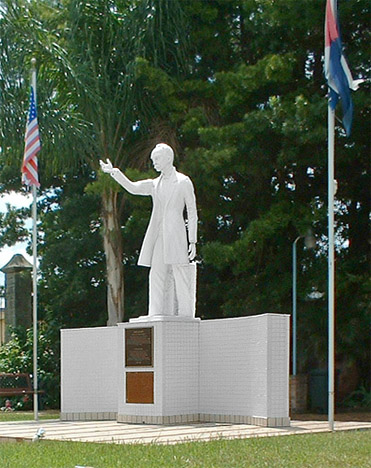
. This statue of Jose Marti is similar to one placed in Havana, Cuba
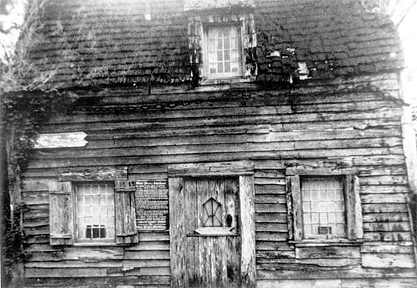
Jose Marti headquartered his activities in the United States in the Pedroso home. Whenever Marti stayed here, the flag of the budding Republic of Cuba fluttered outside. In the evenings, the Cubans formed groups outside the little house to watch the "Apostle of Freedom" through the little windows.
Marti died in battle in 1895, but Cuba gained its independence. The Pedrosos moved to Cuba in 1910 and sold the property. It passed through several hands, and was purchased in 1951 by a couple living in Havana who wanted to give the property to the Cuban state as a memorial to Marti.
In 1956, they transferred the ownership to "Estado Cubano," or the Republic of Cuba. Fulgencio Batista's administration officially accepted the property, and the American consul in Havana certified the transaction. The house was razed and Batista donated money to establish a park. Then, Fidel Castro took over Cuba in 1959 and everything got confusing. "The park was established when Cuba was free and democratic," said city Parks and Recreation spokeswoman Linda Carlo. "Once it became a Communist country, the city was in a quandary of what to do with it. City officials decided they would maintain the park's lights and irrigation, but leave it in the hands of the Cuban-American community in Tampa. They may not have known how divided the community was, and still is today. In the early 1960s, the park was hub for clashes between pro-Castro and anti-Castro Cubans, said West Tampa historian Maura Barrios. That tension didn't fade with the decades. In 1990, former Mayor Sandy Freedman entrusted park management to an anti-Castro activist group called the Cuban Historical and Cultural Center, which still manages the park. It's led by retired U.S. Army Col. Orlando Rodriguez and a group of former political prisoners. Attorney Ralph Fernandez pays the taxes. The park is open from 8:30 a.m. to 1:30 p.m. Monday through Friday. If someone wants to open the park on weekends, they have to call the number on the gate, Rodriguez's home. "But it's preferred if you stick to the schedule," Rodriguez said in Spanish. "If not, every time someone would get there, they'd call to ask to be let in." Rodriguez doesn't deny that the park is locked for political reasons. The arm of the Marti statue has been broken several times. He considers it pro-Castro vandalism. He says pro-Castro speech isn't welcome inside the park. Rodriguez says he and the exile group are "guardians" of the tiny remaining patch of free Cuban soil. But that protection, critics say, comes at the cost of free speech. Rodriguez's group painted the park's once bronze-colored Marti statue white, to symbolize the purity of Marti's message about democracy, and mirror the white marble Marti statues throughout Cuba. On either side of the walkway leading into the park, trees are rooted in planters named after each of the historic provinces of Cuba. Each of the planters contains Cuban soil brought from the respective province. At the center of all the noise, Jose Marti's statue quietly watches over it all - for most of the day, from behind bars. The above from 2006 Article: "Politics In Ybor City Park." See "The Cigar That Sparked A Revolution" here at Tampapix
|
|
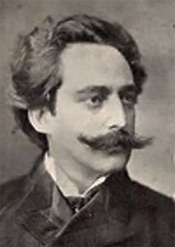 Before leaving Veracruz, Mexico for his expedition to Cuba, Martí wrote his "literary will" on April 1, 1895, leaving his personal papers and manuscripts to Gonzalo de Quesada, with instructions for editing. Knowing that the majority of his writing in newspapers in Honduras, Uruguay, and Chile would dissipate, Martí instructed Quesada to arrange his papers in volumes. Gonzalo de Quesada |
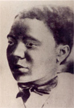 Paulina Pedroso
was one of
the great women patriots of Cuba. She was born and died in Cuba. From
the 1880s to 1910, she and her husband, Ruperto, worked at cigar making
while organizing La Sociedad Libres on behalf of Cuban freedom. After an attempt on the life of Jose
Marti, the Pedroso house became his refuge. Marti's room remained
lighted until late at night and at times in the silence, the scratching of his
pen could be heard. Any intruder would have found Ruperto, Paulina's
husband, on guard duty. Paulina Pedroso
was one of
the great women patriots of Cuba. She was born and died in Cuba. From
the 1880s to 1910, she and her husband, Ruperto, worked at cigar making
while organizing La Sociedad Libres on behalf of Cuban freedom. After an attempt on the life of Jose
Marti, the Pedroso house became his refuge. Marti's room remained
lighted until late at night and at times in the silence, the scratching of his
pen could be heard. Any intruder would have found Ruperto, Paulina's
husband, on guard duty. |
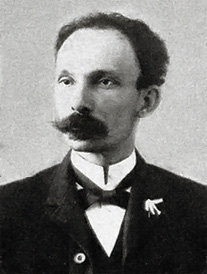 The expedition, composed of Martí, Gómez,
Ángel Guerra, Francisco Borreo, Cesar Salas and Marcos del Rosario, left
for Cuba on April 1, 1895. Despite delays and desertion by some members,
they got to Cuba. They landed at Playitas, near Maisi Cape, Cuba, on April
11. Once there, they made contact with the Cuban rebels, who were headed
by the Maceo brothers, and started fighting against Spanish troops. By May
13, the expedition reached Dos Rios. On May 19, Gomez faced Ximenez de
Sandoval's troops and ordered Martí to stay rearguard, but Martí separated
from the bulk of the Cuban forces, and entered the Spanish line. The expedition, composed of Martí, Gómez,
Ángel Guerra, Francisco Borreo, Cesar Salas and Marcos del Rosario, left
for Cuba on April 1, 1895. Despite delays and desertion by some members,
they got to Cuba. They landed at Playitas, near Maisi Cape, Cuba, on April
11. Once there, they made contact with the Cuban rebels, who were headed
by the Maceo brothers, and started fighting against Spanish troops. By May
13, the expedition reached Dos Rios. On May 19, Gomez faced Ximenez de
Sandoval's troops and ordered Martí to stay rearguard, but Martí separated
from the bulk of the Cuban forces, and entered the Spanish line.José Martí was killed in battle against Spanish troops at the Battle of Dos Ríos, near the confluence of the rivers Contramaestre and Cauto, on May 19, 1895. Gómez had recognized that the Spaniards had a strong position between palm trees, so he ordered his men to disengage. Martí was alone and seeing a young courier ride by he said: "Joven, a la carga" meaning: "Young man, let's charge!" This was around midday, and he was, as always, dressed in a black jacket, riding a white horse, which made him an easy target for the Spanish. The young trooper, Angel de la Guardia, lost his horse and returned to report the loss. The Spanish took possession of the body, buried it close by, then exhumed the body upon realization of its identity. They are said not to have burned him because they were scared that the ashes would get into their throats and asphyxiate them. He is buried in Cementerio Santa Efigenia in Santiago de Cuba. The death of Marti was a blow to the "aspirations of the Cuban rebels, inside and outside of the island, but the fighting continued with alternating successes and failures until the entry of the United States into the war in 1898. |
|
|
Commemorative Cuban Peso from 1953 celebrating the birth of Jose Marti (Mouseover the photo to see the flip side of the coin.) |
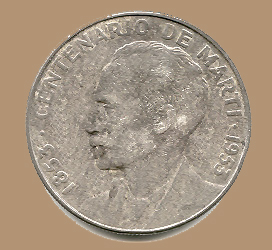 |
|
Page 1 | Page 2 | Page 3 | Page 4 | Ybor State Museum | Centennial Plaza Park | Casitas | Columbia Restaurant |
|