This website is not affiliated with the Columbia Restaurant
Group or any of its employees or directors.
If you wish use an image from this feature, please have the courtesy to mention
where you got it,
and the ultimate source when indicated. If you plan to use an image for a
profit-making venture, contact me about it first. Contact info is here at the
bottom of the page.
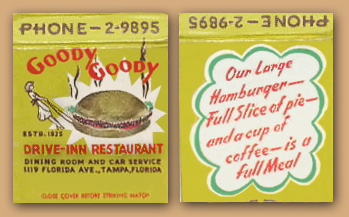
The history of Tampa's Goody Goody drive-in restaurant starts
nearly a decade before Ralph Stephens established the first one in
Tampa in 1925.
Little did Ralph
and Amanda Stephens know that when they opened the first Goody
Goody sandwich shop in Tampa in 1925, they were
establishing an iconic Tampa restaurant that would last 80
years, hibernate for 11 years yet remain in the hearts and
memories of Tampans near and far, then reawaken in Tampa's Hyde
Park Village in grand style in 2016, thanks to Richard Gonzmart
and the Columbia Restaurant Group!
SEE PREVIOUS
PAGE, GOODY GOODY
ROOTS, for the events that led up to Ralph Stephens' first
Goody Goody here in Hannibal, Mo.
Find out where he got the idea to name it "Goody Goody."
Stephens moves to Florida
“We
closed, and being sort of soldiers in fortune, we took off for
Florida,” Stephens explained in a 1968 interview. “The land boom
was on then and we went to Tampa and opened one restaurant, then
another. They had told us there were no rooms in Tampa so we
bought a tent and slept under that until we almost flooded out.”
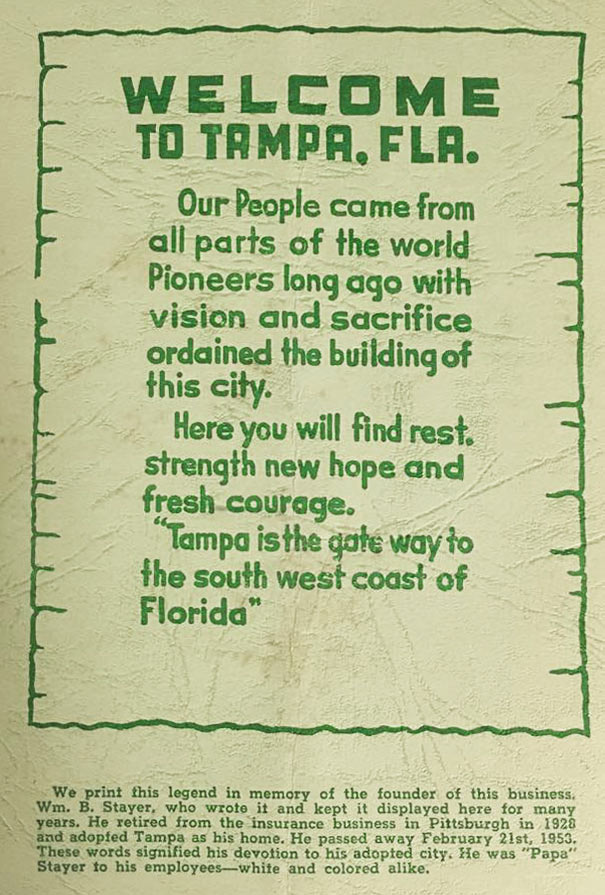
GOODY GOODY IN TAMPA
Newspaper ads marked with * are courtesy of Tampa
Tribune archives.
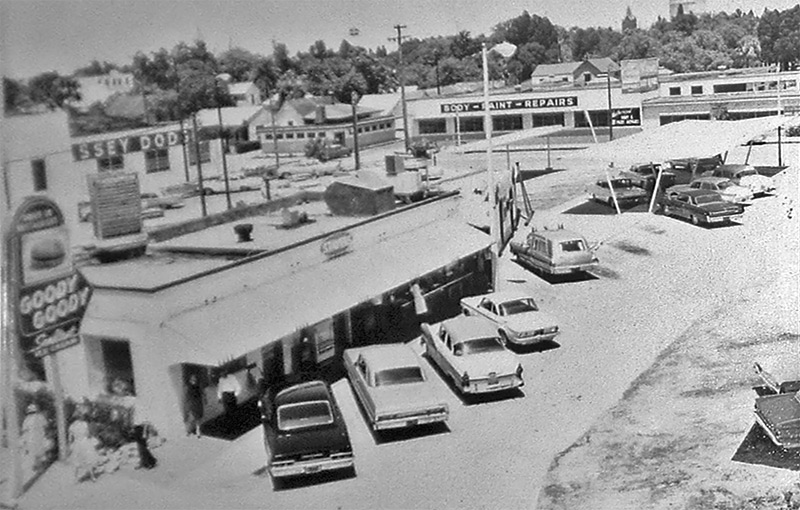
Although most longtime Tampa residents
associate the Goody Goody with its downtown Florida Avenue location, the restaurant's
Tampa start was actually on Grand Central Ave., what is now Kennedy Blvd.
Ralph A. Stephens began
the drive-in as "Goody Goody Barbecue" when he was 32 or 33 years old,
along with 35-year-old partner Wm. L. Reid, in late 1925. City
directories show it was originally at 1603 Grand Central Avenue, between
S. Dakota and Rome Ave., but closer to S. Dakota on the north side of the
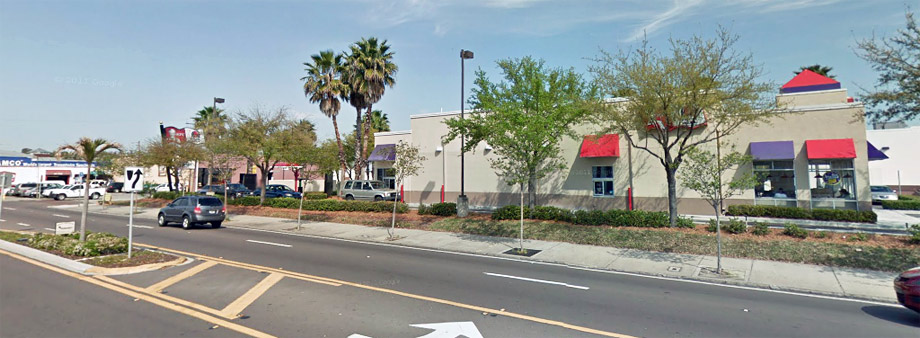
street. It operated there for a few years, then moved to the corner at
1629 Grand Central.
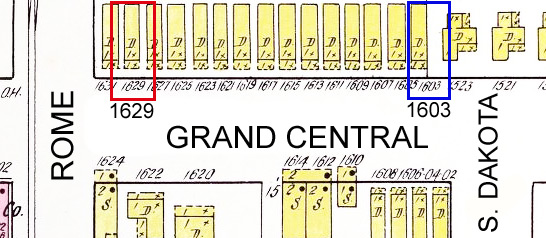
The map at right
shows this block in 1915 when dwellings occupied the area. However, it is
useful to show the relative locations of 1629 and 1603 Grand Central Ave.
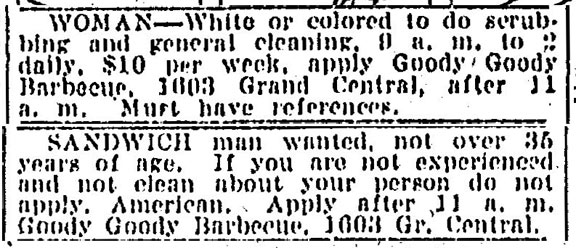
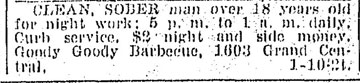
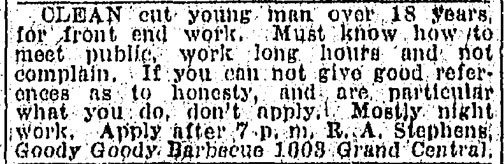
Various classified ads for help placed by Stephens
*The
first ads Stephens placed in the Tribune were help wanted ads.
Mar. 21, 1926 Want Ad for sandwich maker assistant.
April 25, 1926*
June 16, 1926*
Jun 25, 1926*
Stephens seeks a new or second location
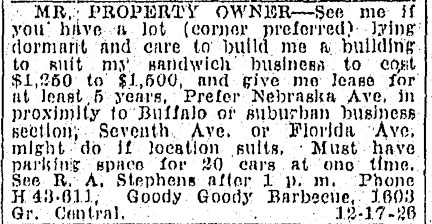
This Dec. 17, 1926 want ad by
Stephens shows that he was looking for a corner location early on, and that
ample parking was an issue. He may have had a 2nd location in mind, or may
have been considering relocating. He preferred a location near Nebraska Avenue
and Buffalo Ave. (today's Dr. Martin Luther King, Jr. Blvd.,) or Seventh Avenue
or Florida Ave.
Goody Goody moves down the
block to the corner of Grand Central and Rome Ave.
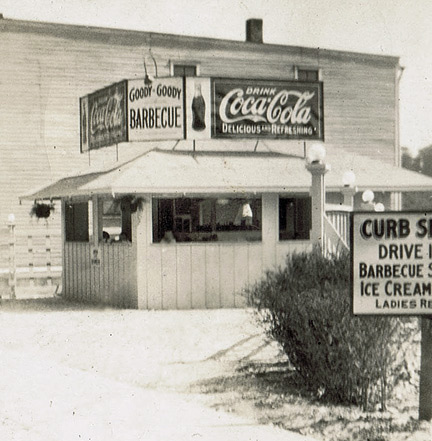
By Nov. 1927, Stephens
moved the Goody Goody down the block to the northeast corner of Grand Central
and Rome, at 1629 Grand Central, where it operated until Oct. 1933.
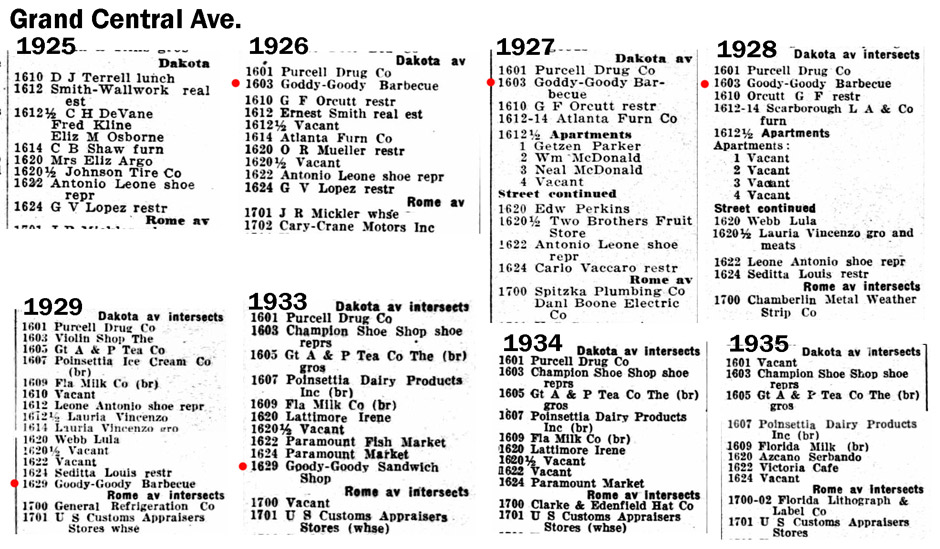
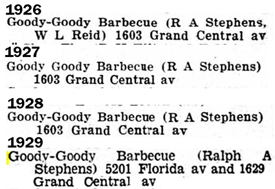
City street
directory listings showing Goody Goody at 1603 Grand Central in 1926, 1927 and
1928*.
*Although Goody Goody is listed at 1603 Grand Central in
1928, a Nov. 1927 ad (see below) shows it had already moved to 1629.
Gasparilla
Parade, 1926*
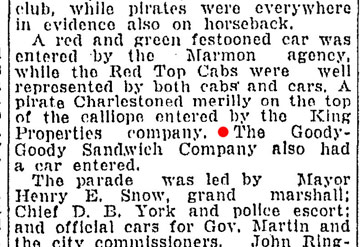
Stephens didn't miss a great
advertising opportunity to parade his new business in front of Tampa's
revelers, literally. A Feb. 9, 1926 full page story on the Gasparilla
parade states that there was a Goody Goody car in the parade.
Jan 10, 1927*
Apr. 4, 1927*
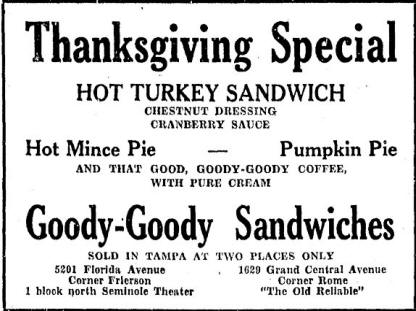
A second Goody
Goody opens in Tampa
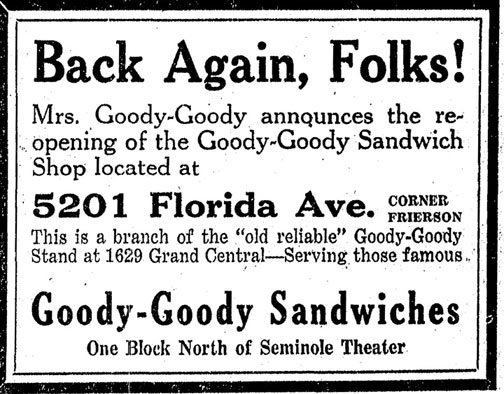
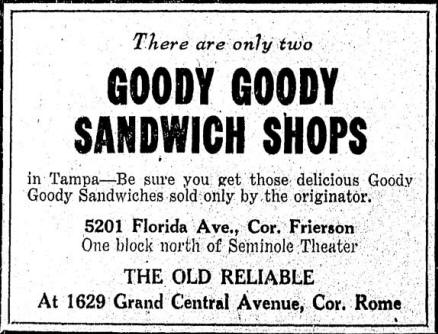
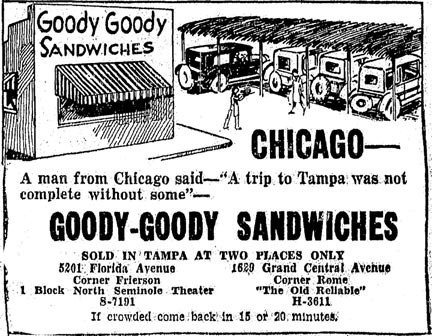
In
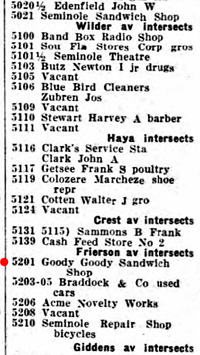
1927, Stephens opened another unit at 5201 North Florida Avenue, in the
Seminole Heights area, a block
north of the Seminole Theater.
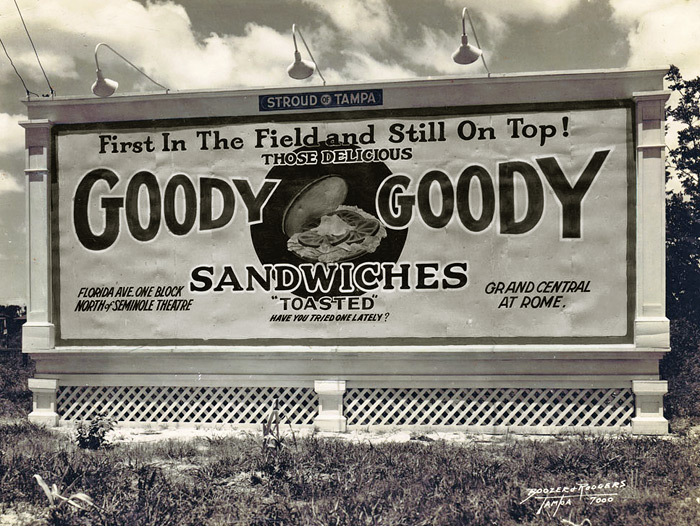
Goody Goody billboard
from 1928-1930 advertising both locations
Photo from
RetroMetro Oklahoma City
Place your cursor on the photo to see it colorized
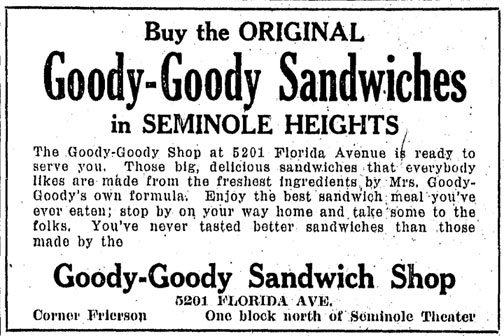
Goody Goody in Seminole
Heights first appears on the 1929 Tampa city directory, but the first
promotional ad for Goody Goody, seen below, was for the Seminole
Heights location and indicates that it opened by Nov. 3, 1927.
Goody Goody
promotional ads Newspaper ads marked with * are courtesy of Tampa
Tribune archives.
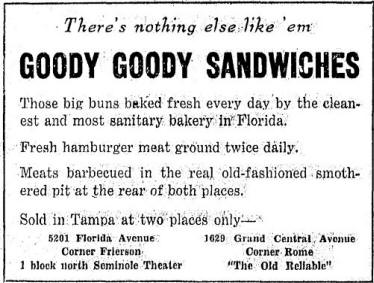
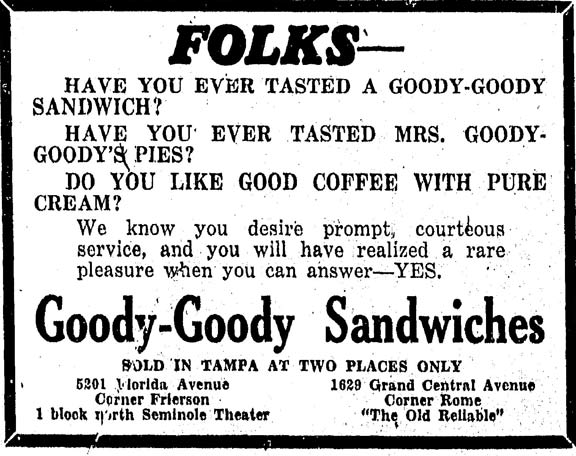
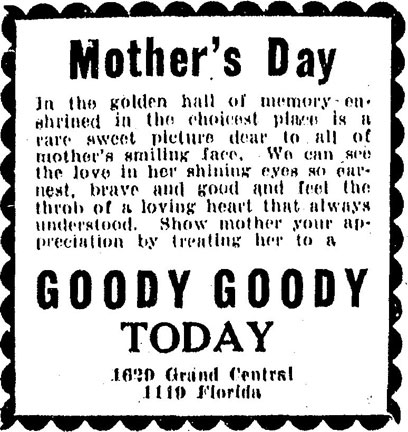
Beginning on Nov. 3, 1927, through
October 1928, over 300 Goody Goody ads appeared in the Tribune and continued
almost daily, rarely skipping a day, and rarely repeating the same ad for more
than one or two days. Some are presented here.
Regarding the "re-opening,"
it is not known at this time if it meant that it existed previously and
had been closed for a time.
Nov. 3, 1927*
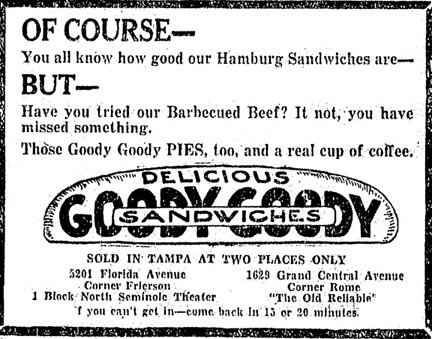
*Nov. 9, 1927 - This ad is evidence
that Goody Goody was already at 1629 Grand Central Ave. by the end of 1927.
*Nov. 17, 1927
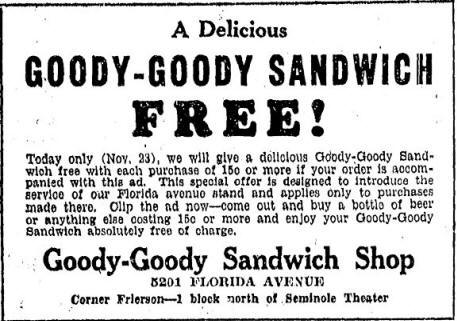
*Nov. 23, 1927 - "--come out and buy a
bottle of beer..."
Prohibition
was in effect from 1919 to 1933, but during that time, brewers were
allowed to make beer containing less than ½% alcohol per volume. This
became known as
Near Beer.
On February 20, 1933,
Congress enabled states to ratify the 21st Amendment (repeal of
Prohibition) if they chose, which most did rather quickly, but Florida
waited until Nov. 14, 1933. On March 22, 1933, President
Franklin Roosevelt had already signed into law the Cullen–Harrison Act, legalizing
beer with an alcohol content of 3.2 percent (by weight) and wine of a
similarly low alcohol content.
*Nov. 24, 1927
*Nov. 26, 1927
*Dec. 4, 1927
"Mrs. Goody Goody" is clearly a reference to Amanda Stephens. She
may have even managed the Seminole Heights location.
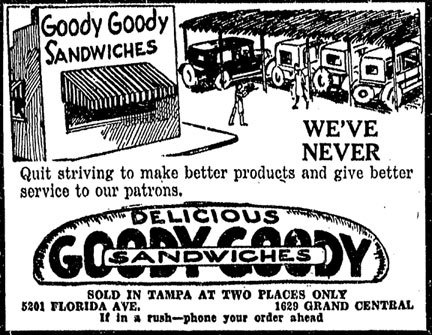
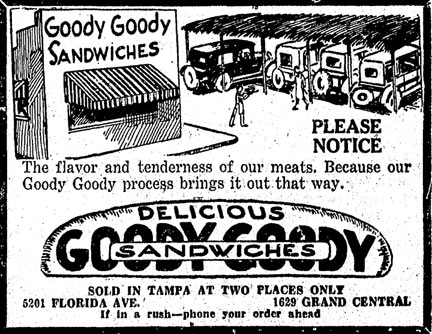
*Dec. 9, 1927
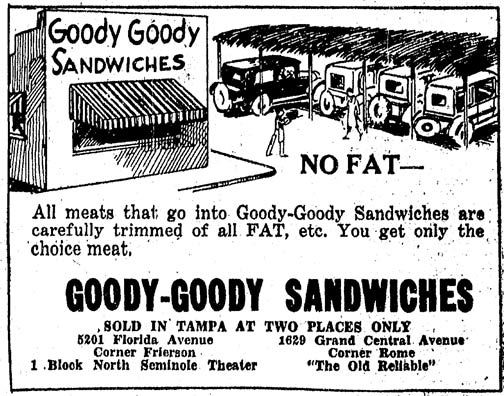
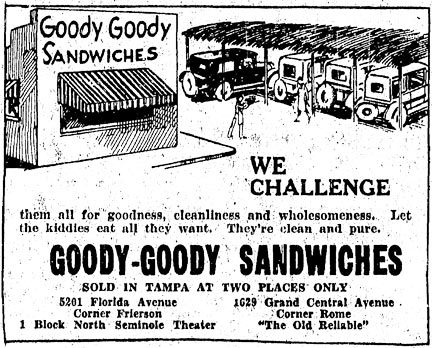
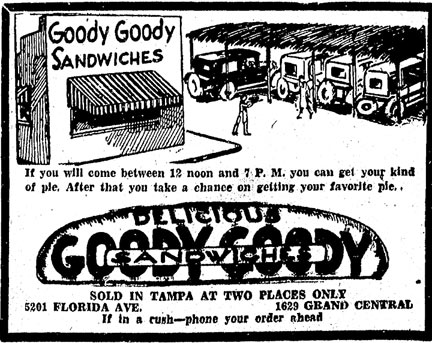
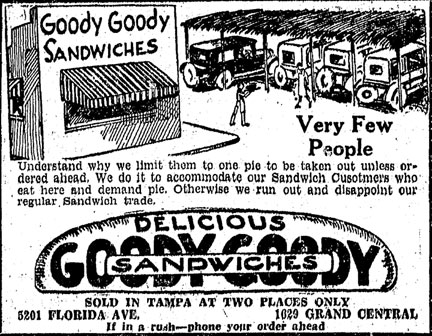
Stephens adds a
sketch of the Grand Central location to his advertisements. This
begins a long series of ads in this format, with different messages. Notice
the parking shelters with palmetto frond roofs, which was replaced by
1930.
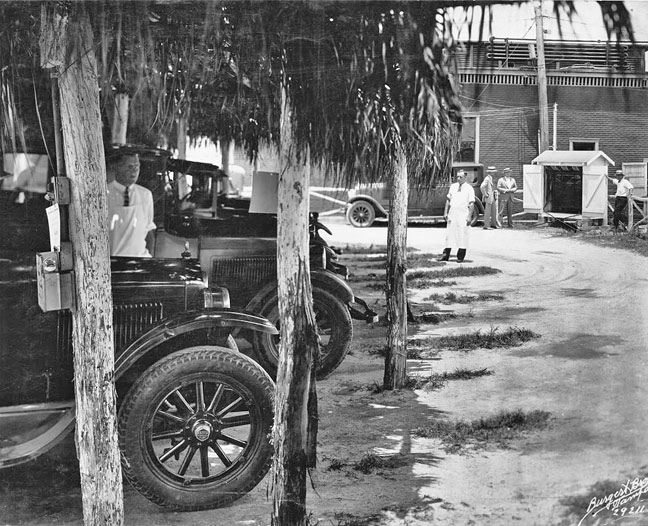
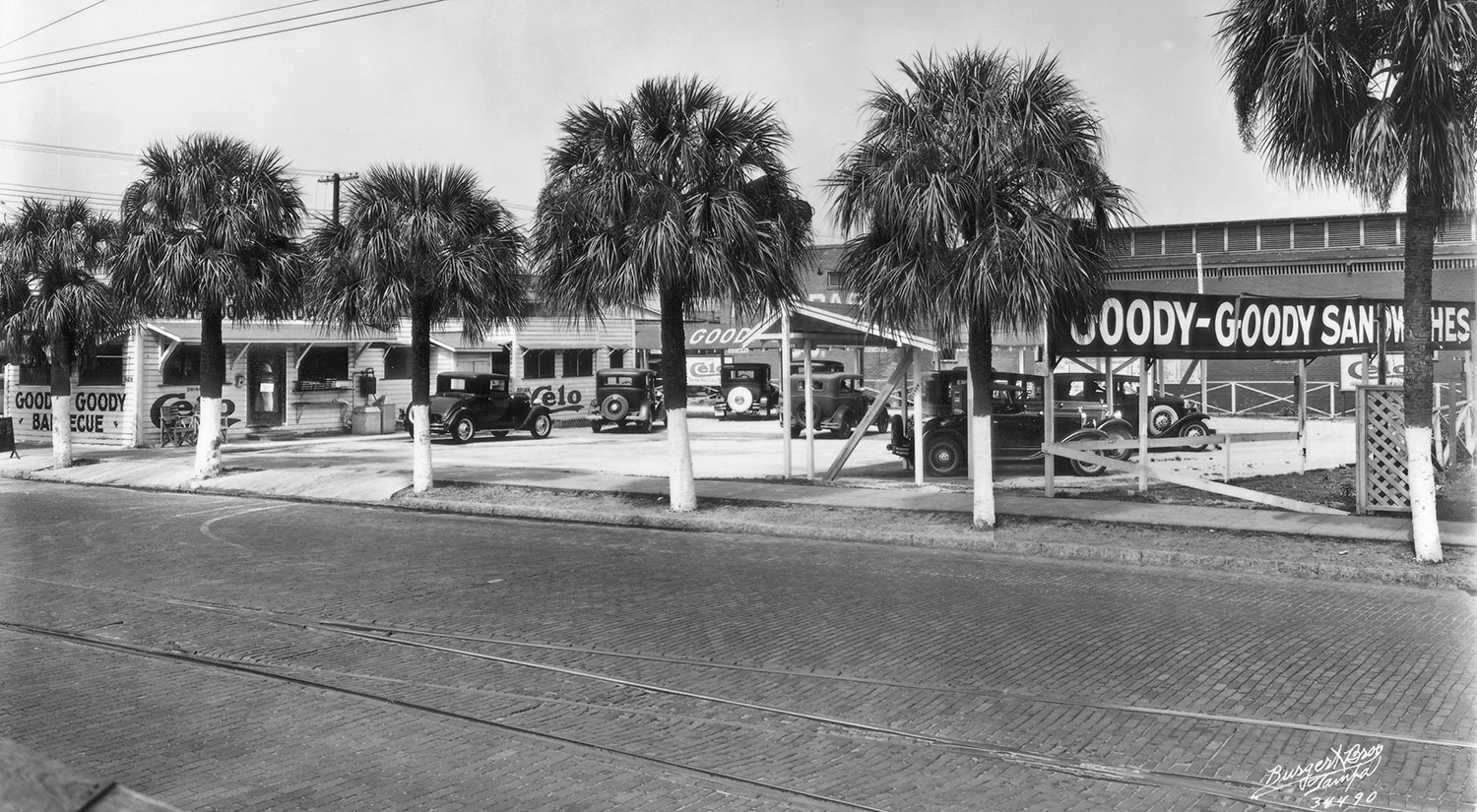
Original car shelters with palmetto
frond roof at the Grand Central Ave.
Goody Goody circa 1928
Burgert Bros. photo courtesy of RetroMetro Oklahoma City
*Dec 23, 1927
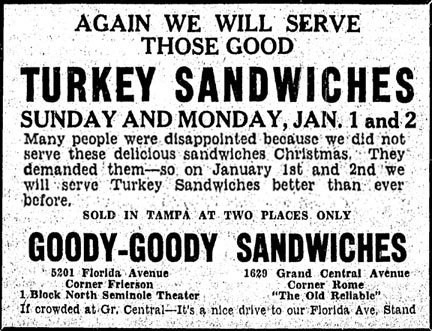
*Jan 1, 1928
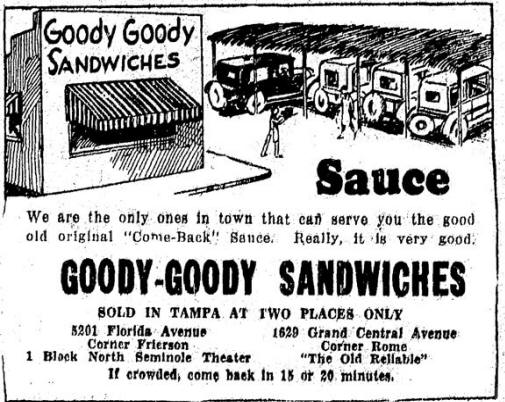
*Jan 19, 1928
Before they came to Tampa, while in Hannibal, Amanda Stephens had obtained
a recipe for “Come-Back” sauce from a barbeque stand in nearby
Quincy, Ill. It became the famous Goody Goody Secret Sauce used
until its last day of operation in Tampa.
*Feb. 11, 1928
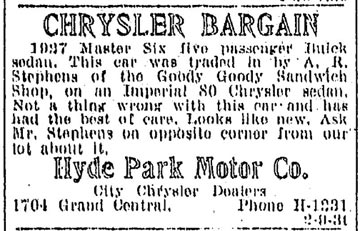
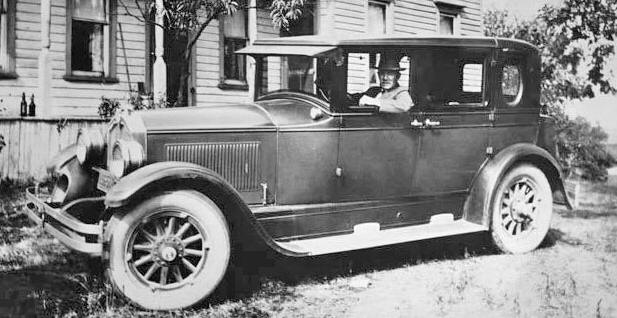
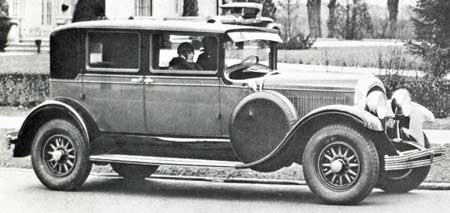
Ralph Stephens was apparently doing well enough to trade up from his 1927
Master Six 5-passenger Buick sedan to an Imperial
80 Chrysler sedan. Notice Hyde Park Motor Co. was caddy-corner to
the Goody Goody on Grand Central Ave.
In 1926, Stephens was living one block west of the
Goody Goody--at 1715 Grand Central. The 1927 Tampa city directory
does not list a home address for Stephens, it only shows "(Goody Goody
Barbeque)" next to his name. The 1928 directory shows that he
resided at 1603 Grand Central, the restaurant itself.
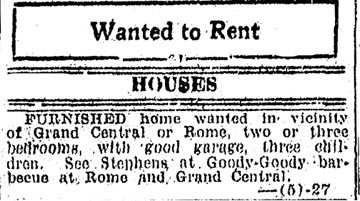
*May 27, 1928
This May 27, 1928 Want Ad shows he
was looking for a furnished home to rent for himself and his family.
He is not listed in the Stephens section of he 1929 directory, but is
listed in the G section as the owner of Goody Goody at 5201 Florida Ave.
*Jun 26, 1928
*Aug 15, 1928
*Sep 15, 1928
*Oct. 26, 1928
Inexplicably, this was the last promotional ad of 1928. Stephens
placed a want ad for a cleaning woman on Nov. 27th & 28th.
*The absence of Goody Goody ads
continued until this very small one appeared on May 13, 1929. This
same ad continued throughout the year, appearing less often--once every 3
to 5 or 6 days.
The collapse of the Florida land
boom in the late 20s caused
Stephens to once again want to bail out.
Stephens sold the Goody
Goody to William B. Stayer in 1929 and the Stephens family
returned to Oklahoma City with Ralph determined to settle his
debts and prove he could be a successful restaurant operator.
He and his family left Tampa and returned to Oklahoma City armed
with their "secret weapon" Before they came to Tampa,
while in Hannibal, Amanda Stephens had obtained a recipe for “comeback” sauce
from a barbeque stand in nearby Quincy, Ill. It may have been the origin of the
famous Goody-Goody secret sauce used in Tampa. He went on to successfully establish "Delores Restaurant," named for his
daughter.
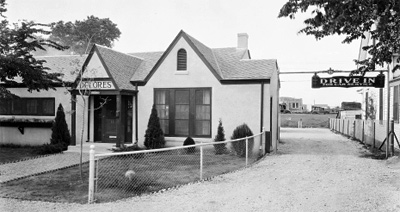
Dolores' Restaurant in Oklahoma City opened at 33 NE 23rd on April 15, 1930.
It was named after Stephens’ daughter.
Photo from
RetroMetro Oklahoma City
The Ralph Stephens story
and above photo comes
from
OKC History
where you can read more
about the Stephens family and the years after Tampa.
Stephens went on to open a successful restaurant named after his
daughter, Dolores.
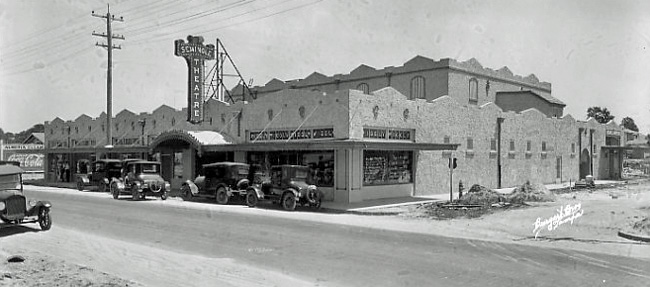
The 1929 Tampa city directory shows Goody Goody listed at
5201 N. Florida Ave. at Frierson Avenue, a block north of
the Seminole Theater shown in this photo. This is the
only year this location was listed. Notice Seminole
Sandwich Shop at 5021 N. Florida Ave.
THE STAYER YEARS
1929 - 1980
Special thanks to Glenda Stayer Wood for contributing the personal information below about
her grandfather, William Bechtel Stayer, and his family. The information
is presented here in paraphrases
and quotes from William's sons and daughter, and from
some of the Stayer cousins, collected by Glenda with the
help of her cousins. Stayer family photos are courtesy
of Glenda Stayer Wood and Elizabeth New Nolan. Carl Stayer's
ads and his writings are courtesy of Pipper Stayer Ellinor.
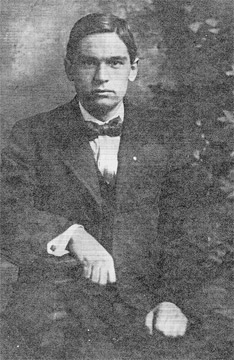
William
Bechtel Stayer, 1909.
William
"Papa" Bechtel Stayer
William Bechtel
Stayer was born in 1883 in New Enterprise, Penn. Growing up, William was a
good student, had a fine voice, and dark black hair. When he
was in high school, he taught school and later went to Juniata
College to prepare for a teaching career. He grew up to
be a handsome man with a ready smile and a fine command of the
English language at home, among friends, at work or in the
clubs – wherever he went. He had a round German face, a
natural smile and a fine tenor voice.
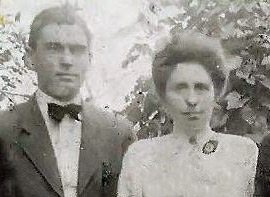
William and
Edna, ca. 1910
Marriage to Edna Shires
William's time at
Juniata College was brief. In 1903 William married Edna
Maude Shires (a daughter of John Emory Shires and Iola
Gertrude Stover) in Altoona, Penn. In the early years of
their marriage, William worked as a postal clerk in the Railway
Mail Service, sorting the mail on trains from New York to
Pittsburgh. In 1909, the Stayers settled in Pittsburgh, and by
1915, with a wife and five children to support, William left
the Railway Mail Service to sell insurance.
In 1918,
Edna died of the Spanish Influenza when the epidemic was
sweeping the country, leaving William with five children to
raise: Carl age 14, Bill age 13, Glenn age 8, Betty age 5, and
Bob age 3. In 1920, William
married Mary Mitchell Cooper in Philadelphia, Penn.
William B. Stayer's insurance business
William was a
partner in the Carl Vander Voort Company and insured lumber
yards and dealers. The great Kemper Company was one of the
reinsuring agents and had a trade organization called The
Retail Lumber Dealers Association of which William was the
secretary. Each year William organized and was Master of
Ceremonies for conventions lasting at least four days in the
ballroom of the William Penn Hotel. He would book some
of the country's most noted speakers like Pres. Bradley of
Chicago., Con. McCole of Wilkes Barre, Sen. Carraway of Ark.,
and Sen. Welles of Ohio and many more.
William B.
Stayer moves to Florida, buys an orange grove
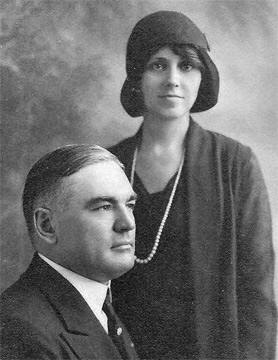
William and Sadie Rawls Stayer, 1929
Around 1927,
William sold his partnership in Carl Vander Voort Company and
decided to make a new start in Florida. At age 45, the
Pittsburgh story was over. His second marriage having failed,
he bought a grove and moved with his children to Winter Haven,
Florida. He stayed there for a few months and then
moved to Lakeland where he bought a 50-acre grove.
While in
Lakeland, William was hospitalized and a nurse named Sadie Rawls
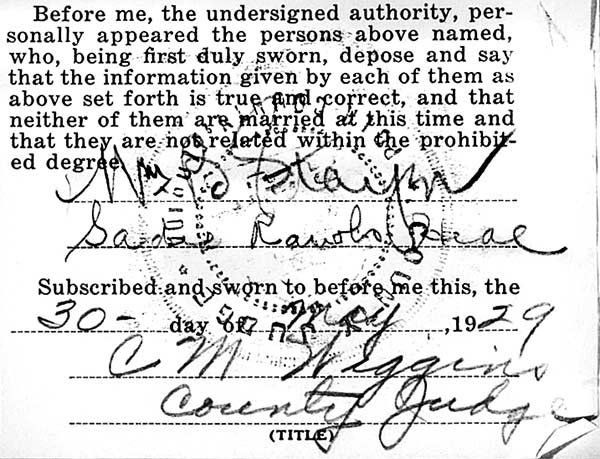
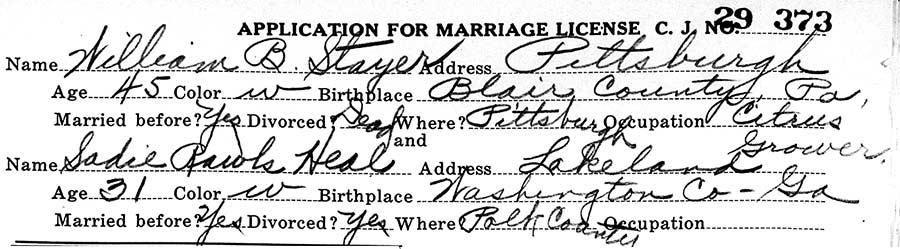
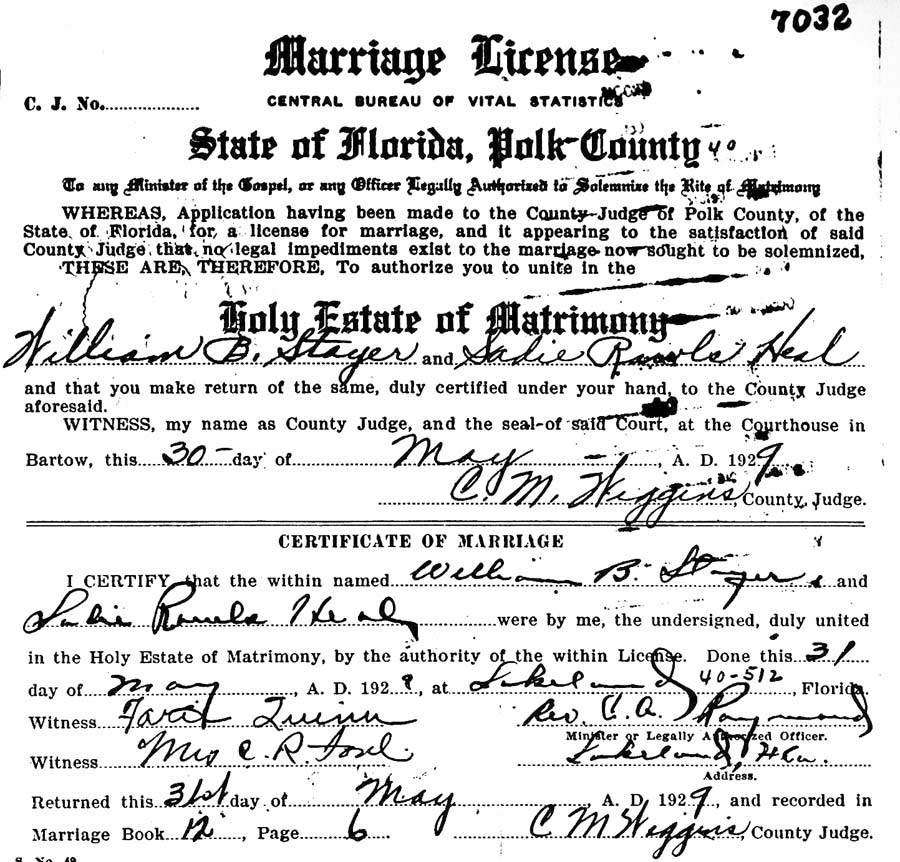
took care of him. Sadie became his third wife on May 30, 1929.
Stayer listed his
occupation as "Citrus Grower." He and Sadie had both
been married and divorced before.
According to his
eldest son, Carl Stayer, "He arranged to have his grove
fertilized, have it sprayed with insecticide and to pick the
fruit. That would take about ten days out of the year and
leave Dad about 355 for the Elks Club and managing his family.
Still Dad didn't have enough to do."
"Dad had traveled frequently to Tampa
to eat dinner in the great Spanish restaurants and drink in
the bars. Tampa was a very pleasant city then, as it has
been ever since. It was a seaport and had a very large second
and third generation Latin population to cook fine food, to
make good cigars and to operate social clubs where they played
dominos and talked. They were gentlemen in the old fashioned
way."
William B. Stayer advertises for an established business
When William and Sadie returned from their honeymoon, William
was itching to get back into business. A common story among
the Stayer family was that "watching oranges ripen was too
boring." So William placed a classified ad that read:
"Have $10,000 to invest, would like to buy a small
business." According to his daughter, Elizabeth, he
got lots of replies; many came from barbeque stands caught
in the economic collapse of the late 1920s. "During
the Great Depression, there were many businesses for sale.
There used to be sandwich shacks all along the highway, but
Papa wanted no part of them. No shacks. He got a
bushel of answers from all over south Florida, but the
businesses were dead; there was nothing worthy of
investigation and so Papa became discouraged."
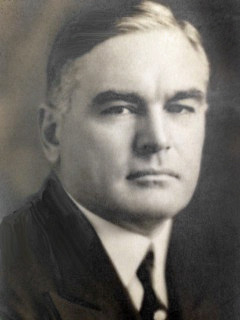
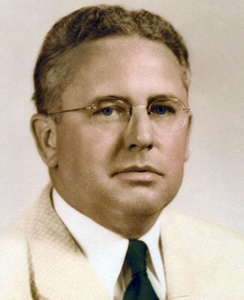
William Bechtel Stayer, around the time he bought Goody Goody.
Everyone who knew him, friends and family alike, called him "Papa."
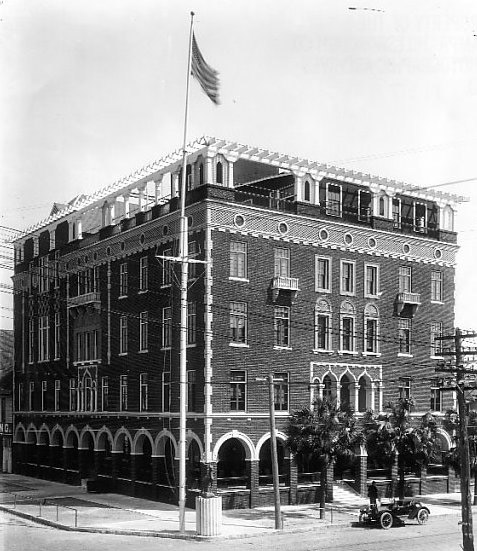
The
Elks Club building at 425 N. Florida Ave. in 1915.
It was demolished in 1962. Photo courtesy of the
Burgert Bros. collection at the Tampa-Hillsborough
County Public Library.
"Then Papa met a real estate man at
the Elks Club. Papa told the man that he had a little money to invest and the
real estate man told him that he knew of a flourishing drive-in barbecue
business. The man told him, 'There is a barbecue pit in the back where they do
their own barbecuing. The owner Mr. Stephens came from Oklahoma City and
set up a good business. His wife couldn't stand it here because it was low
class, only a barbecue stand.'"
"Papa had vowed not to buy a barbeque
stand, but did anyway. Ralph Stephens' Goody Goody appealed to him."
So William moved his family to Tampa and became a restaurant operator.
Elizabeth
"Betty" Stayer
Stayer first
tries to improve on the Grand Central location
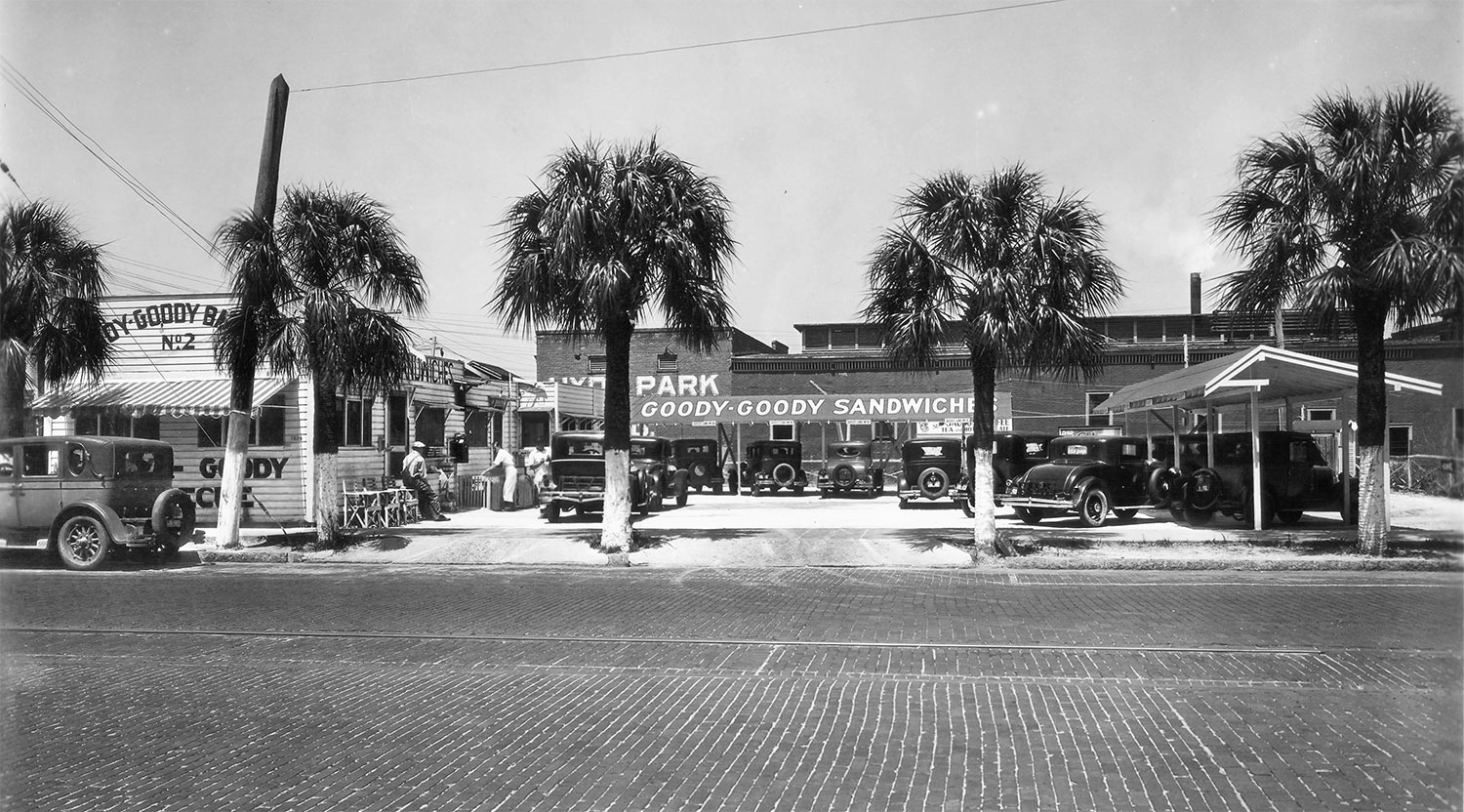
Goody Goody
Barbecue at 1629 Grand Central Ave., Tampa - 1930
Notice the sign on the building,
Goody-Goody Barbeque No. 2
(No. 1 was the Goody-Goody in Hannibal, MO.)
William B. Stayer
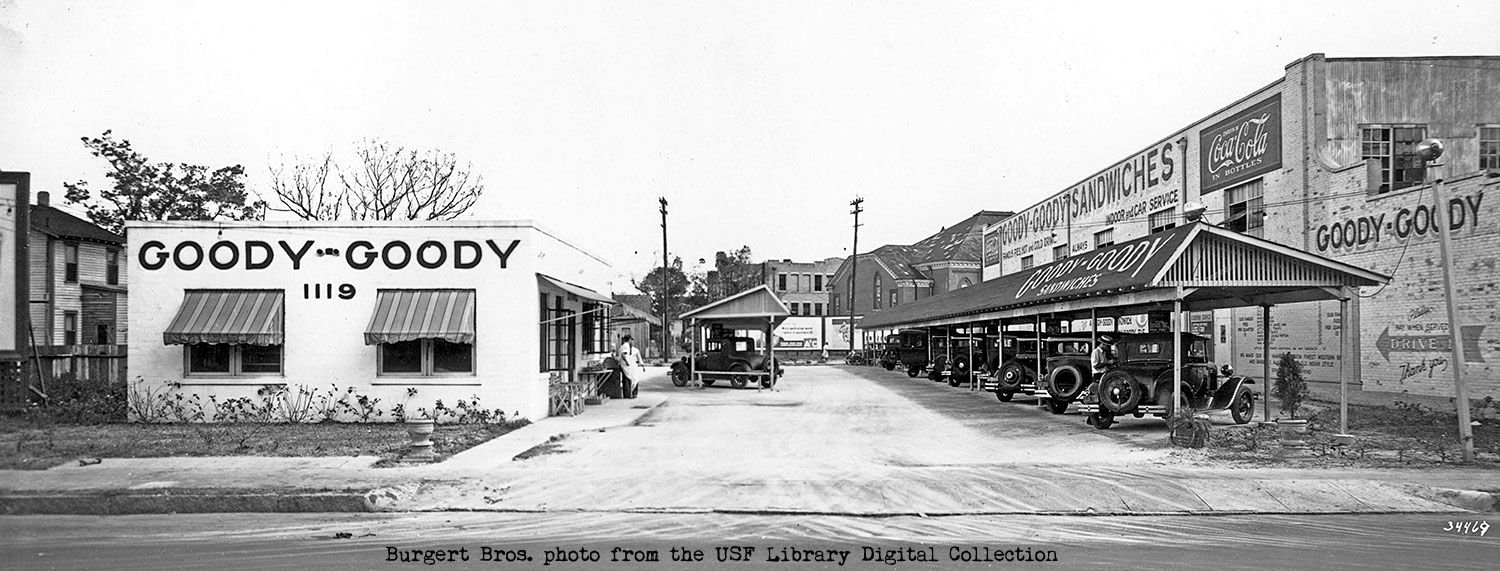
opens a new location downtown
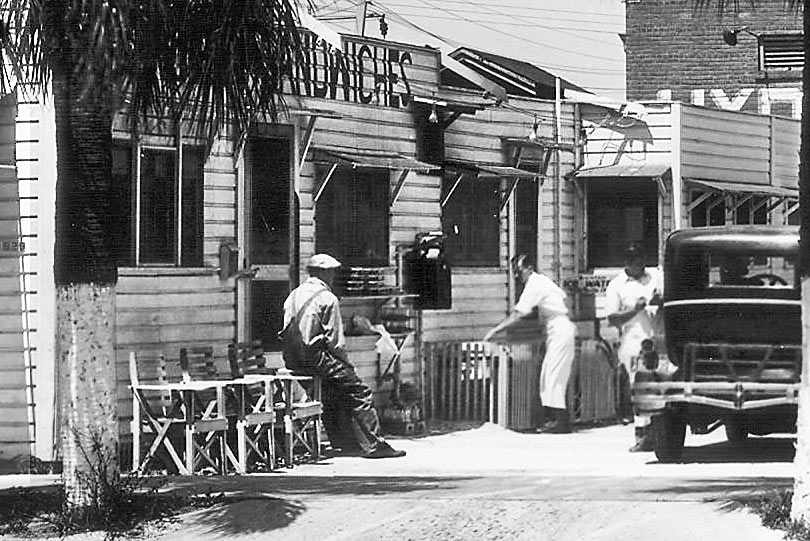
The
new downtown Goody Goody
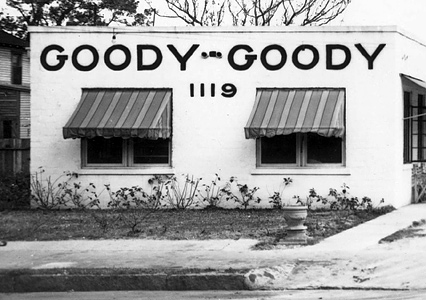
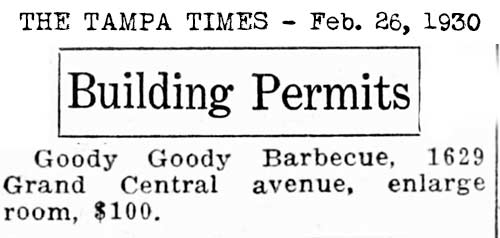
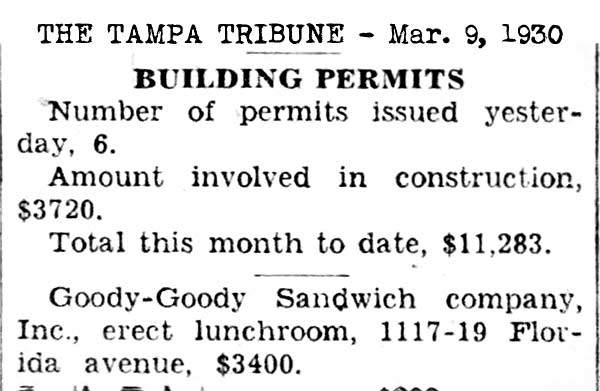
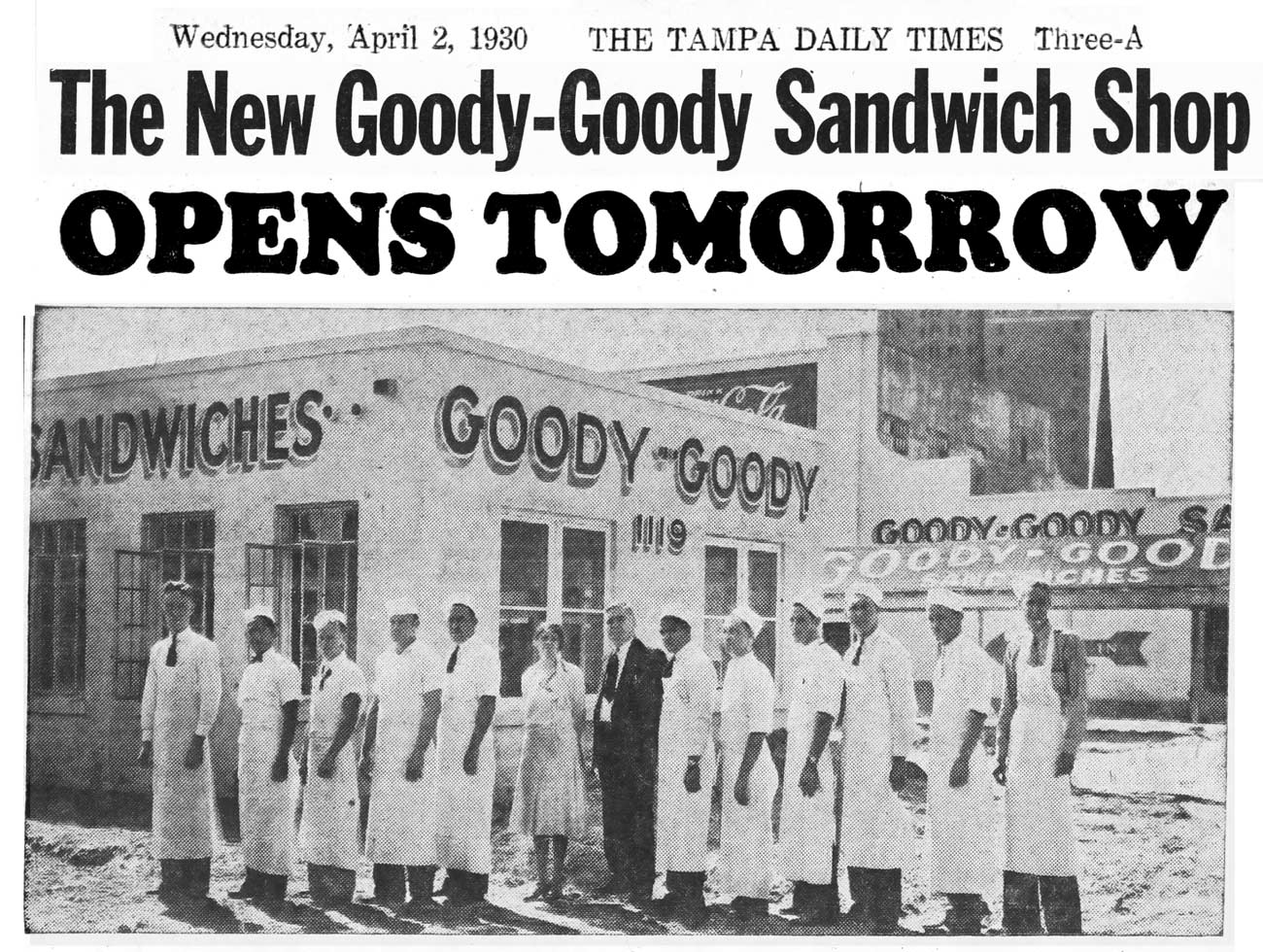
On Mar. 9, 1930, William obtained a permit to
build a lunchroom for $3,400 at 1117-9 Florida Avenue.
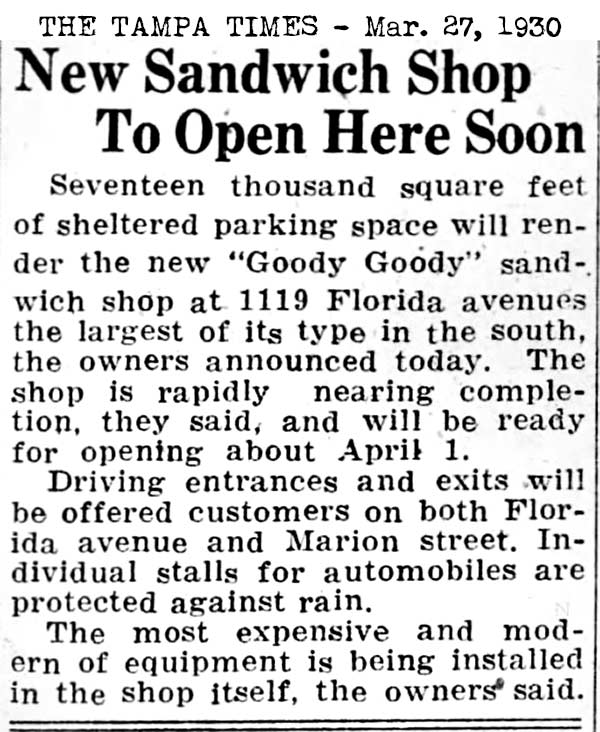
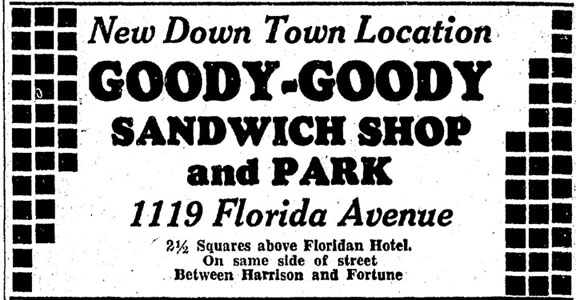
On April 3, 1930, he opened "Goody Goody Sandwiches" at a new location in
the northern downtown area--1119 N. Florida Avenue.
*
The location at 1119-1121
North Florida Avenue downtown was previously a car lot in 1928, and August Richarde's
confectioner, and Robinson's Used Car Market in late 1928-early 1929.
Mr. & Mrs. William B. Stayer
and the staff pose the day before opening
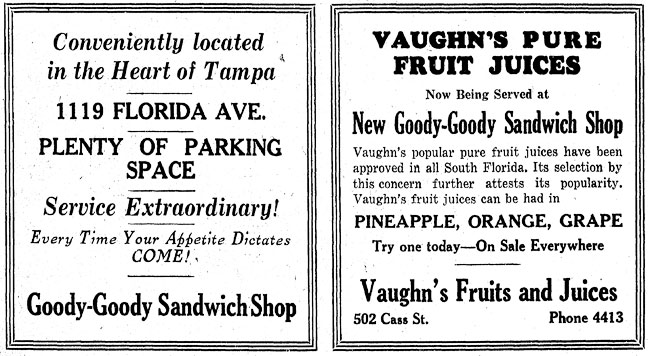
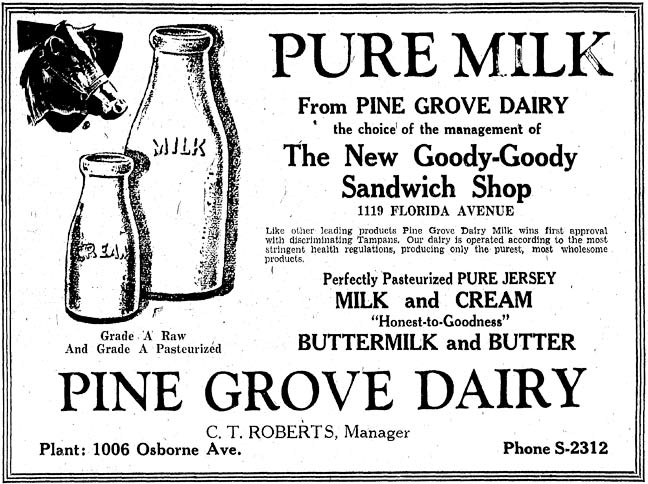
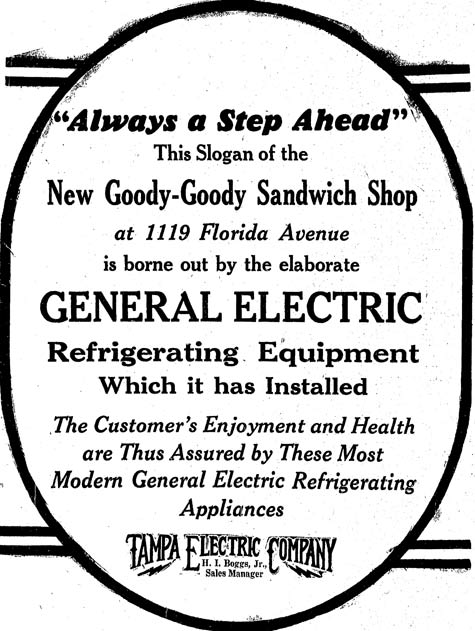
This photo was part of a full page of
ads which are shown below.
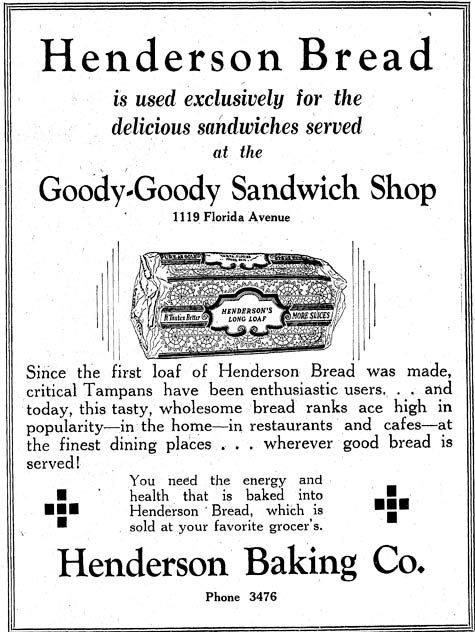
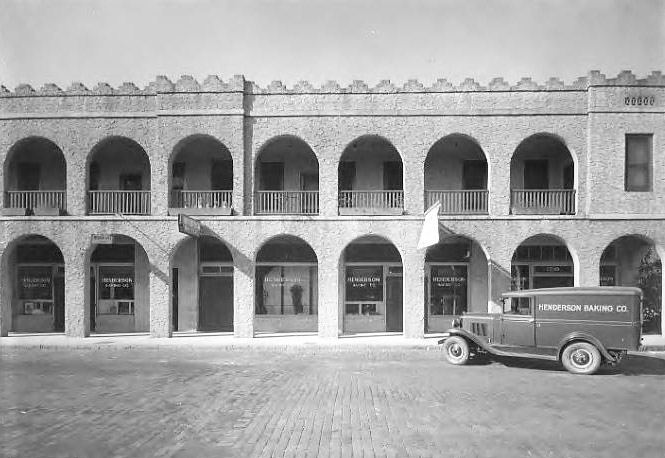
Henderson Baking Co. and delivery truck at 2700
block of N. Florida Avenue; Goody Goody's bread supplier.
Burgert Bros. photo courtesy of the Tampa-Hillsborough County
Public Library System
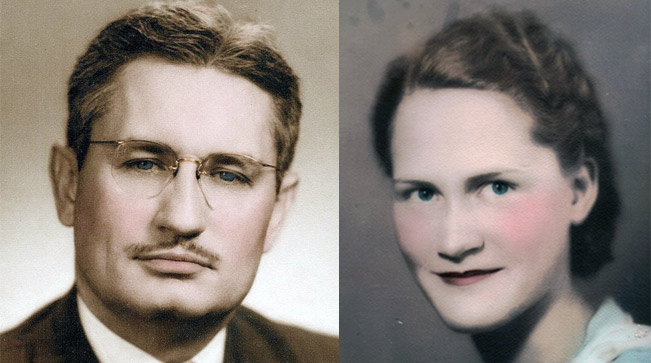
In 1940, William Stayer's son, Dr. Glenn Stayer, married Marian Irene
Henderson, daughter of Marvin H. Henderson. Sr. Marian's
uncle owned the Henderson Baking Company.
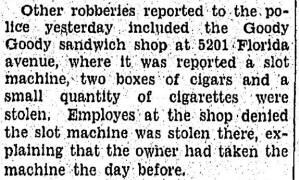
After opening at 1119 Fla.
Ave., William wanted to consolidate operations at this location downtown. In March or April of 1930 he closed the 5201 N. Florida
Avenue location in Seminole Heights. The last mention of that location is in a Mar. 27, 1930 article about local robberies.
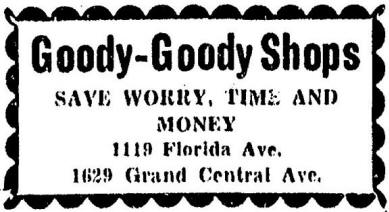
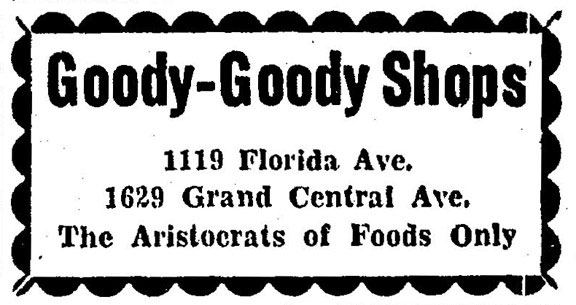
The type of ads seen below appeared over 300 times, almost daily from May 29, 1930
through Nov. 1931.
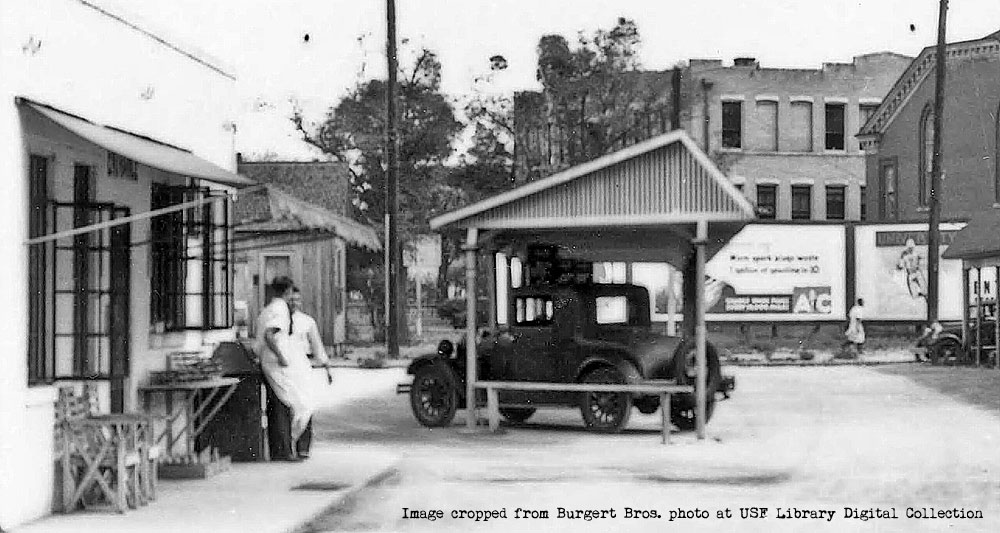
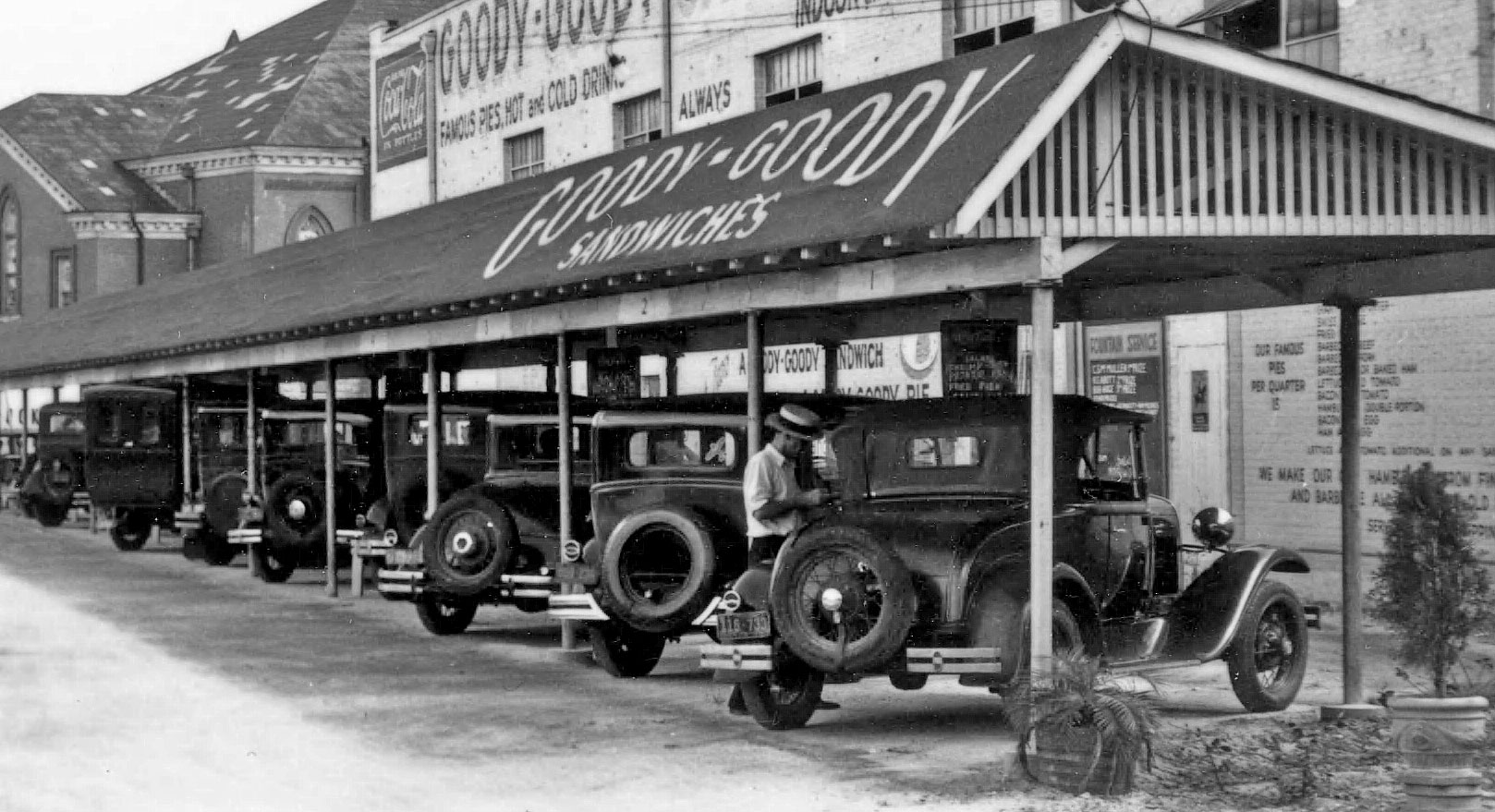
Notice the same desk chairs from the Grand Central location.
Close ups from 1932 downtown location photo
Carl Stayer
Carl Stayer on Goody Goody's
beginnings
"When Dad
bought the business, he bought the recipes for the pies and the barbeque
sauce, and stayed very close to the methods of buying and preparing the
materials, especially the hamburger meat. We operated the business for
50 years and when we left it, the recipes and methods were the same
as when we bought them."
Carl's memories of his father:
"He could not do
short-order cooking, run the cash register or wash the dishes. What
he did might be called maitre d'in a class restaurant and public
relations officer in a large corporation. He patrolled the drive-in
section, directed traffic and met the customers. It was a popular
restaurant with the most prominent people in town driving in. Very soon he
was Mr. Goody-Goody in Tampa. In his leisure he went to the Elks Club,
Paul Webber’s White Rose and other bars, and promoted the Goody-Goody the
way those places he frequented sold their drinks. In the yard he kept selling himself and his product,
also in clubs wherever he went. It was a humble business but he raised the
restaurant up to his dignified and infectious personality and it became
very well known all over south Florida."
Despite the depression gripping the country, the Goody Goody
"clicked" at 1119 Florida Avenue.
Even though "Barbeque" stayed on
the signs and on the menu for years, the Goody Goody made its reputation with its
hamburgers--liberally doused with a specially-made barbeque sauce--and its pies. The sauce
and pie recipes were closely guarded secrets.
Sep
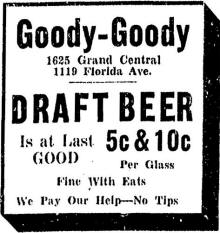
17, 1933 ad* "Draft beer is at last GOOD," a reference to the end of
Prohibition
Oct. 2, 1933*
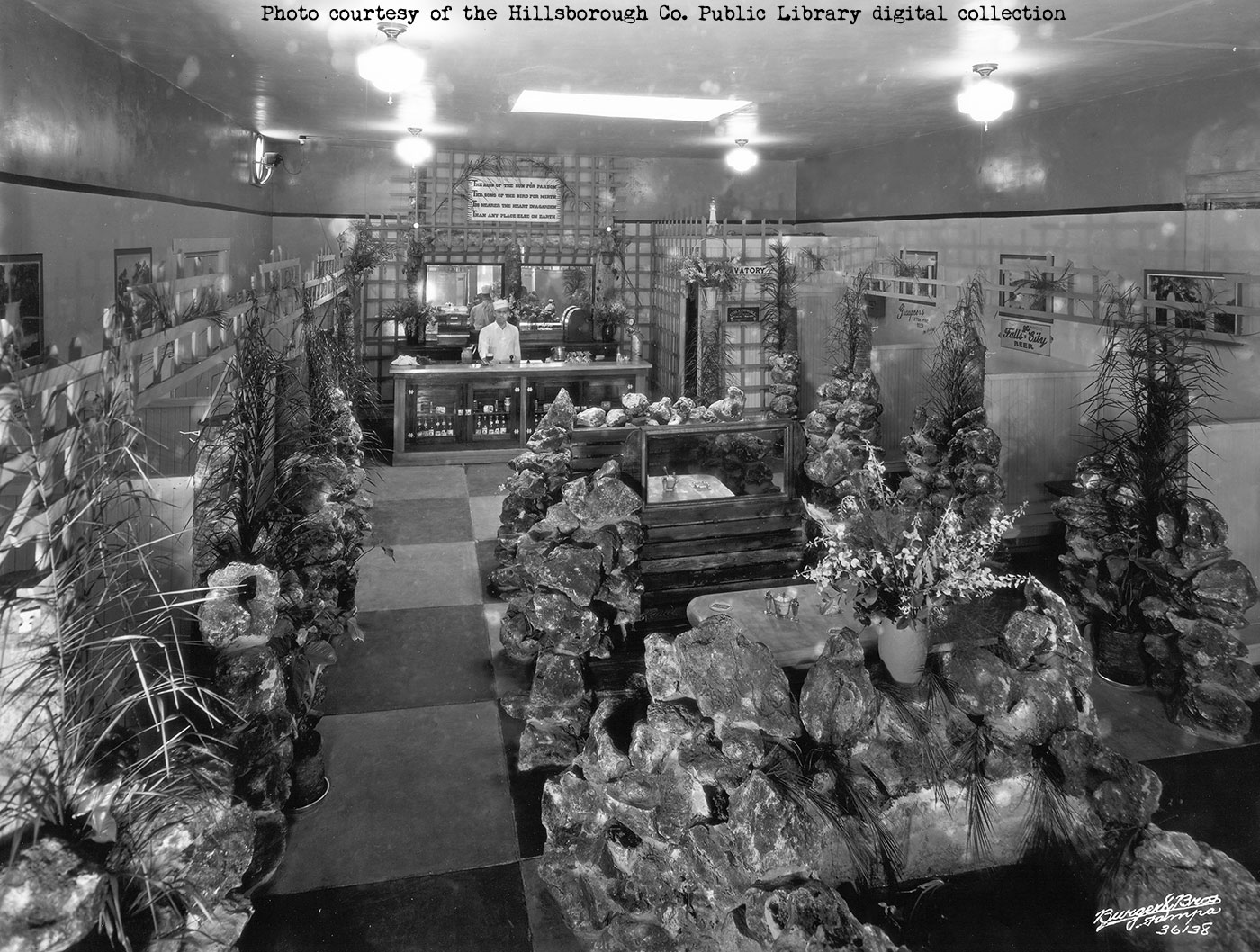
See Rock Garden ad below
Nature's Rock Garden at Goody Goody
1119 N. Florida Ave.*
The original Goody Goody on Grand Central
closes
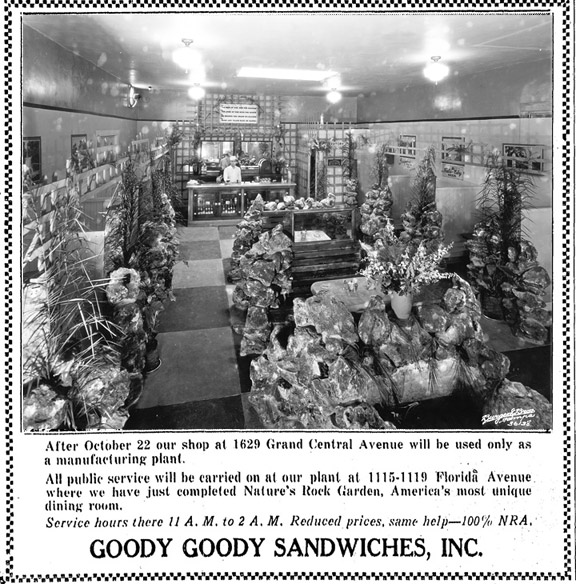
At left, an Oct. 22,
1933 ad in the Tribune said that the original
location "will be used only as a manufacturing plant. All
public service will be carried on at our plant at 1115-1119 Florida
Avenue where we have just completed Nature's Rock Garden, America's
most unique dining room."
On Oct. 22, 1933, the
Goody Goody on Grand Central Ave. closed.
Perhaps William B. Stayer intended to continue using the Grand Central location
to prepare the meats or other items, then serve them at the Florida
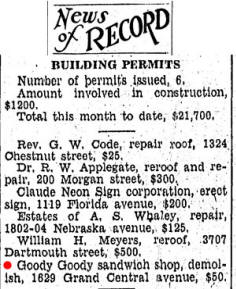
Avenue location, but on Nov. 30, 1933, he obtained a permit and at a
cost of $50 and demolished the old location.
Photos below courtesy of David Parsons,
Tampa-Hillsborough County Public Library
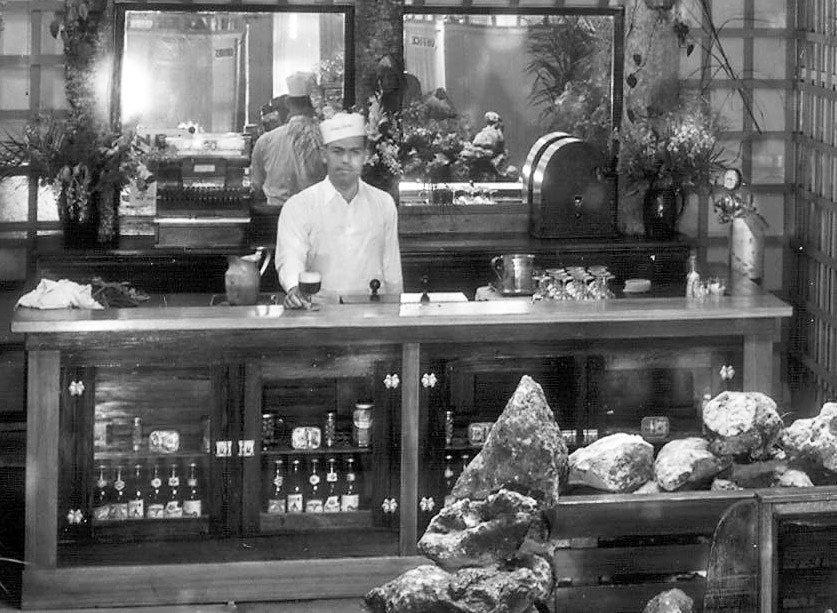
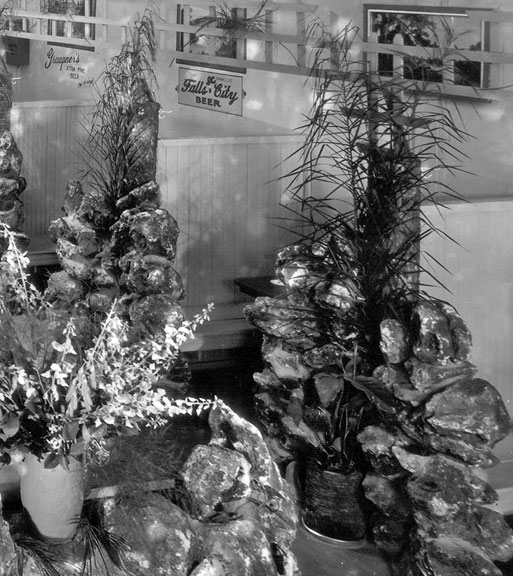
Goody Goody at 1119 N. Florida Avenue - The "rock garden" dining
room
It was the end of
Prohibition and beer was on the menu at Goody Goody.
Close up of booths
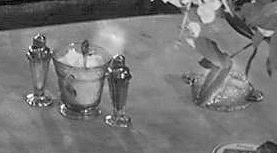
Salt, pepper, sugar bowl
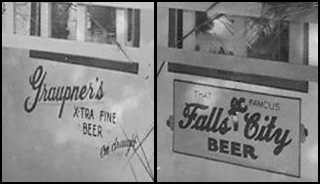
Graupner's X-tra Fine Beer and Falls City Beer ads on the wall and
close up of sign above clerk
Sep 22, 1935*
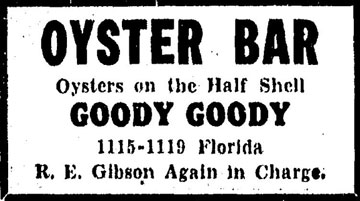
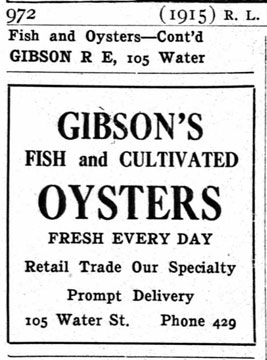
Robert E. Gibson was a long-time Tampa oyster and seafood retailer.
From 1912 to the mid-1930s he operated in Tampa's local markets such
as City Fish Market at #34 City Markets downtown, and as proprietor
of his own oyster harvesting business. In 1928 he partnered
with the Mirabella's as "Gibson and Mirabella."
These ads in September of 1935 show he was manager of the oyster bar
at Goody Goody downtown. It was probably an arrangement he had
with Stayer where Gibson sold his oysters at Goody Goody and Stayer
got a cut of the profit. The
ad ran almost every day for a month.
1915 ad*
Goody Goody in
Jacksonville
1940 Jacksonville city directory
Around 1938 or 1939, Stayer
opened a Goody Goody in Jacksonville, FL at 128 Riverside Ave, with
Paul Gilbert as the manager. It operated until 1941.
Paul Gilbert, a long-time Goody Goody employee, was listed as
a sandwich maker at Goody Goody in Tampa in the city directory.
From 1930 to 1936 (the last directory researched) and probably
through 1937, he worked as a clerk, manager, and cook in Tampa.
Due to missing pages from the Jacksonville city directories, it is
not possible at this time to determine if Goody Goody was there in
1938 and 1939. Gilbert first appears in Jacksonville on the
1940 census and 1940 directory with his occupation is "fountain man"
at "Goody Goody Sandwiches." After 1941, Goody Goody
Sandwiches no longer is listed in Jacksonville directories.
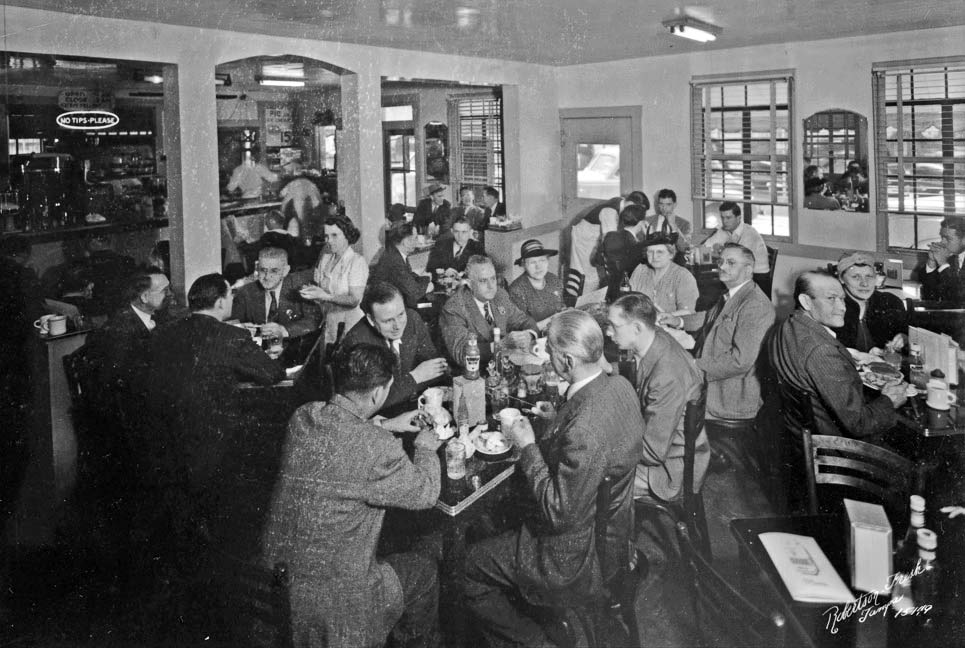
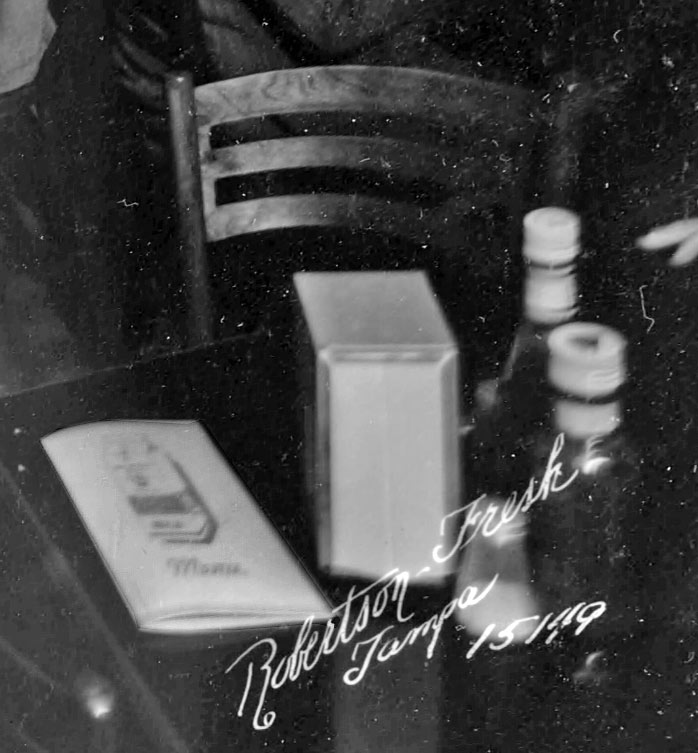
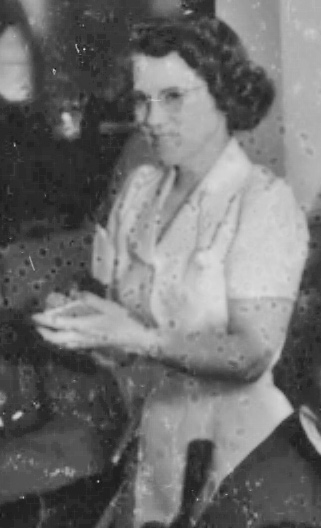
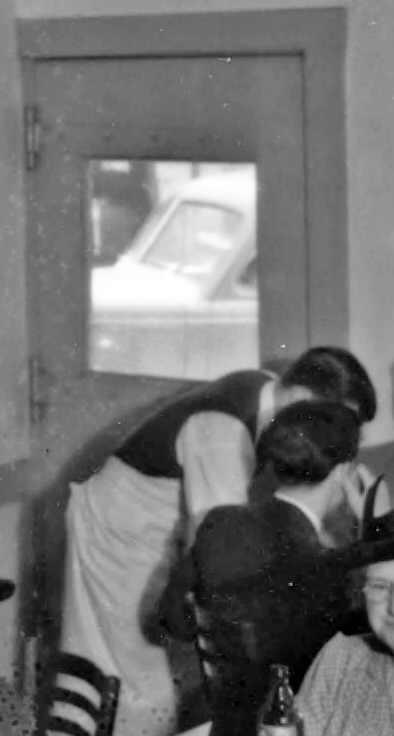
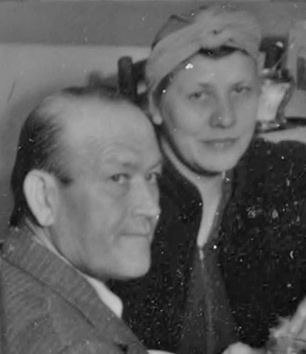
Feb 24, 1941 - Inside
the Goody Goody, downtown Tampa
Some time by Feb. 1941, the
Goody Goody was expanded in the front with the addition of this dining
room. The original
front wall of the building became the partition with archway seen at left.
See the layout of the Goody
Goody through the years, with expansions indicated. Robertson & Fresh photo from the University of South Florida Digital
Collections
Close up portions of above
photo
Sign at service counter
"Open 11am, Close 2am, Except Fri. & Sat"
Sign: Pie with Ice Cream 15¢
Coffee mugs
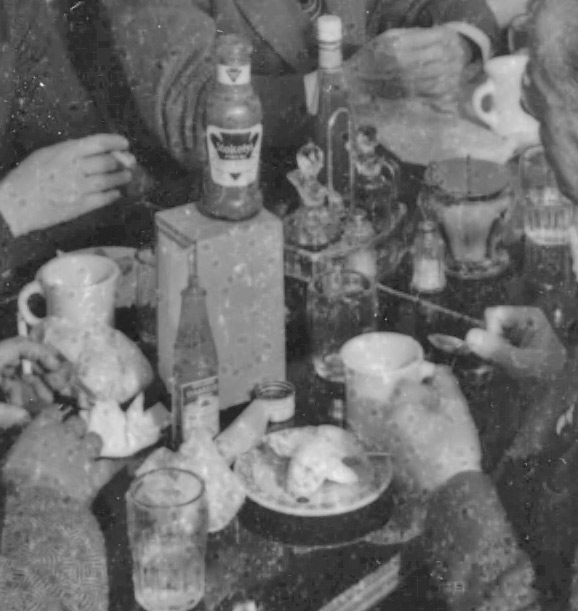
Items on table: Stokley's ketchup, hot sauce, glass oil & vinegar
cruets in wire serving basket with salt & pepper shakers, sugar
bowl, water glasses, coffee mugs
Menu with image of milk
carton on cover, napkin dispenser, ketchup bottle, unknown sauce
bottle, chair back.
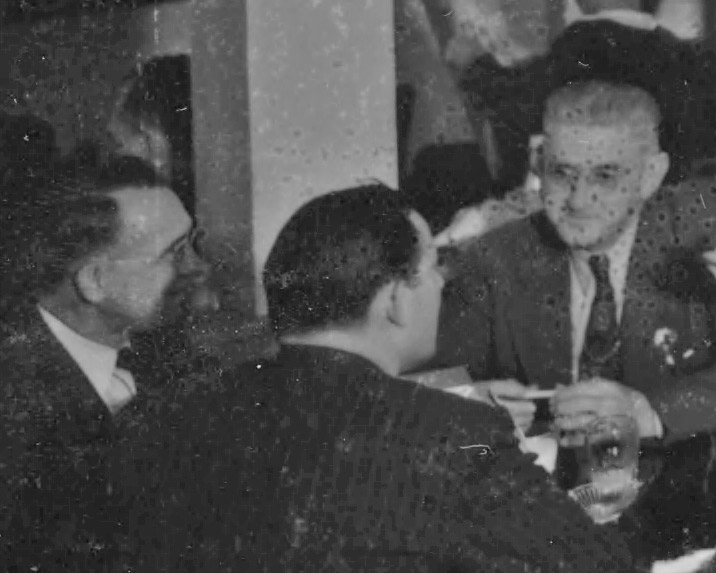
Waitress
Customers
Dining room door, south side,
and waiter
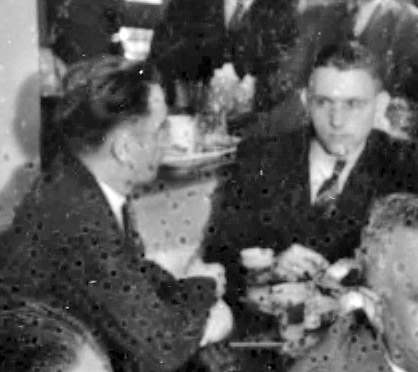
Customer
Customers
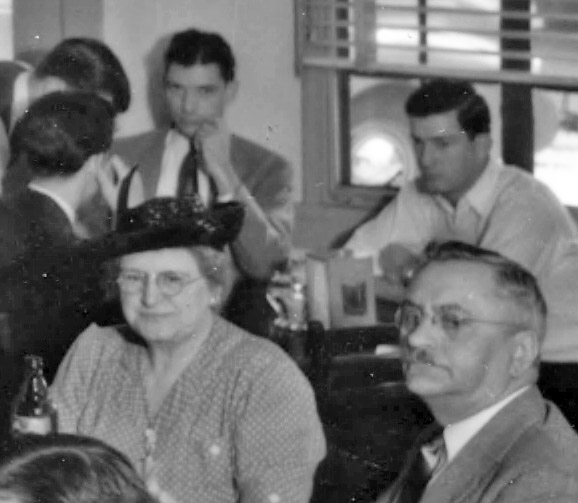
Customers
Customers
Customers
Customers
Customers
William Stayer returns to farming
"Around 1940 Papa's dream of
living on a farm came over him again. This time it was a dairy farm in
Palm River, but not a recently built dairy farm. He was going to expand,
farm and pasteurize the milk for the Goody-Goody. This didn’t go far as
the health department outlined extensive rebuilding and new equipment
necessary. So instead, he had a neighbor graze his cattle on the 10
acres to control the grass and weeds. He moved Sadie out there and in the
evening when he went to the Elks Club, he would bring her into town to
wait for him at the Goody-Goody."
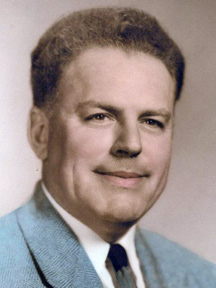
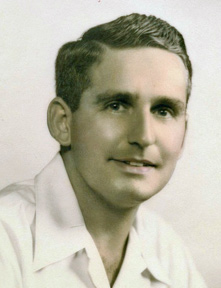
Bob Stayer
- Mainstay of Goody Goody
Sons Bill and Bob Stayer got
involved in the business--with Bob, the youngest, becoming his father's
mainstay in the day-to-day operation of Goody Goody. Another son, Glenn, became a
doctor in and lived in Tampa before moving to Birmingham, Alabama.
William "Bill" Drew
Stayer
Robert "Bob" Edward Stayer
Bill and Bob Stayer, with their father William B.
Stayer.
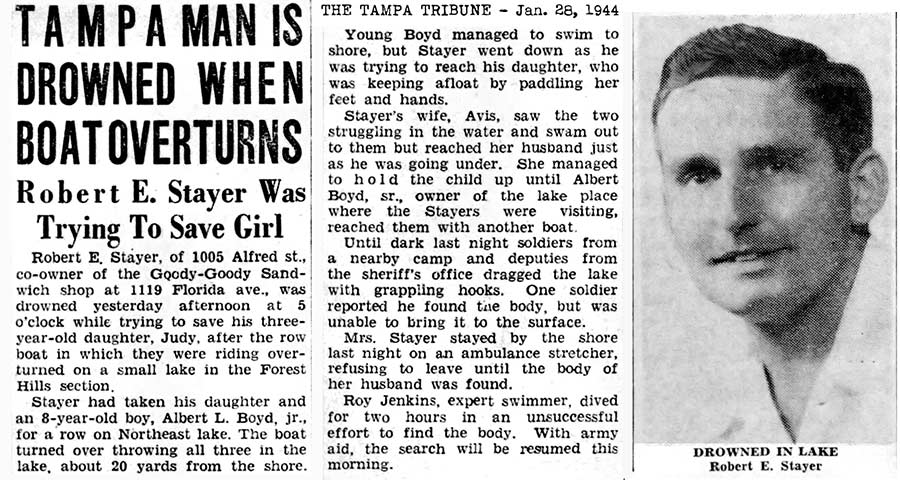
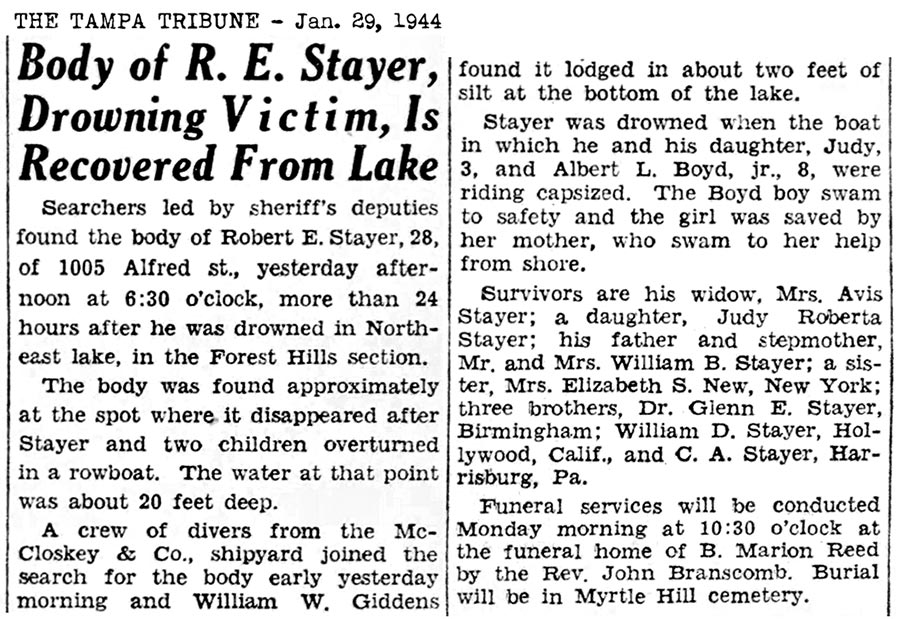
On Jan. 26, 1944, Bob Stayer, a popular young man,
drowned in a tragic accident at age 28. It was a grievous loss to
the Stayer family as well as to friends and patrons of Goody Goody, and
the loss of his favorite son caused William great anguish.
Carl Stayer and his family
moves to Tampa
It was at this time that
William B. Stayer was able to
convince his eldest son Carl, to leave his promising job with GM in Harrisburg, PA,
and bring his family to Tampa in 1945 to run the business.
Carl
remembered, "When we first went to Tampa to
visit in 1932, stores downtown had signs that they spoke Spanish, but when
I went there to live and do business, such a sign was not necessary. The
Spanish were very much a part of Tampa, making it a pleasant place to
live, especially Ybor City and West Tampa and very much a part of the rest
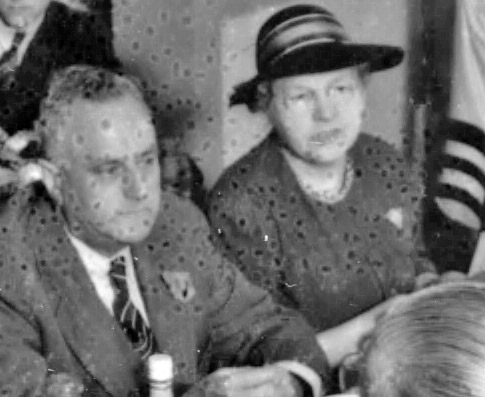
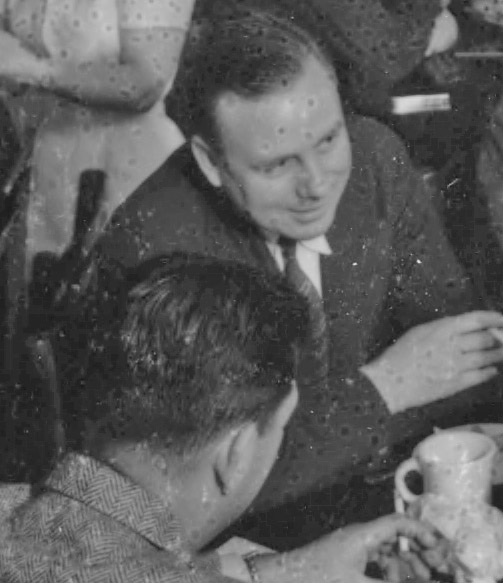
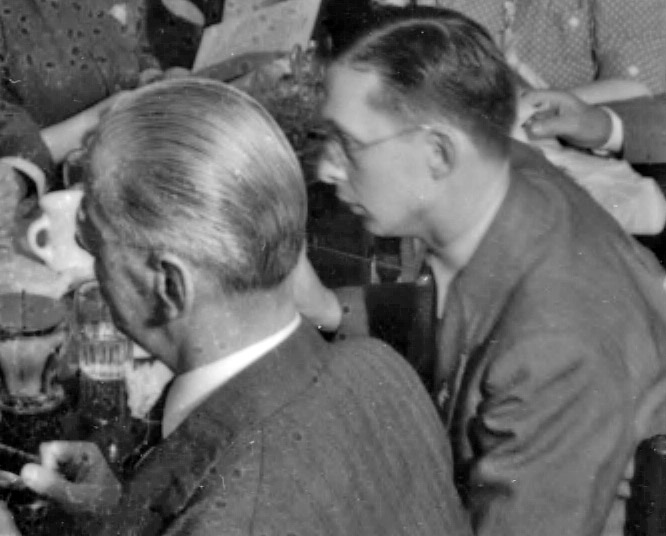
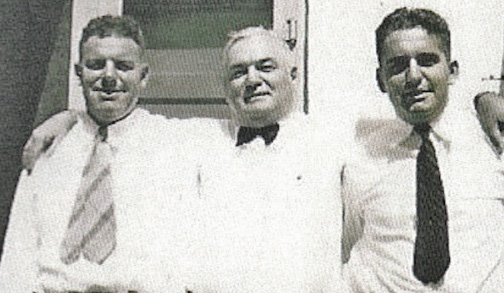
of the city. We dealt with Johnny Lala to buy
our produce, the Garcia
Brothers,
Victor and Gonzalo for our insurance, Joe Gagliardo at the
Florida Dairy, Poncho Gonzalez at Sealtest , Jose and Manuel Campoamor
and Rudy Ginex for Seafood. Above all, we enjoyed the Spanish Restaurants.
At the Spanish Park, as we came in from the parking area, Gus would seem
to be walking away from us but when he came to greet us and take our order
at the table , he already had our Martinis. Joe Valdes, the owner and his
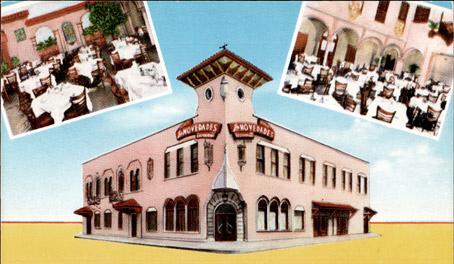
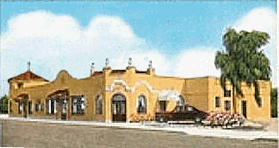
wife, along with Gus were our personal friends. Also, the Las Novedades
and Cafe Seville on Howard Street."
"Most of us in GM working
with the automobile dealers everyday had a yen to have our own business.
I was looking forward to the end of the war and having a branch of my own
and being a top flight General Motors Executive. I was working in
Pittsburgh for a new company, the General Exchange Insurance Corporation
allied with General Motors Acceptance Corporation insuring financed cars.
GEIC was a new business operated within the family of General Motors,
itself in the early stages of competition with Ford."
Stayer family life centered around 1119 Florida
Avenue
The
Stayers at W. B. Stayer's dairy farm in Palm River, Palm River Road
& 58th Street. William's grandchildren in the front: Glenda,
Pipper, Judy, Liz, Peter. Back row on the left is Carl
Stayer, next to him is Marian Henderson Stayer, wife of Dr.
Glenn Stayer. The lady behind the children next to
Marion Stayer is Avis Thibault Stayer, widow of Bob Stayer.
Behind her and to the right is Dr. Glenn Stayer. On the right is
Sadie and her husband, William B. Stayer.
For William's
daughter, Elizabeth "Betty" Stayer
Hendryson, it was a great place to bring her high school friends after a
dance. Sometimes her tab shot as high as $2.50, which she charged to her
dad. But her dad soon ordered her to "cease and desist!"
Later, while Elizabeth was
attending library school, her children Liz and Peter New came to live with
their grandparents on the Palm River farm. Liz, who lived there
when she was 2 years old until she was 6, remembered getting bathed and
dressed every afternoon for the trip to the Goody Goody. After
Liz and her brother ate supper in the restaurant, they would entertain
themselves, waiting with their grandmother while their grandfather went off to
play cards at the Elks Club. "We would tear off one end of the paper
wrappings on the straws and blow them at each other." Although she was
very young at the time, she remembers the employees. "The waitresses
always seemed so wonderful. They were so good to us, and they were
wonderful looking women. They had a certain snappy talk, always
cheerful." She also recalls the managers--Lionel "Cicero"
Roberts, William Mote and Milt Gaston.
Bill Stayer said, "I remember
really looking forward to going into town to eat at the Goody Goody. I was
known as the hamburger kid at the time. My favorite waitress there taught
me how to place an order for a hamburger with just ketchup and a chocolate
milkshake."
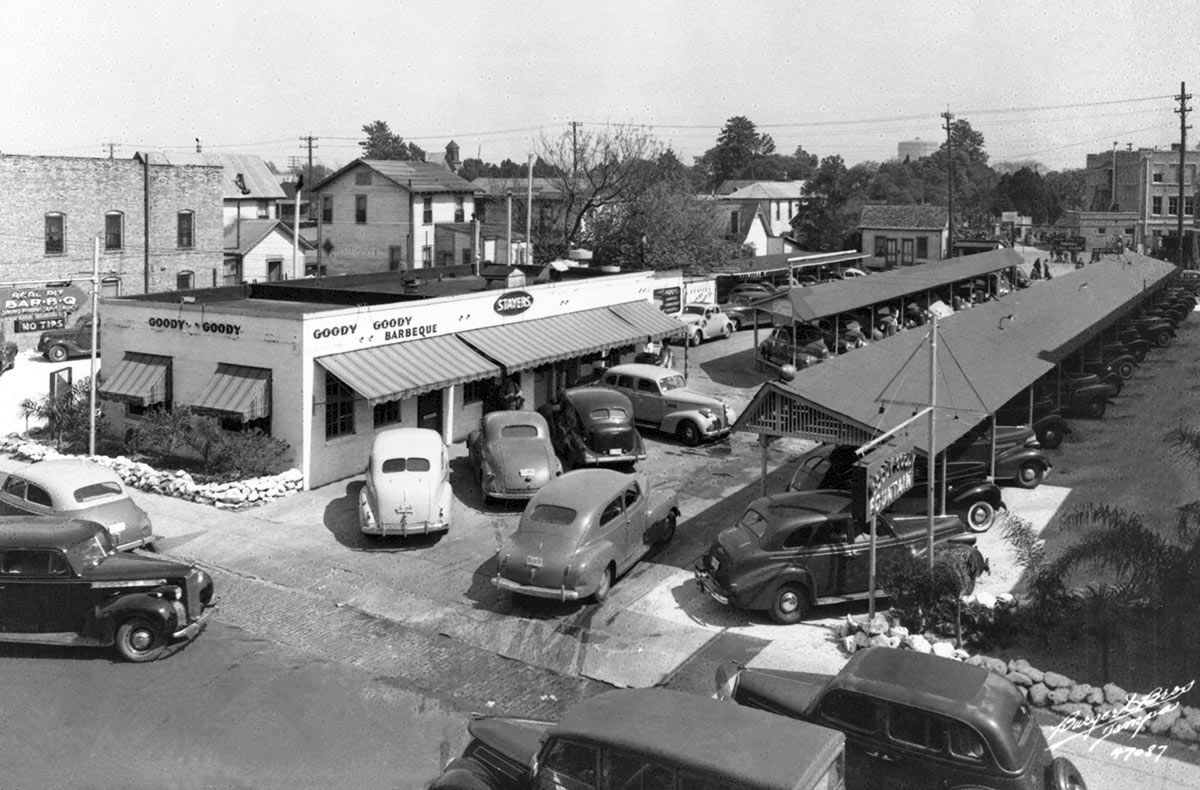
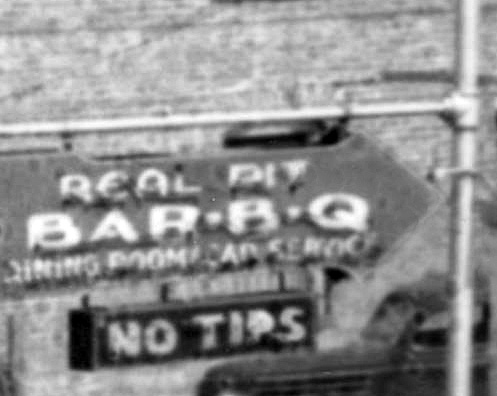
William Mote, former Goody
Goody manager, recalls that there were big signs posted when he came to work in
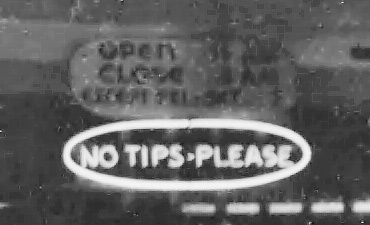
1941: "No Tips, Please." The carhops were still young men,
and the going salary was 20 cents per hour.
Peter New, on his grandfather "Papa" Bill B. Stayer
Papa
took me everywhere: to the orange plant, to Hav-A-Tampa cigar
factory where I talked to the Cuban workers; to get supplies for the
Goody Goody, particularly the boxes of hot dogs precooked, my
favorite thing; to the bread factory, hundreds of loaves of bread;
to the mayonnaise factory, to the tomato farm. We went to Morton’s
meat packing plant, went into gigantic refrigerators where sides of
beef were hanging on hooks. Papa picked out what he wanted and big
trucks brought them to Goody Goody. Papa would keep a copy of the
Congressional Record in the front seat of the car and make long
lists of things to do with his pencil.
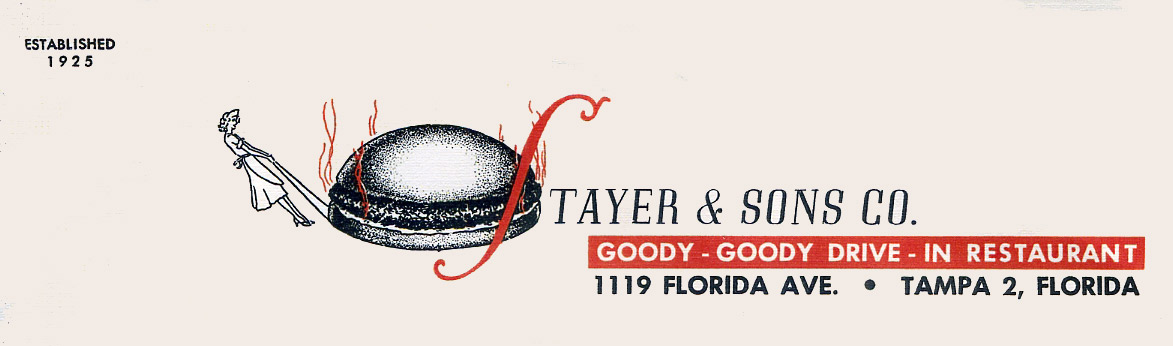
Goody Goody letterhead, 1940.
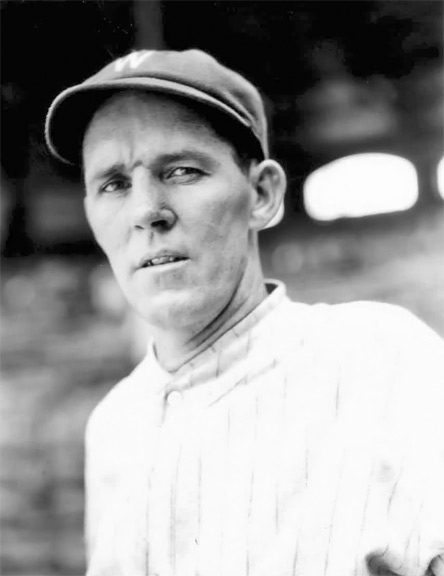
Milton Gaston,
Goody Goody manager, by Carl Stayer
Nathaniel Milton Gaston,
1928 - The only year he was with the Washington Senators. Photo from
Mears Monthly Auctions
Dad had been our companion in
baseball from the time we were about six years old. By the time Bill and I approached age 40 we were familiar with the personnel on the
baseball teams and had followed the action daily. We idolized baseball players, but I
had never met one.
When I got to Tampa, there was a real life player,
Milton Gaston, as one of the managers of the Goody Goody. He had played
for the Patterson Silk Sox in New Jersey, then on into military service where he
was on the battleship "Texas," the champion of the service teams. After
the war was over, his brother Alex, who was a catcher for the New York Giants,
advised Milt to take an offer from the Yankees, where he played on that famous
team with Babe Ruth. After a year he was traded to the Browns in St. Louis where
he met his lovely wife Pearl, who was especially admired by my wife Peg. He then
went to Washington, then on to Boston where his wife's sister was to meet
another good pitcher, Danny McFayden, and they were married. Finally he closed
his career with the White Sox.
When I worked with Milt I wondered
again why Dad had asked me to come to Florida. Milt was a level-headed
intelligent man that could have managed the business very well without the help
of a member of the family. Our duties involved both being there at noon and
maybe having a half hour at 2pm to sit together and talk, and better than that,
about two hours on Saturday and Sunday evening. There, I was practically in the
dugout at my favorite game of baseball.
Milt Gaston
(86 at the time of Hampton Dunn's 1992 article) lived in Bradenton and was the oldest former
ball player for the Boston Red Sox at the time. He managed the Goody Goody for a
number of years before becoming a Hillsborough County Sheriff's deputy.
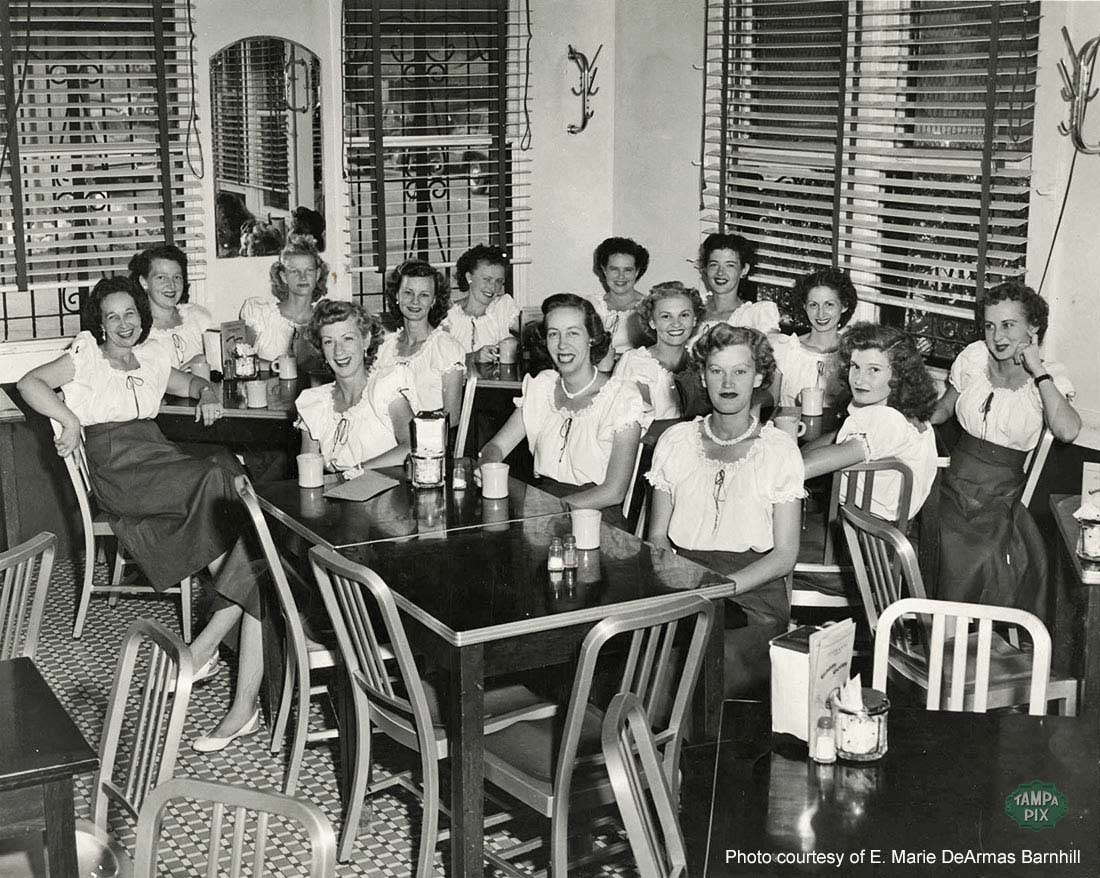
Goody Goody waitresses, circa 1950-51
Place your cursor on the photo to see names.
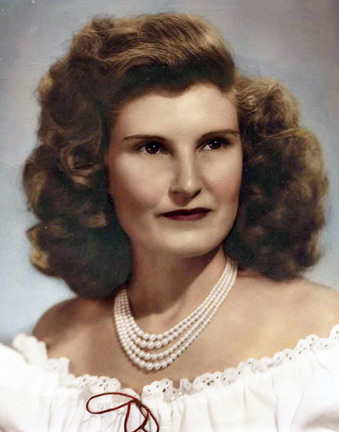
The "Goody Goody Girls" circa
1950-51 was shared with TampaPix by E. Marie DeArmas Barnhill.
The photo belongs to Marie's mother-in-law, Zena
Sanford, who is seated 2nd from far right, looking over her
shoulder. Zena married Tom
Barnhill in July of 1951 and she said it was taken a short time
before she married. The photo was taken by Hal's studio of
photography, 8716 Edison, Tampa Florida. The individual portrait at
right left is from Paul Sherman studio, 409 E Cass St. Rm 236, Tampa.
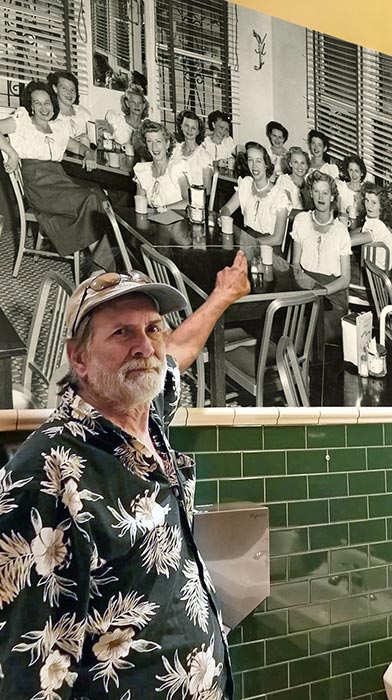
Sometime after adding
the above photo to this feature, TampaPix was contacted by Dave Gaskins,
who identified his mom, Loraine Brown Gaskins, in the photo.
Loriane said "The carhop/waitress 'uniform' was the white peasant
blouse and red skirt, which was hand made and provided for the girls
with the cost deducted from their pay, along with white shoes. Their
jobs as carhops were highly coveted as the tips earned were quite
substantial for the day."
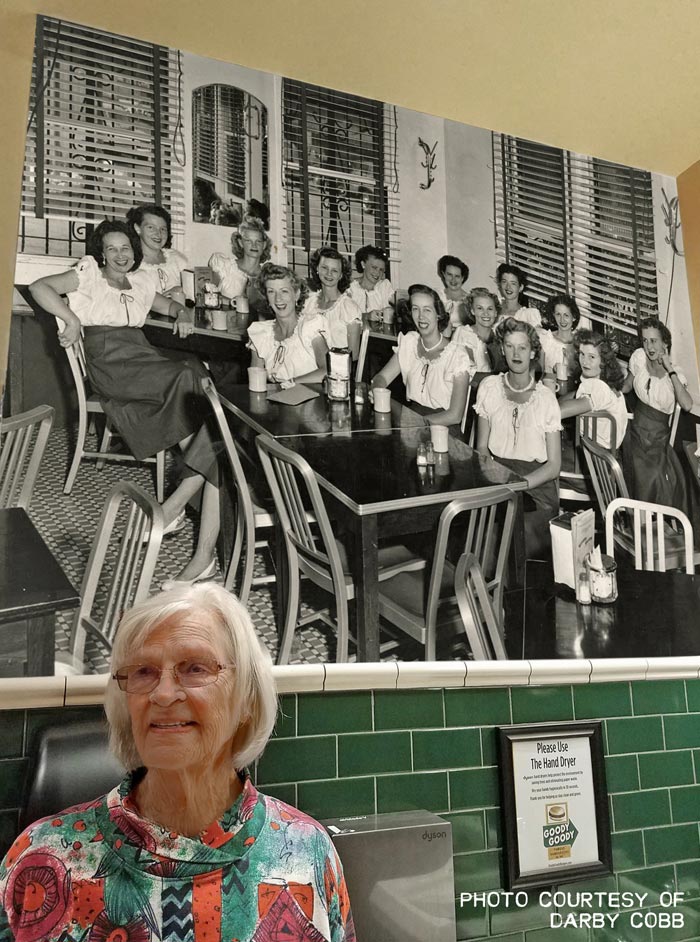
Recently, TampaPix was contacted by Darby Cobb, who identified her
aunt and her mom in the photo! Darby's mom, Ella Louise Cook,
and aunt Phyllis Marie Cook, were sisters.
Dave Gaskins
points to his mom, Goody Goody waitress Loraine Brown
Gaskins. Photo courtesy of Goody Goody Facebook page.
Thanks, Dave, for your and your mom's memories of the
waitresses and their uniforms!
Darby Cobb's
mom poses in front of the picture she posed in about 68
years ago when she was Ella Louise Cook! Ella is all
the way in the back in front of the mirror. Thanks,
Ella and Darby for sharing this priceless treasure!
Photo & caption below from
"Tampa Pastimes" Sunland
Tribune 15/1 (November 1989)
A Journal of the Tampa Historical Society, from the USF Library digital
collections.
AHH!
THOSE GOOD-LOOKING GOODY GOODY GIRLS! Just a chance to flirt with a bevy of
pretty car-hops was enough to draw the guys to The Goody Goody at
1119-21 Florida Ave. in the glory days before and after World War II.
But the food - especially those delicious pies-was the best in town. The
popular restaurant was family-owned from 1929 when William B. Stayer
bought the place until it was closed in May 1984. A few months later, in
January 1985, one of the long-time Goody Goody girls, Yvonne Freeman,
reopened the landmark. This photo was taken about 1945**. -Photo from
HAMPTON DUNN COLLECTION
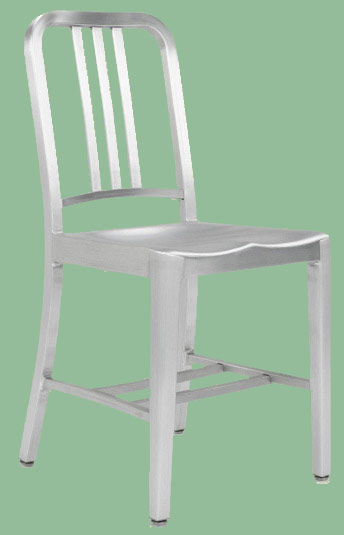
About
the aluminum chairs
Legend has it that the seat was
modeled after Betty Grable's!
In 1944, Wilton Carlyle Dinges founded the Electrical Machine and
Equipment Company (Emeco) in Hanover, Pennsylvania, utilizing the
skills of local craftsmen. During WWII the U.S. government gave him a
big assignment, make chairs that could withstand water, salt air and
sailors. Make chairs lightweight and make them strong, build them
for a lifetime. Aluminum was the obvious choice, engineered for
practical purposes, designed by real people. Emeco named the chair
with a number: 1006, some people call it the Navy chair. Emeco still
call it the Ten-o-six. Forming, welding, grinding, heat-treating,
finishing, and anodizing, are just a few of the
77 steps it
takes to build an Emeco chair. No one else makes chairs this
way. No one can. It takes a human eye to know when the process is
done right, and it takes human hands to get it that way. Emeco's
goal--make recycling obsolete by continuing to make things that last.
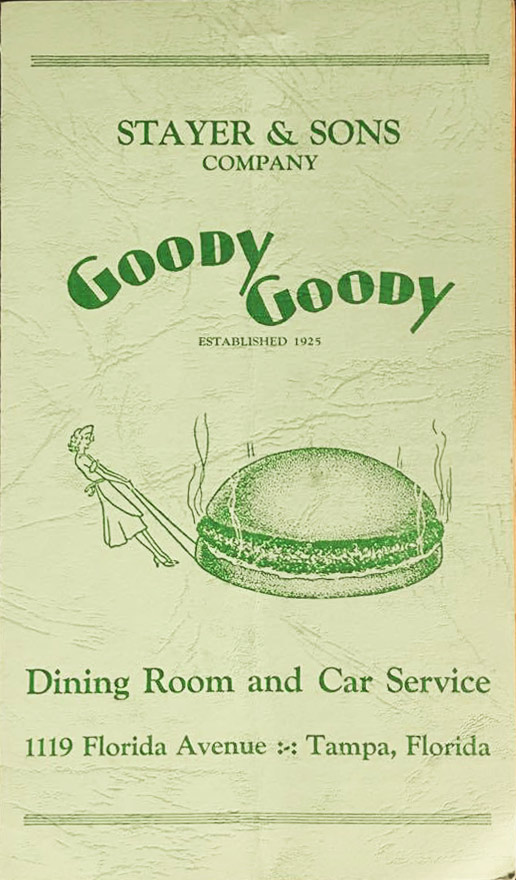
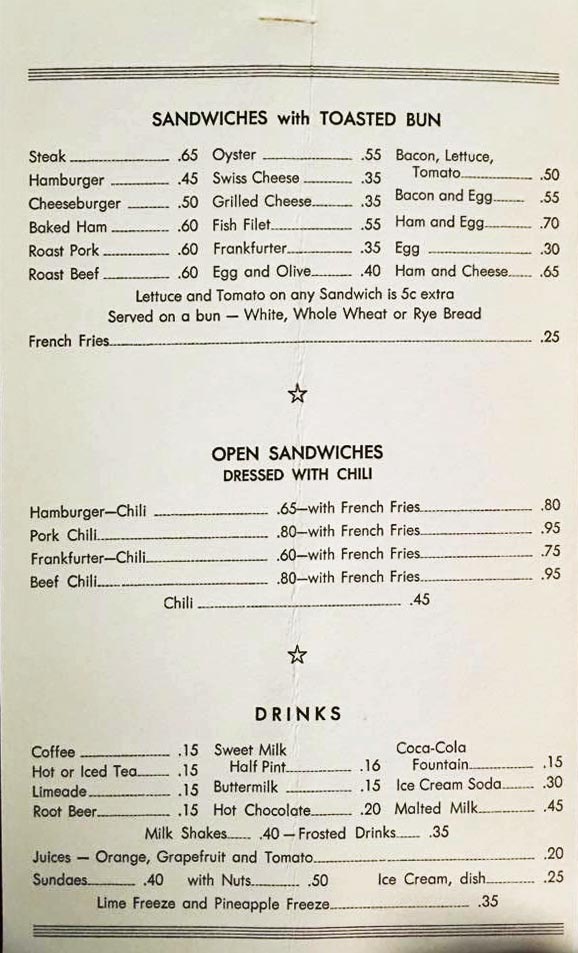
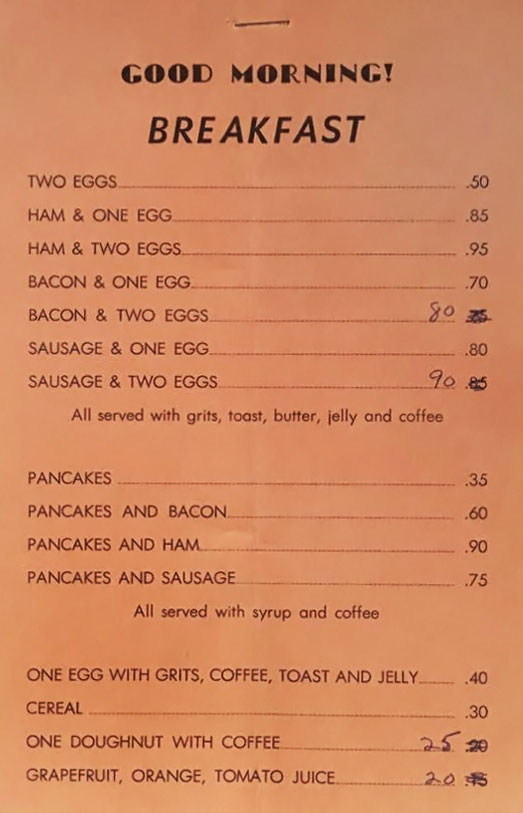
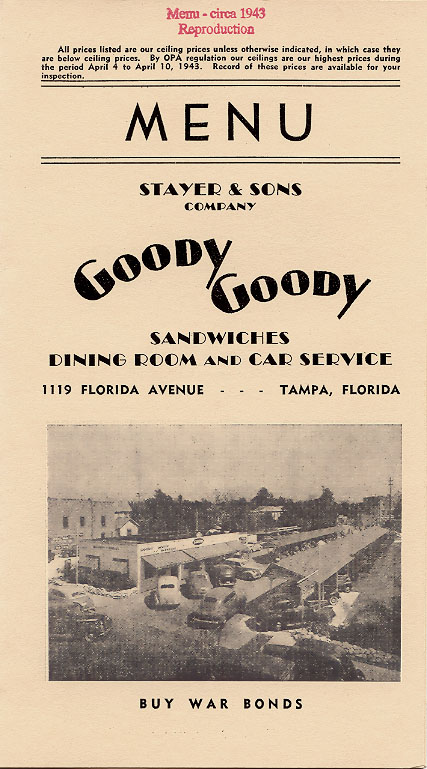
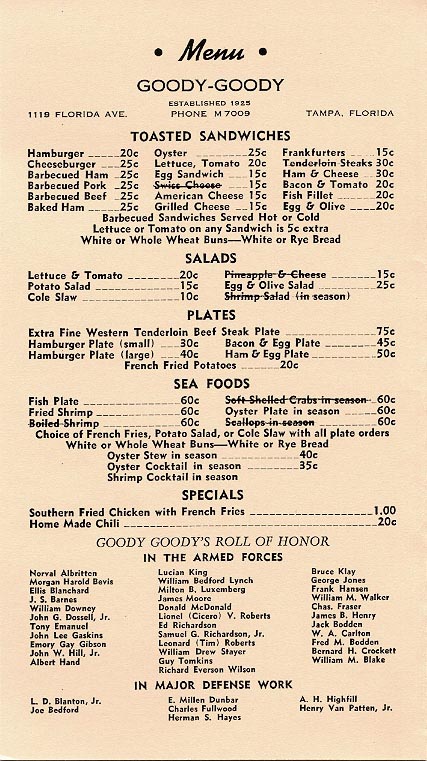
When customers drove up for
curbside service in the late 1940s, a hamburger cost 30 cents.
The last
car was served in May of 1984
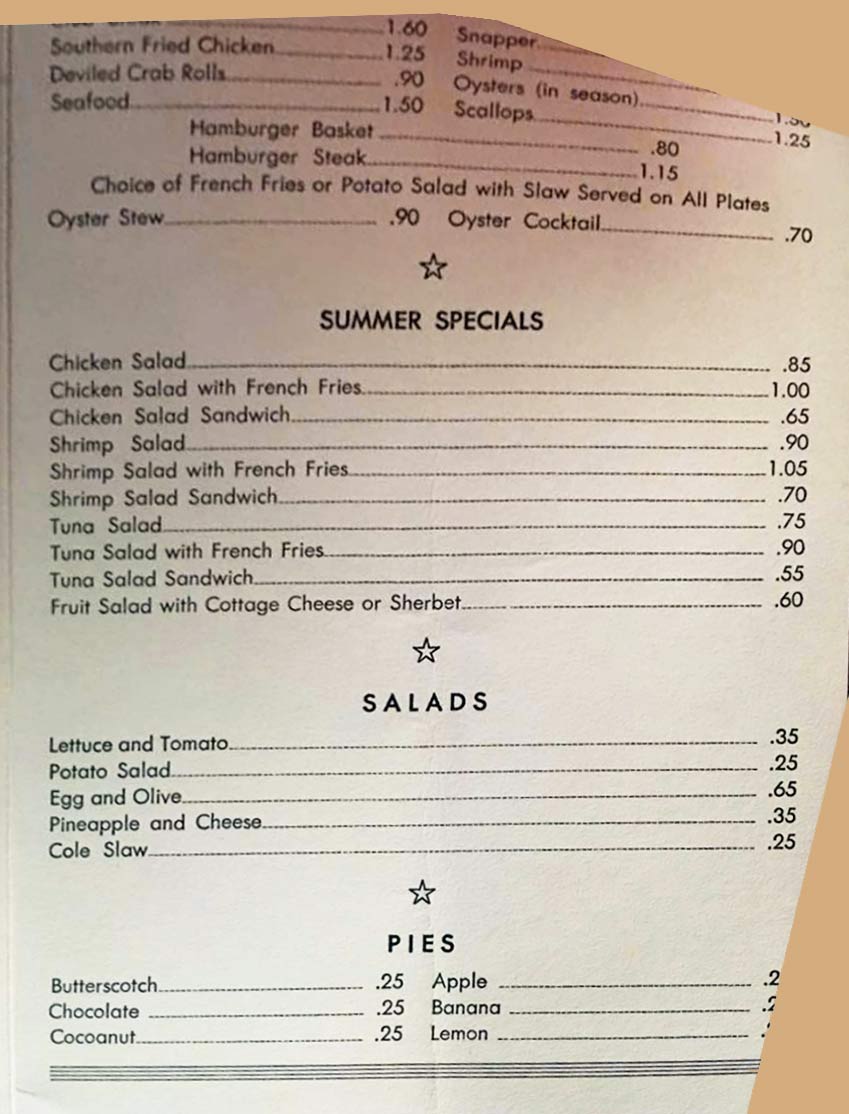
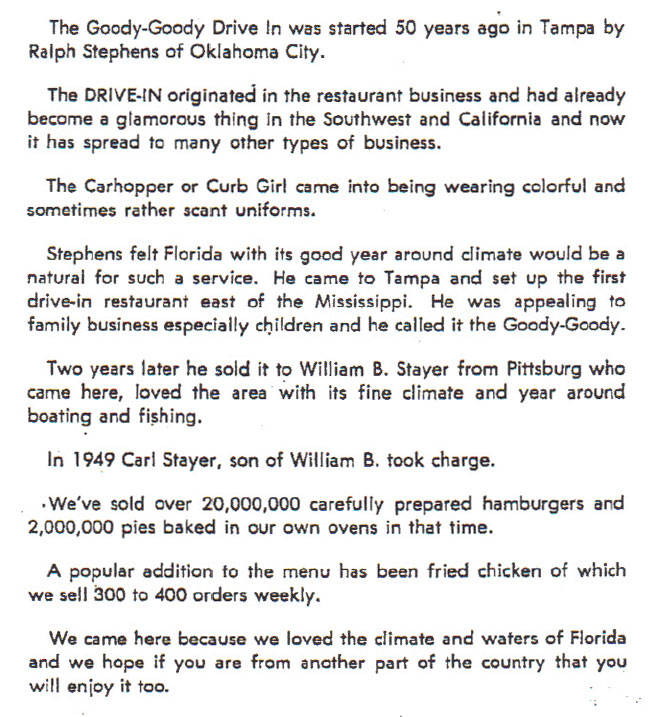
Click menu
pages to see full size
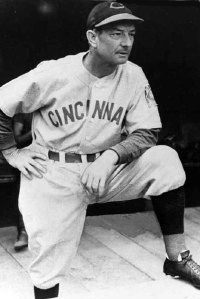
Bill McKechnie, Reds manager
from 1938 to
1946
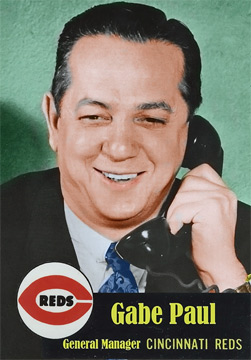
In 1934, Gabe Paul
was traveling secretary of the Red Wings and two years later, he was
brought to Cincinnati by Warren Giles. In 1943, Paul entered the
army for a two-year stint, then rejoined the Reds. By 1947, Paul was
named assistant to the vice president and took over as vice
president and general manager in 1951, succeeding Giles, who left to
become National League president. Photo from Out of the Park
Community Blog
Goody Goody fed the
Cincinnati Reds
After the WWII ended, the
Cincinnati Reds returned to Tampa for Spring Training. They had 175
players to try out, including all of those that had left the team for war
duty over a period of 4 years. Bill McKechnie sent Gabe Paul to Goody Goody to
ask them to supply their lunches. Carl Stayer was very happy to have this
assignment and would carry the lunches to the dressing room himself to get
close to the team. "We would make 175 sandwiches a day of ham, roast pork and
beef, and cheese. The property manager, Larry McManus would give us a list
of the sandwiches to be made for each player the day before and I would
take them to the dressing room at noon when they came in from morning
practice."
To get the order and to assure further business,
Carl Stayer went to
all of the games. "I would buy a ticket at the ticket window and try to
walk by Gabe Paul and wave hello with a rain check (his ticket stub) in my hands so he could
see I was a paying customer, see the game and go to the dressing room for
the next day’s order. Gabe was fussy about people he did business with
getting in on passes."
Everyone in the kitchen
worked on the Reds spring training orders with José, a Cuban cook, taking
charge. When the spring games started, Carl began to receive comments from
some players that their sandwich had twice as much meats in it on some
days than others. Not knowing why, Carl spoke to José about it. It
turned out that José was watching the box scores and rewarding the players
that hit home runs or pitched shutout ball with a double sandwich. Carl liked the idea and told Jose to go ahead with it.
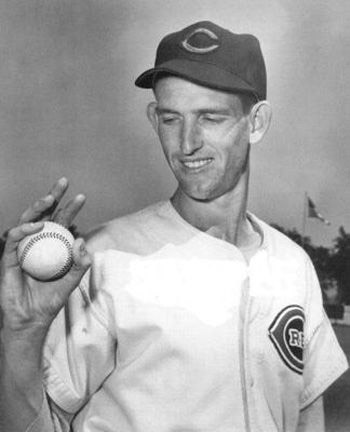
Ewell Blackwell and
Goody Goody's milkshakes
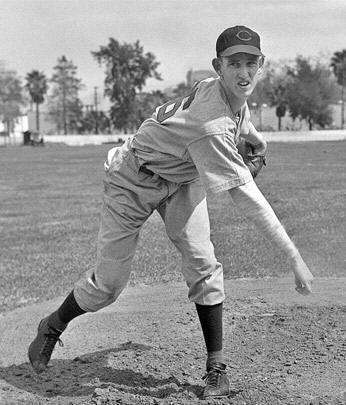
Pitcher Ewell
Blackwell of the Cincinnati Reds at Spring Training in March, 1942
at Plant Field in Tampa. Photo by Diamond Images / contributor
"Ewell Blackwell was on the
team and pitched some of the most unhittable ball in the Majors in the
next few seasons. In spite of a powerful pitching arm, he was too thin.
The trainer suggested he drink a milk shake every night. He came to our
fountain. Our Eddie Turlington was a baseball fan and here he was making
milk shakes for Ewell Blackwell. A milk shake is supposed to be milk, a
dip of ice cream and some flavoring. Eddie ignored the milk, filled the
shaker with ice cream, put in a little flavoring and let the shaker stir
it until it began to be a liquid, then let Blackwell decide whether to try
to drink it or eat it with a spoon.
With shakes like that Eddie
kept coming back. He had a fine record each season. Whether he
gained weight I don't know."
When Carl joined his dad in
1945 they both agreed that word of mouth advertising was the best for a
good restaurant, but by 1953 a great many new restaurants were started on
Dale Mabry and Hillsborough Avenues-- McDonalds, Burger King and Kentucky
Fried Chicken, and there were many new people who moved to those areas
after the war, taking some of Goody Goody's business with them.
In order to curb the loss of
business, Carl advertised for a year or two to reverse the trend. He
didn't need to reason with himself very long.
The business
increased immediately, and so Carl went right on through the second year
using a small ad each week.
He treated his new
endeavor as seriously as the advertising manager for Oldsmobile treated
the introduction of a new model, and worked very hard at it. He wrote his
own ads, taking space in the Tampa Tribune once a week. Carl was a
heavy reader, and read about history a great deal, and when he read of the
eating habits of the Romans or the people of Zanzibar, he had an ad for
that week. When he read of the development of a new food, whether it was
chicken, coffee, cheese, hamburgers, or whatever, Carl had his ads. When
little things happened in the business that he thought were worth a
headline, he had an ad.
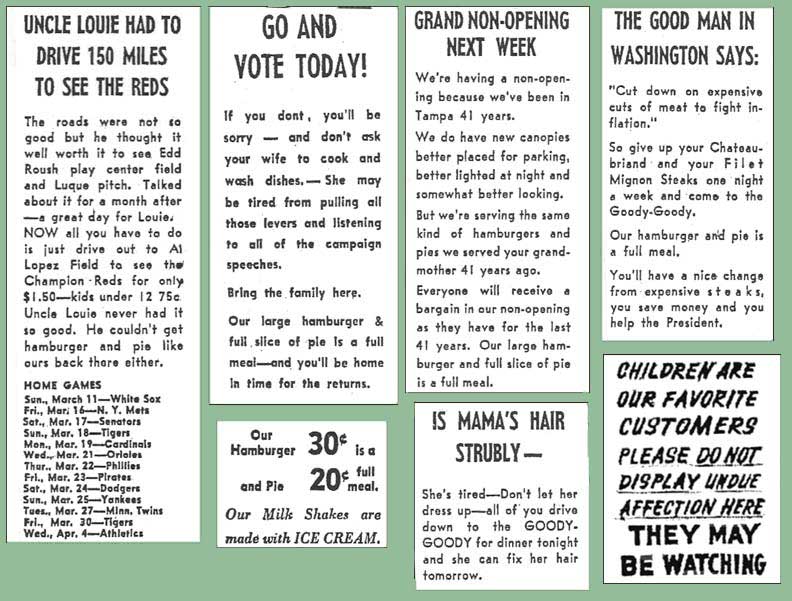
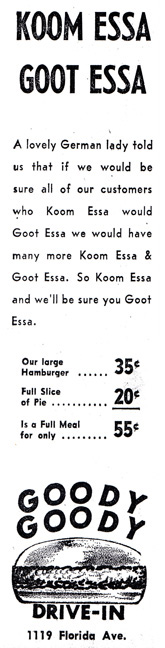
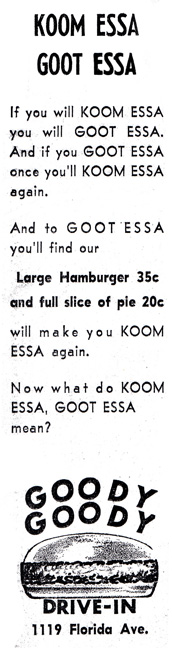
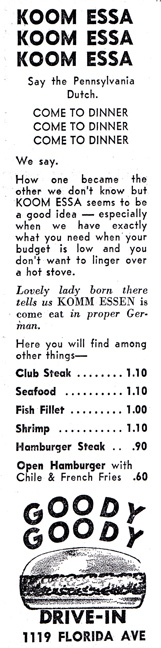
In the
1940s
and 1950s, there was a sign on the south side of the Goody Goody
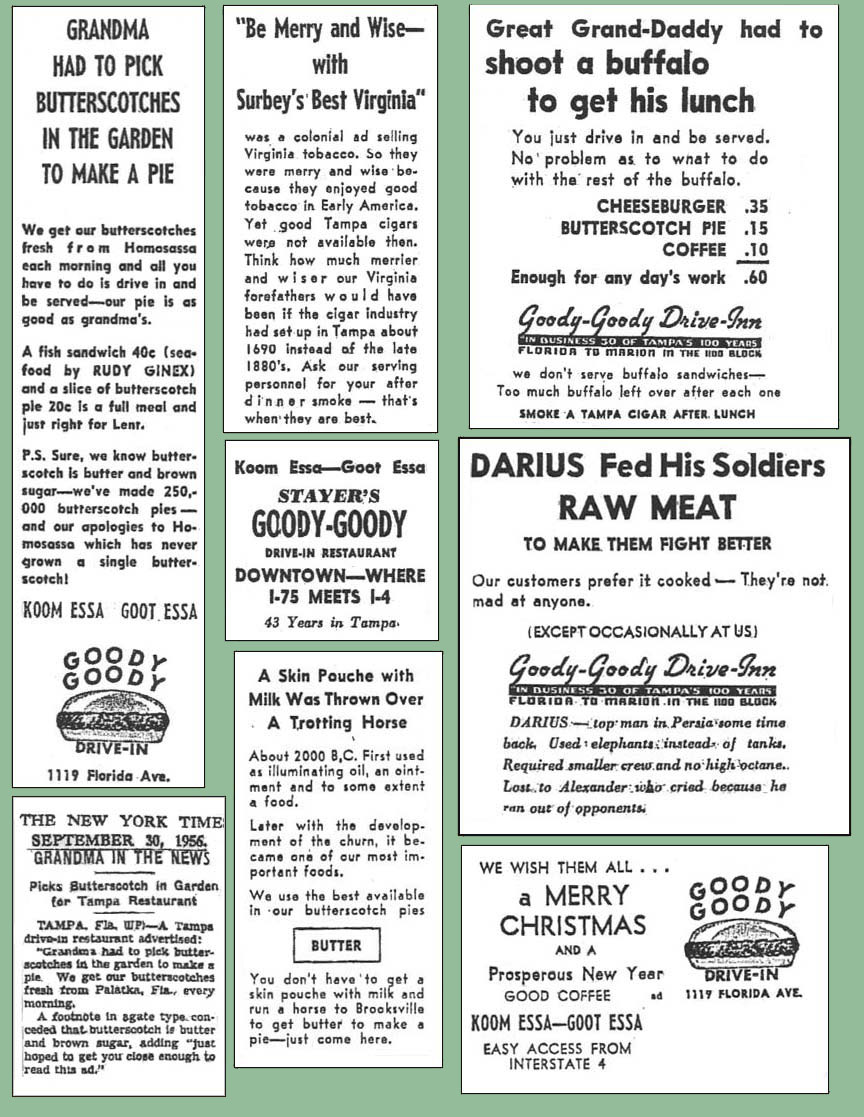
parking lot that read Koom Essa, Goot Essa. Here
are newspaper ads circa 1950s that used the same phrase.
By the 1980s, the sign and
the phrase had been forgotten, except for the new owners who made a
small sign with the phrase, framed it, and hung it on the wall when
they were decorating the place.
The Pennsylvania Dutch were
not Dutch at all; they were German. The word Dutchin this usage is often thought to be a corruption of Deitsch, which is itself a local variant of the modern
German Deutsch, meaning German in
German!. Koom Essa seems to be a phonetic spelling/variant of Kumm Esse which means come eat, come
dine or come to dinner. Likewise,
Goot Essa, isfrom Gut Esse,
which means Good dinner or Good meal.
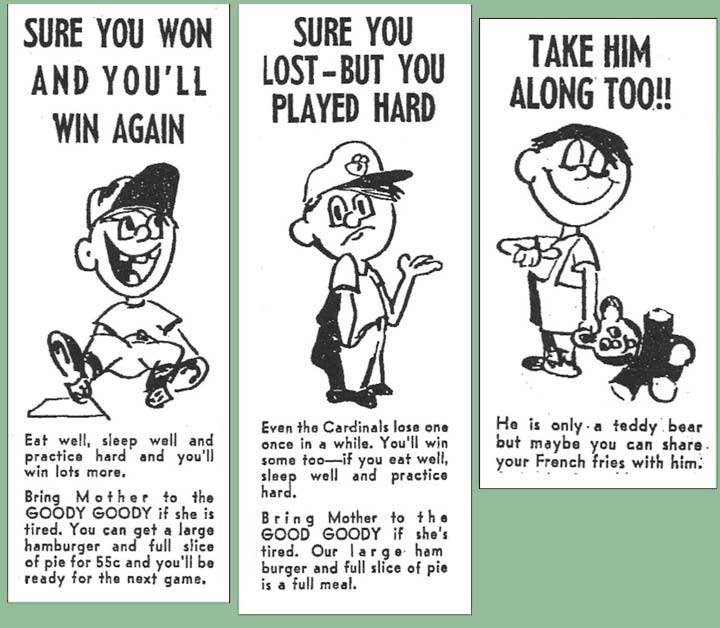
Goody
Goody newspaper ads, 1950s and 1960s, courtesy of
Pipper Stayer Ellinor
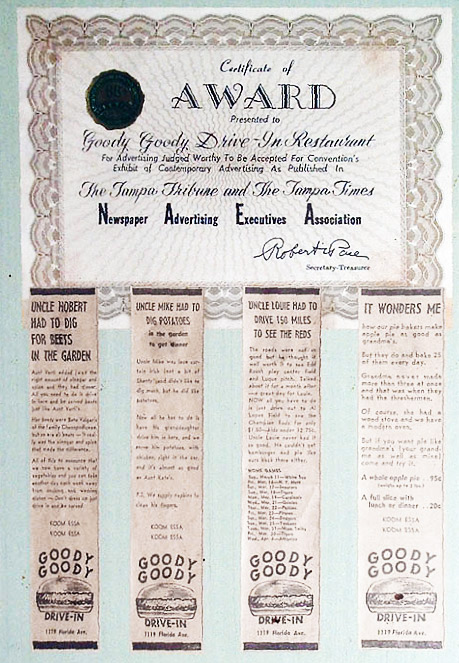
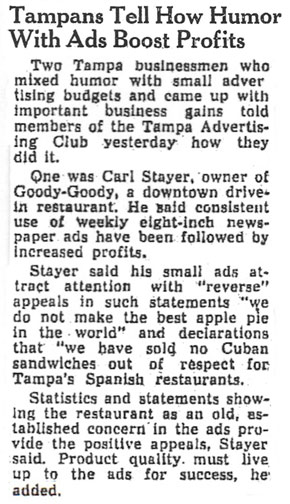
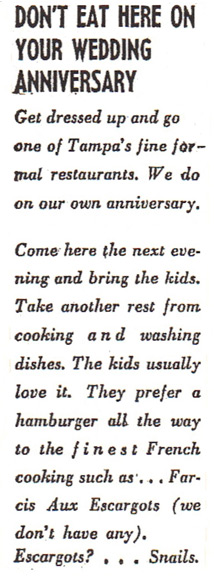
"Our
small ads attracted attention with reverse appeals such as, We have
sold no Cuban sandwiches out of respect for Tampa’s Spanish restaurants.
We combined humor with a small advertising budget and came up with
business gains." When a man left his cane in the dining room, Carl
had a headline: Man comes in with cane and goes out without it. Must
have found new strength with our hamburgers.
One
ad brought a United Press International story and a brief appearance in
The New York Times in 1956.
Grandma Had to Pick Butterscotches in the Garden to
Make a Pie.
We get our butterscotches fresh from Homosassa each morning. All you
have to do is drive in and be served. P.S. We know butterscotch is
butter and brown sugar. We’ve made 250,000 butterscotch pies. Our
apologies to Homosassa which has never grown a single butterscotch.
We Do Not Make the Best Apple Pie in the World
Our mothers and grandmothers do. They learned it cooking for large
families over old-fashioned coal or wood stoves. But We Do Make the Next
Best.
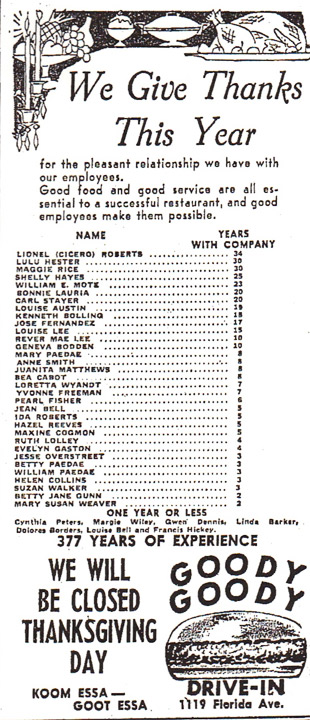
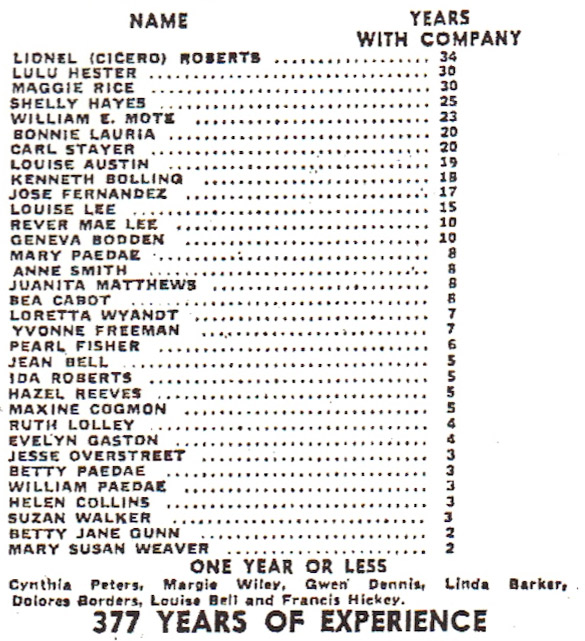
This 1965 newspaper ad lists
all the Goody Goody employees and the number of years working there
to date.
Goody Goody's dedicated employees
William Stayer capitalized
on his assets: recipes that customers liked and employees who
performed their job well. Along with the business, William acquired
key employees.
Annabelle Johnson, Pie Baker. There may have been
mothers and grandmothers that could bake better pies in their own kitchen,
but none that baked them better to sell, along with an unusual
personality.
Nathaniel Wilson, never called anything but "Peanuts," bought front quarters of beef and ground them up, added just the right
amount of fat, and made the mouth-watering hamburgers.
Lulu
Hester, a sweet person who listened, smiled, talked a little and worked
very hard.
Maggie Rice was a cleaner who had a lifetime war with dirt,
kept the dining room and kitchen spotless. Maggie was the opposite of
Lulu. She liked to be considered a little stern and did not smile as
easily.
Shelley Hayes, who had lived a life of hard labor working on the
railroad, as what they called a "Gandy Dancer," maintaining the
right-of-way. He was a good humored old guy who had never learned to read or even to write his own name. He did odd jobs and
cleaned the yard and washed dishes when the regular dishwasher failed to
show up.
"Shorty" who could work at
many jobs like clean the yard, clean the kitchen and even cook a little.
Lionel “Cicero”
Roberts, manager, started work in 1929 as a carhop. The day
he started, someone asked what the new kid’s name was and Bob Stayer,
remembering that Lionel took Latin with Elizabeth Stayer in high
school, said “I don’t know. Call him Cicero.” That was when the Goody
Goody’s parking lot was made of oyster shells and on rainy days,
Cicero’s shoes would bog down in the shells and get all cut up as he
waited on the cars. By 1978 he was working at the take-out window.
William Mote,
Dec. 2005
William Mote, manager,
started in 1941. Over the years, he worked as a carhop, behind the
soda fountain, and in the kitchen. Mote remembered that in 1941 there
were big signs posted that said. “No tips, please.” The carhops were
young men and the going salary was 20 cents an hour. Mote’s wife
Lillian Rae Mote started as a carhop in 1950. She was very slender and Cicero, the
manager who hired Rae, teased her, saying that she had to stand in the
same spot twice to make a shadow.
Yvonne
Freeman
Yvonne Freeman
started as a carhop in 1947 and then worked as a waitress. Throughout
her years at the Goody Goody, she always worked to keep the same
wholesome atmosphere. Yvonne then leased the Goody Goody from owner
Mike Wheeler and operated it from 1984 until it closed in 2005.
Bonnie Lauria,
waitress, started work in 1943. She always thought that the other
employees and the customers were part of her family.
Susan Weaver,
cashier, once said, "It isn’t the money I come down here for. It’s
just all the customers. There’s a homey atmosphere here. We are
treated like family. Coming to work is like a tranquilizer. I have met
my best friends here.
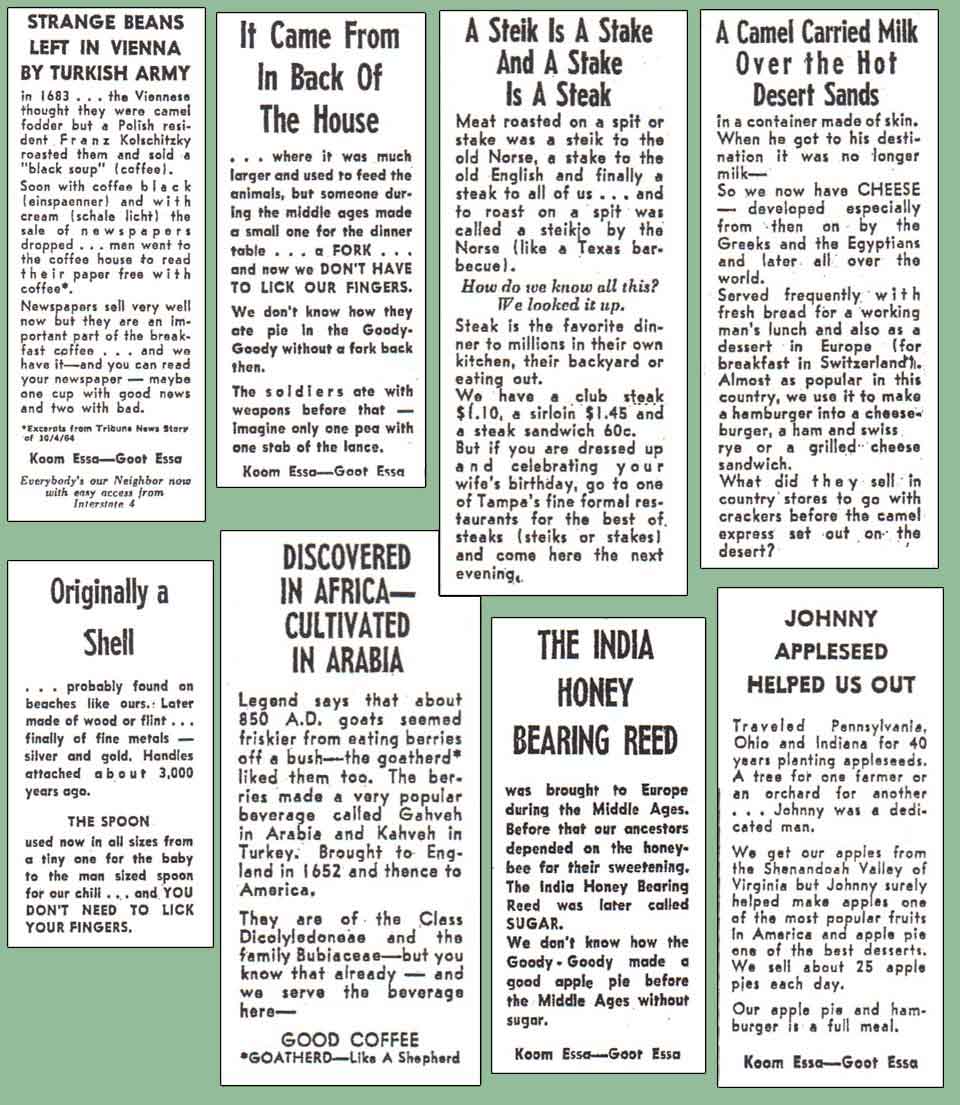
Goody
Goody newspaper ads, 1950s and 1960s, courtesy of
Pipper Stayer Ellinor
These ads show how Carl Stayer used history to advertise coffee, pies,
steak, cheeseburgers and chili.
Carl Stayer was a master at advertising, and
he didn't fail to give credit where it was due.
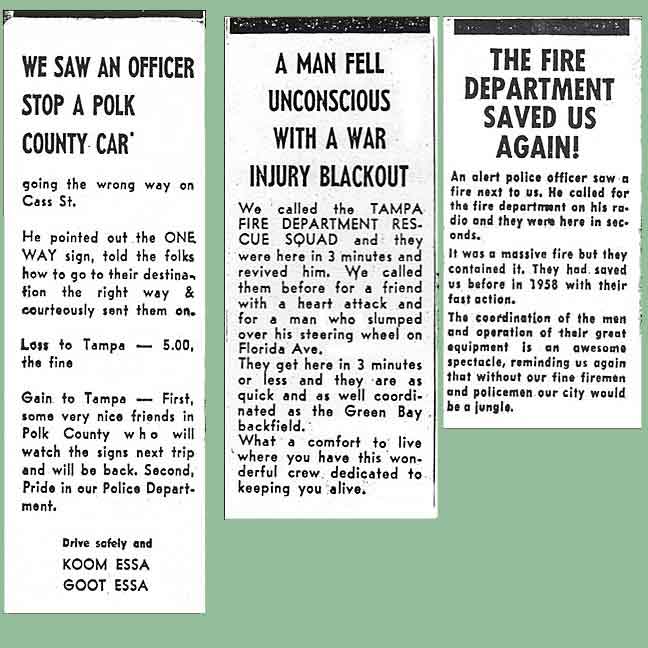
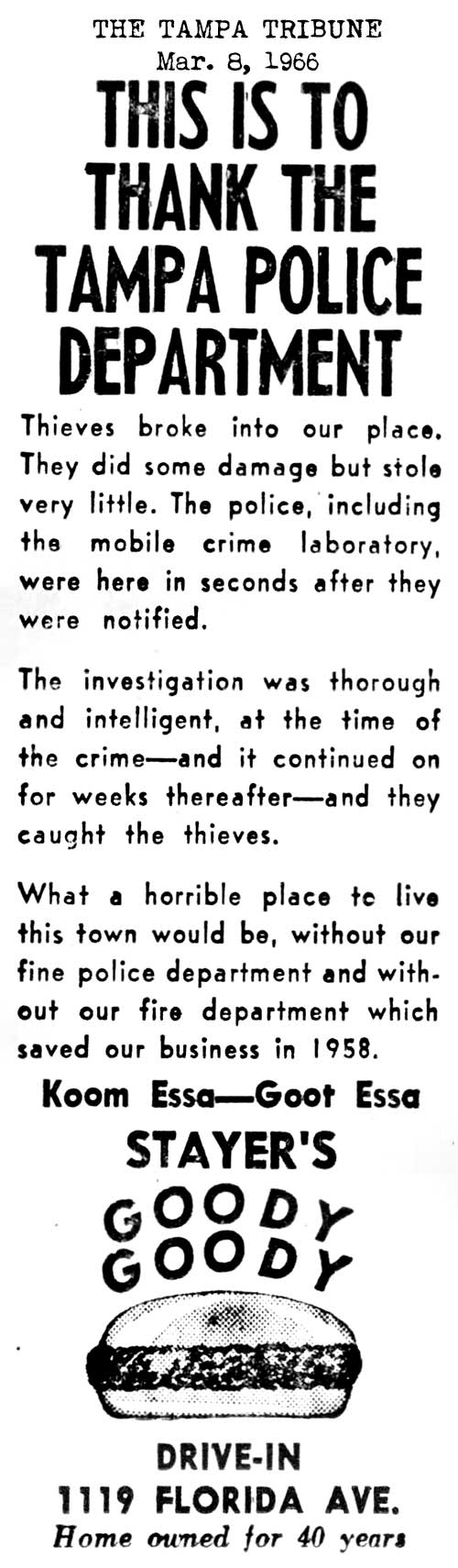
These three ads from the 1950s and 1960s
give praise to the Tampa Police Department and Tampa Fire & Rescue.
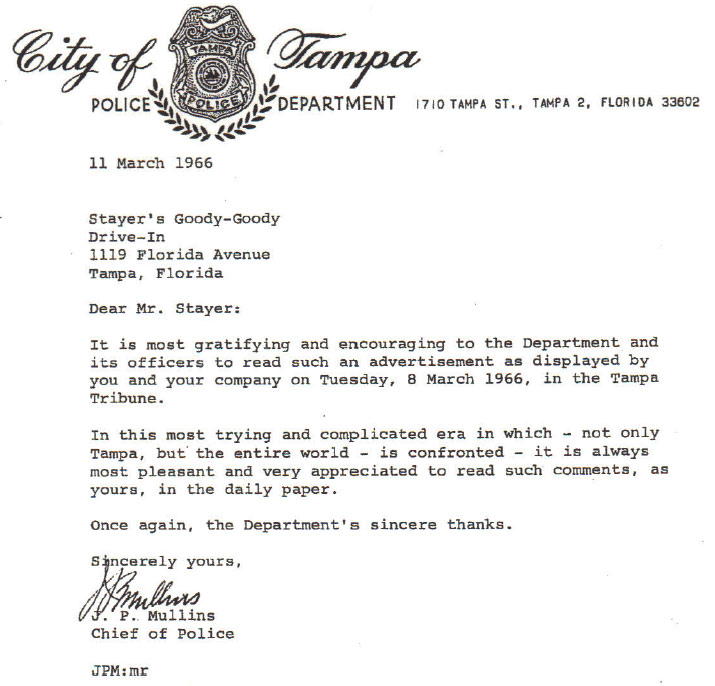
"We especially
appreciated this letter. We had the good fortune to be a good
place for the Police to stop by when they were on duty, with the
radios open for messages, to get coffee, Coca Colas and a quick
snack. Also for the Patrolmen on duty on Franklin St. to stop by
for a moment's break. We became well acquainted with these fine
young men and enjoyed knowing them. The fire department came
very quickly a number of times, but especially in 1958 when they
saved the business." --Carl Stayer
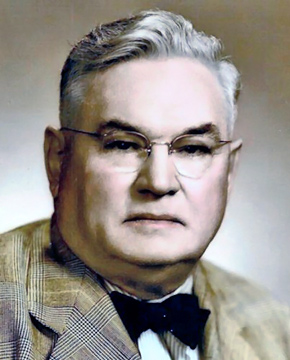
William Bechtel
Stayer
"Mr. Goody Goody"
1883-1953
William Bechtel Stayer
suffered a stroke in 1949 and passed away on Feb. 21, 1953. During
the four years he was incapacitated, he was taken care of at home by his
loving wife, Sadie. He is buried in Myrtle Hill Memorial Park.
Carl Stayer retired in 1974.
In 1989 he wrote "Now I am writing to occupy my time at 85 and I see them
[his Goody Goody ads over the years] all in the space of a few days. You spend a lot of time when
you are my age, looking back at the good things and also the bad.
Fortunately, there are more good than bad and this opportunity to write
about the advertising program has taken me back to the happy years
operating the Goody-Goody and being a part of that great city of Tampa."
After Carl retired, Judy
Stayer Richter (daughter of Bob and Avis Stayer) managed the Goody Goody
until it was sold to Mike Wheeler in 1980.
Carl Stayer died on Aug. 8,
1990 in Havana, FL. He is buried in Woodland Cemetery in Havana, FL. Carl
was born Mar. 22, 1904 in Altoona, PA. He attended Wooster College in
Wooster, Ohio in the mid 1920s. Carl and his wife Margaret had two
children, Jan and Carol A. Stayer.
Click on each page to view larger in new window, then click in new window
to view full size.
The back of the
Goody Goody menu in 1975
For a history of the Goody
Goody during the Wheeler/Freeman years, 1980 - 2005, visit
Goody Goody Tree and
Goody Goody here at TampaPix.com.
Goody Goody in the 1960s
Photo of memorabilia on the wall at Goody Goody
1960s Goody Goody letterhead, courtesy of Mike
Wheeler.
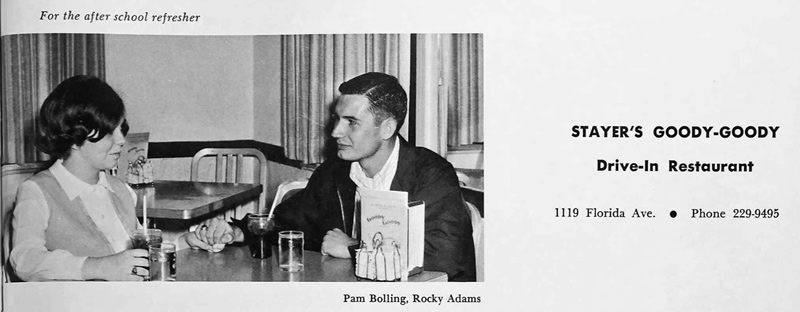
Sponsor ad in 1966 Chamberlain High School
yearbook
Some
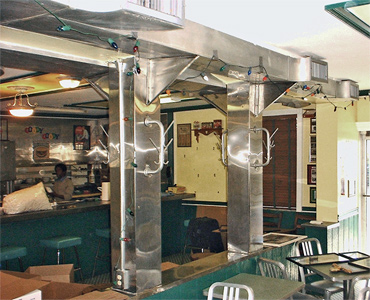
time between 1932 and 1941, the dining area was expanded at the front of the building.
This
partition marks where the building's original front wall facing Florida Avenue
was located.
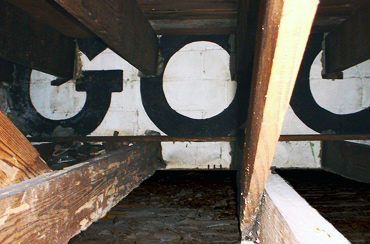
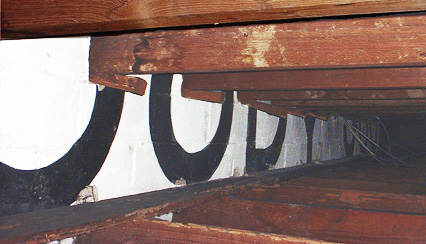
The original lettering on
the front of the building could be seen in the crawl space above the
dining area.
For a complete history of
Goody Goody from beginning to end, and more photos,
visit Goody Goody Family Tree
 Old
Days
Old
Days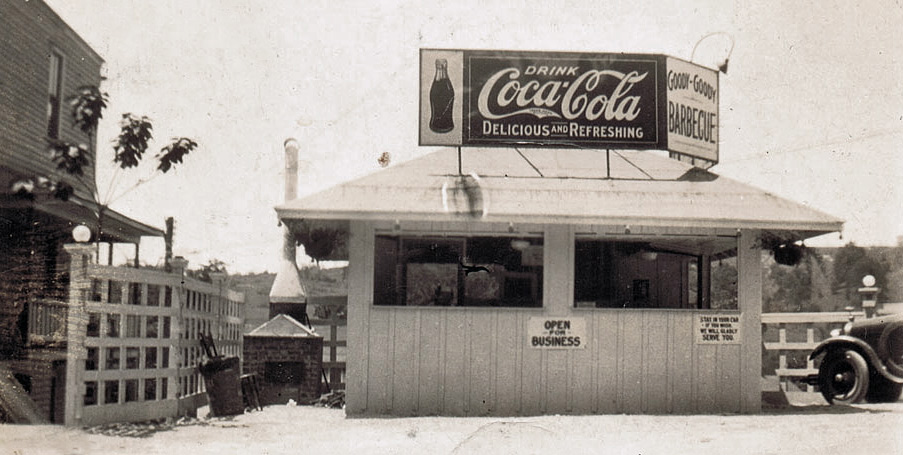
 *The
first ads Stephens placed in the Tribune were help wanted ads.
*The
first ads Stephens placed in the Tribune were help wanted ads.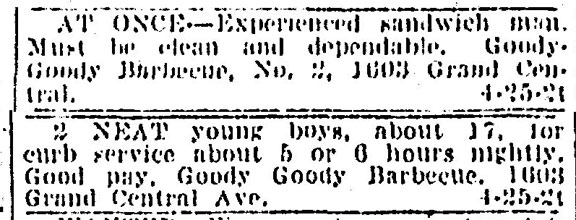

 Around 1927,
William sold his partnership in Carl Vander Voort Company and
decided to make a new start in Florida. At age 45, the
Pittsburgh story was over. His second marriage having failed,
he bought a grove and moved with his children to Winter Haven,
Florida. He stayed there for a few months and then
moved to Lakeland where he bought a 50-acre grove.
Around 1927,
William sold his partnership in Carl Vander Voort Company and
decided to make a new start in Florida. At age 45, the
Pittsburgh story was over. His second marriage having failed,
he bought a grove and moved with his children to Winter Haven,
Florida. He stayed there for a few months and then
moved to Lakeland where he bought a 50-acre grove.
 The
new downtown Goody Goody
The
new downtown Goody Goody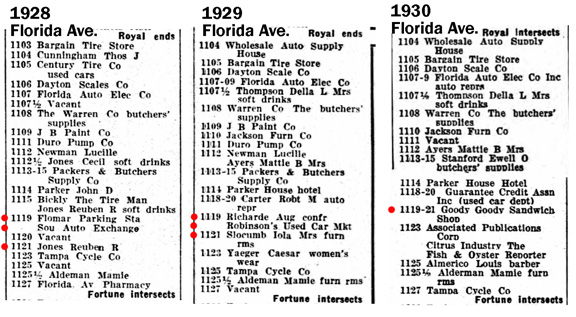

 Sep
17, 1933 ad* "Draft beer is at last GOOD," a reference to the end of
Prohibition
Sep
17, 1933 ad* "Draft beer is at last GOOD," a reference to the end of
Prohibition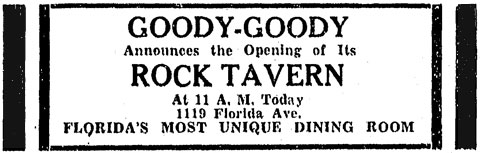

 our produce, the Garcia
Brothers,
our produce, the Garcia
Brothers,
 Victor and Gonzalo for our insurance, Joe Gagliardo at the
Florida Dairy, Poncho Gonzalez at Sealtest , Jose and Manuel Campoamor
and Rudy Ginex for Seafood. Above all, we enjoyed the Spanish Restaurants.
At the Spanish Park, as we came in from the parking area, Gus would seem
to be walking away from us but when he came to greet us and take our order
at the table , he already had our Martinis. Joe Valdes, the owner and his
wife, along with Gus were our personal friends. Also, the Las Novedades
and Cafe Seville on Howard Street."
Victor and Gonzalo for our insurance, Joe Gagliardo at the
Florida Dairy, Poncho Gonzalez at Sealtest , Jose and Manuel Campoamor
and Rudy Ginex for Seafood. Above all, we enjoyed the Spanish Restaurants.
At the Spanish Park, as we came in from the parking area, Gus would seem
to be walking away from us but when he came to greet us and take our order
at the table , he already had our Martinis. Joe Valdes, the owner and his
wife, along with Gus were our personal friends. Also, the Las Novedades
and Cafe Seville on Howard Street."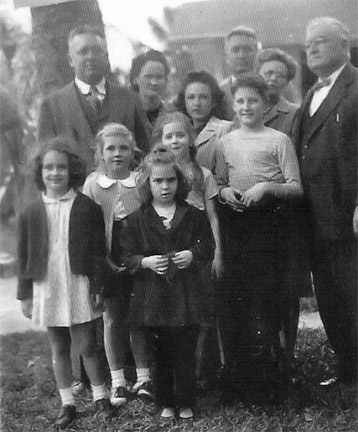
 William Mote, former Goody
Goody manager, recalls that there were big signs posted when he came to work in
1941: "No Tips, Please." The carhops were still young men,
and the going salary was 20 cents per hour.
William Mote, former Goody
Goody manager, recalls that there were big signs posted when he came to work in
1941: "No Tips, Please." The carhops were still young men,
and the going salary was 20 cents per hour. 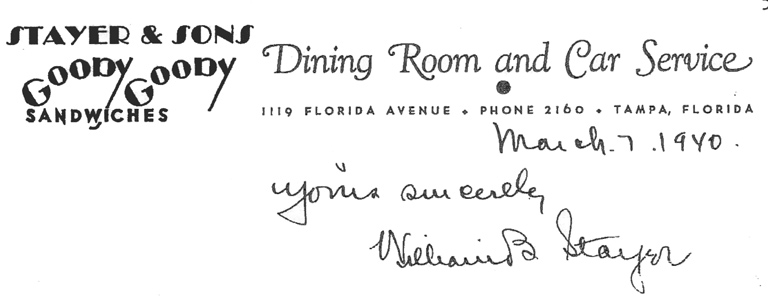
 About
the aluminum chairs
About
the aluminum chairs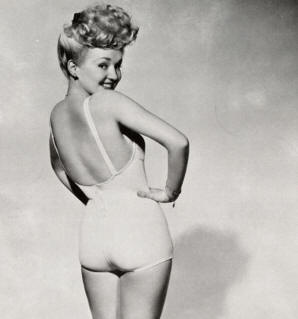

 "Our
small ads attracted attention with reverse appeals such as, We have
sold no Cuban sandwiches out of respect for Tampa’s Spanish restaurants.
We combined humor with a small advertising budget and came up with
business gains." When a man left his cane in the dining room, Carl
had a headline: Man comes in with cane and goes out without it. Must
have found new strength with our hamburgers.
"Our
small ads attracted attention with reverse appeals such as, We have
sold no Cuban sandwiches out of respect for Tampa’s Spanish restaurants.
We combined humor with a small advertising budget and came up with
business gains." When a man left his cane in the dining room, Carl
had a headline: Man comes in with cane and goes out without it. Must
have found new strength with our hamburgers.