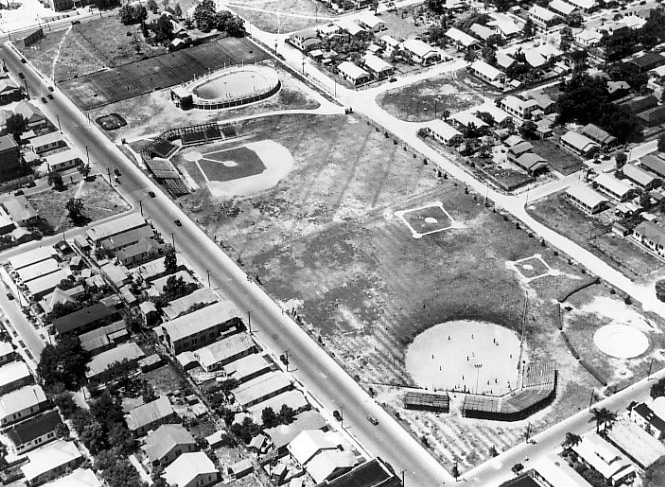
Cuscaden
Park in Ybor City is bounded by Columbus Drive on the south (upper left
corner of photo), E. 21st Ave.
on the north, N. 14th St. and N. 15th St. on the East and West.
From this park hail
some of baseball's greats, among them Al Lopez, Tony La Russa, Lou Piniella and
Tony Saladino. Tennis champ Judy Alvarez also played at Cuscaden as a youth.
|
|
Aerial view of Cuscaden Park
July, 1939
|
|
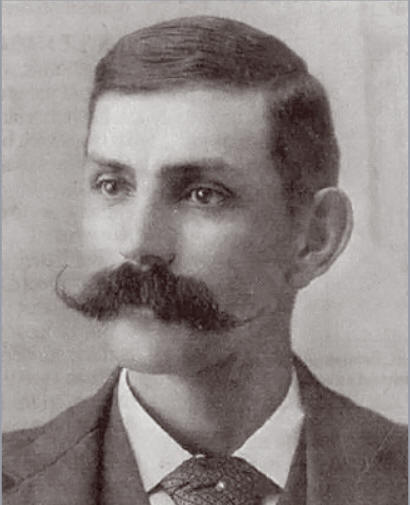
Arthur Weston Cuscaden
was born in 1859 in Ohio to parents Thomas W. Cuscaden and Marietta Mastick. Thomas was a highly-esteemed
physician in Warren County, Ohio and was well-known for being the
first resident homoeopathist in the county. |
City Council
President, June 5, 1902 – June 5, 1904
Born in Ohio on June 8, 1859, Arthur W. Cuscaden was a graduate
of Hiram College. He settled in Tampa in 1878 and planted one of
the first orange groves in the city. He remained active in the
citrus industry until his retirement. Cuscaden also worked in
the cigar business. He ran for mayor in 1906, but lost to
William H. Frecker. He served several terms as a member of the
county’s school board and he had a son named Arthur Cuscaden,
Jr., who also worked in the cigar industry. After his death in
1941, a park and pool in Ybor City was named in his honor. For
many years the park had served as a gathering place for cigar
workers in the neighborhood to play baseball, soccer and meet up
with their friends. The pool, designed by architect Wesley Bintz,
opened in 1937.
Bio and photo from "The City Council of Tampa and Celebration of
Old City Hall's Centennial
**The City of Tampa has removed
this publication from their
website,
BUT you can still read it and
download it here from TampaPix's
Dropbox folder.
|
 |
| |
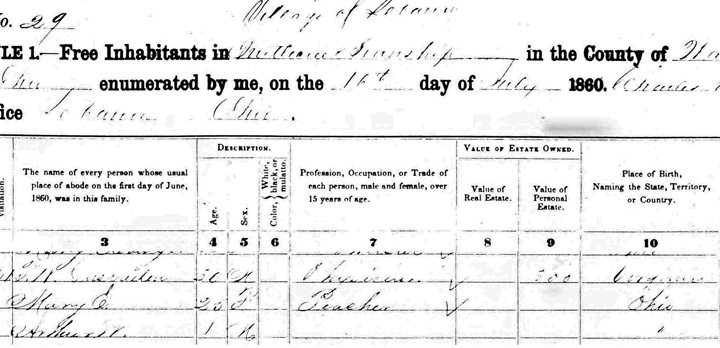
The 1860 Census of Lebanon,
Warren Co., Ohio shows T.W. Cuscaden age 30, Physician, born in
Virginia. Wife Mary E. (Mary Etta or Marietta) was age 25,
born in Ohio, Teacher. Arthur W. was 1 year old.
Arthur moved to Tampa
in 1878 and by 1880 was already in the business of planting orange
groves. In 1890, he married Frances Robles, daughter of Tampa
pioneers Joseph and Mary Ann Robles.

The 1880 Census of Tampa shows
Arthur Cuscaden age 20, single, occupation "Planting orange grove"
His 55-year-old neighbor, J. M. Fields, was in the same business and
was also from Ohio. It's possible they came to Tampa together
to start a business in producing oranges.

The 1900 Census of Tampa shows
Arthur living at 2507 Oak Street. His occupation is "Foreman"
and now his father's birthplace is listed as Ireland. It's
possible his wife gave the census info. Fannie A. is his wife,
Frances "Fannie" Alatha Robles, daughter of Joseph Robles and Mary
Garrison. Note Fannie lists her father was from Spain.
Children are Arthur W. age 8, Ernest age 5, and Walter age 10 mos.
Arthur's mother, Marietta Mastick Cuscaden, was the principal of the
first Hillsborough County High School in Tampa, 1882. Read
more about her here at "The
Eight Homes of Hillsborough High School."
Arthur Cuscaden planted some of Tampa's first orange
trees in the area and later donated his grove for the park that was named for
him. As a businessman, he was active in the cattle and citrus
industries. He was also active in politics, serving as mayor pro tem
during the James McKay administration, and serving on the City Council and
School Board for several terms.
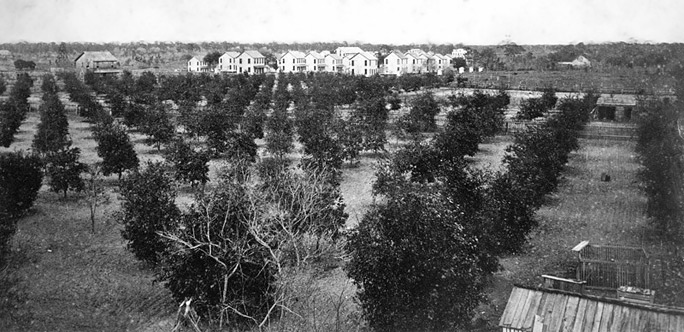
Cuscaden groves in Ybor City, 1889
|
THE BALLPARK
In the 1930s, Tampa began to climb out of the Great Depression with
several WPA projects that provided much-needed jobs to Tampans.
There were hundreds of projects, large and small; for women as well as for
men, for skilled professional people as well as unskilled day laborers.
The first WPA project was Peter O. Knight airport on Davis Islands. |
 |
|
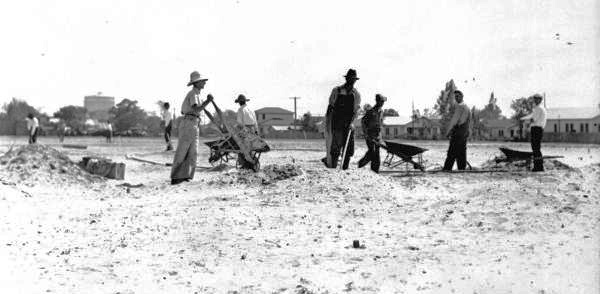
WPA workers
clearing land at Cuscaden Park, April 15, 1935 |
|
Among some of the other larger projects was the improvement of Bayshore
Blvd. and the seawall, repairs and improvements to the Tampa Bay Hotel,
grandstands and bleachers at Plant Park, a new armory (which was renamed
Ft. Homer Hesterly in the 1940s), new buildings and improvements at the
state fairgrounds, and construction of Cuscaden Park. Construction on the park was provided by workers of the WPA and took
place in April of 1935.
|
|
THE PLAYERS AT
CUSCADEN
For years, Cuban,
Spanish and Italian cigar workers flocked to Cuscaden Park to play baseball and meet
friends. Inter-Social, West Tampa, Cigar Factory, Tampa Smokers and Negro
leagues all played ball on the fields with Sunday double-headers pulling
in large crowds.
In 1938, the Inter-Social League began play at Cuscaden Park. It was
made up primarily of Latin players living in both Ybor City and West Tampa.
The League was comprised of about four to six teams such as the Latin Club, Centro
Asturiano, Cuban Club, Loyal Knights and the Italian Club, and were sponsored by well known mutual aid societies and social clubs of the same
name. The Italian Club team dominated the early years by winning
three of the first four championships.
|
|
 |
Many of the
players were Italians who went to military service by 1943. As
a result, the teams changed as did coaching and management.
Marcelo Maseda played for Centro Asturiano but took the manager role
with the Knights, but not for long. A new man named Louis Piniella
became leader. His brother-in-law, Joe Magadan, joined him. If those
names sound familiar, it’s because their sons became two of Tampa’s
most popular major league players— Lou Piniella and Dave Magadan. It
is probable that more professional baseball players came from the
Inter-social League than any league anywhere. A reasonable list
would be Al Lopez, Lou Piniella, Bucky De La Torre, Benny Fernandez,
Bitsy Mott, Faustino Casares, Manuel Seone, Joe Benito, Joe Moran,
Lou Garcia, Monty Lopez, Jesus Corrales, Roland Acosta, Fermin
Montes de Oca, Joe Tomlinson, Bob Dowling, Bob Lavendera, Lenny
Pecou, Jack Henry, Eloy Fernandez, Sam Sinardi, Mike Dominguez,
Ernest Rubio, Chelo Castillo, Sindo Valle, Raymond Rodriguez, Robert
Guerra, Chip Clemente, Indio Jiminez, Bobby Cline, Indio Prieto,
Peaches Hernandez, and Manuel Onis. |
|
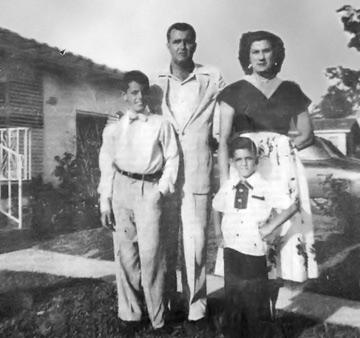
Louis Piniella Sr. and wife
Margaret Magadan Piniella, with sons Lou, Jr. (left) and Joe, 1955.
The Piniellas lived at 2723 Cordelia St. in West Tampa, across the
street from the softball field at Capaz Park that now bears his name. |
|
Their games were played on Sunday afternoons and, after lights were put
in some years later, on Thursday nights. The games were
extremely competitive and would draw as many as two thousand during
regular season and up to four thousand in the playoffs. Spectators
would take tin buckets to make noise with, bang on the tin—old tin cans,
old wash bowls and such, and had lots of fun doing so. While
the quality of play in this league and others like it was never assumed or
presented as being that of major league, it nevertheless provided good
baseball and served the purpose of detouring the minds of the local
citizenry away from the larger events at hand. The relaxation provided by
the game made the effort of returning to the job not quite as taxing. This
in itself, was a purpose well served.
|
Lou Piniella Was Born into Baseball
History of Baseball in Tampa
In Memory of Joe Magadan
|
In those days,
kids up to around fourteen or fifteen years old were allowed to go
in free, but the older folks had to pay a quarter. Even during
tough times, they always had a good crowd because all these clubs
were playing ball to see who would be the champion. On any
given Sunday, about 1,000 to 2,000 people showed up. Cuscaden Park
was a center of attention for all the kids in Ybor City, because at that
time it was the only park around, for a good two to three miles, so
everybody used to come to Ybor City to play ball, basketball, volleyball,
football, baseball, softball and basically any game with a ball.
|
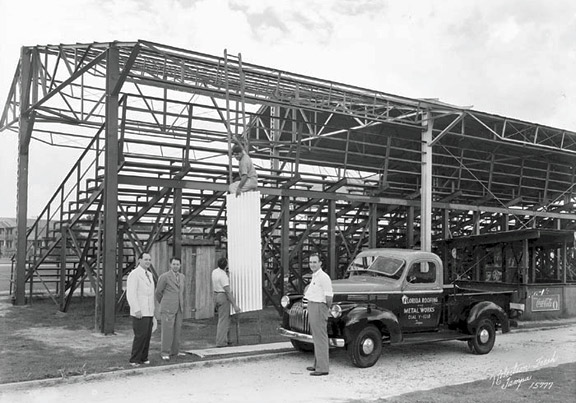
Roofing
construction on bleachers
at Cuscaden Park, Aug. 1941 |
|
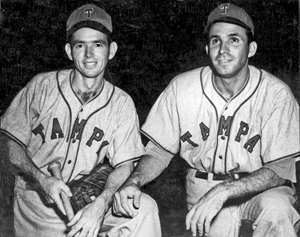 |
1951 - Joe Benito, left, and
Charlie Cuellar, right, were two integral players for the Tampa
Smokers baseball team in the 1940s and 1950s. Benito, an Ybor City
native and a veteran of the Inter-Social League in Tampa, had
numerous stints with the Smokers. A fan-favorite and the ultimate
utility player, Benito was usually signed when a player of any
position suffered an injury. He also put in time with several teams
in the Florida State and Florida International Leagues. Cuellar,
also a native of Ybor City, won 253 games as a minor league pitcher,
appearing on 15 minor league teams from 1935-1950. The hurler made
his mark with the Smokers by throwing a no-hitter on July 23, 1947,
at Plant Field against the Havana Cubans. Cuellar finally reached
the major leagues in 1950, throwing 1 1/3 innings for the Chicago
White Sox in what would be his only two games at that level.
|
|
The softball and baseball diamonds had bleachers, with a roof being
added to the baseball diamond bleachers in 1941, due to the popularity of
the games and the large crowds. It is believed that Tony Provenzano
was the park's first director. |
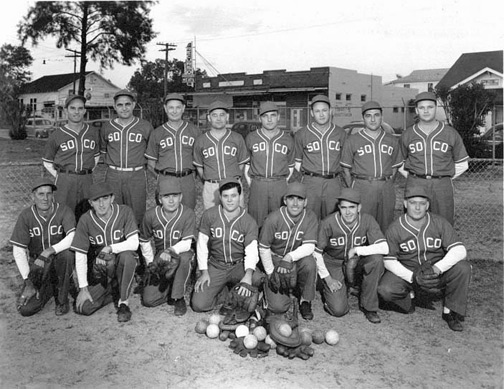
Standard Oil Co. softball team,
Cuscaden Park, 1949
|
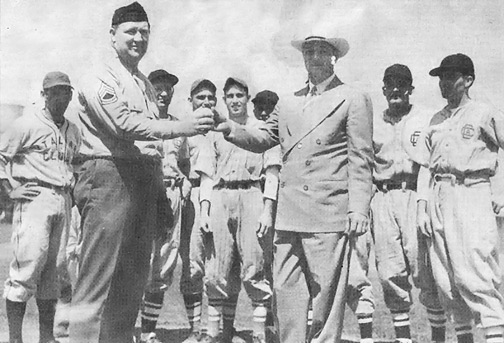 |
Sgt. McGaughin
hands the first baseball of the Intersocial League season to league
president Antonio Castro. Castro served as league president
for 5 years in the 1940s.
Far left is Mickey Hernandez of
the Italian Club team. In the background are members of the
Centro Asturiano team, including brothers Manuel and Benny Fernandez
who went on to play professionally with the Tampa Smokers. |
| |
 |
BOXING AT CUSCADEN ARENA
In the 1940s, the park was home to Cuscaden Park Arena, where boxing
enjoyed its biggest revival in years on Florida's west coast.
In July of 1942, for example, a featherweight match featured Sixto Morales
defeating Joe Ackerman on points at Cuscaden Arena. On July 17,
1942, Matt Perfetti, a New York lightweight with the Army at MacDill
Airfield, outpointed the lesser experienced but promising Al Fern, a Tampa
southpaw featherweight, at the Cuscaden Park Arena. After the match,
Bill "Pop" Stoufer, manager for Red Hutchins, St. Pete's claimant to the
Southern Featherweight Championship, announced a challenge by Hutchins to
meet Perfetti in the ring. Hutchins was quoted in a local paper as
saying, "I'll take that guy in short order. He looks fat around the
middle and too slow and that is just my dish." |
 |
|
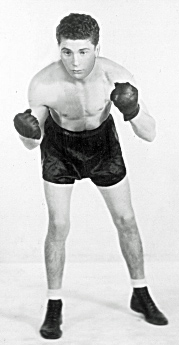
Matt
Perfitti, 1940 |
|
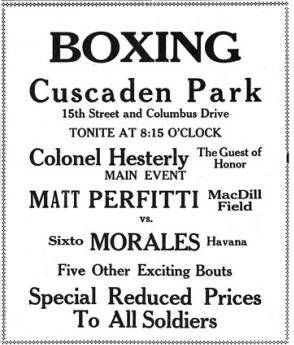
July 24,
1942 promo in Drew Army Airfield's weekly newspaper, "Drew Echoes" |
|
Other matches held at the Cuscaden Arena drew some 2,500 spectators,
and were promoted by Jim Downing. Soldier Roger Goss, a welterweight
punched out a decision over Red Bryan, Plant City lightweight, in a
semi-final. Buster Carroll, bald veteran, played with Max Pixley,
Drew Field welter, for eight rounds and though it seemed he had a
clear-cut edge, judges called it a draw. Soldier Al Stinson, another
Army welter, outpointed Al Jimenez. In the same week, the Army put a crimp in Jim Downing's plans to
feature armed services boxers on regular weekend cards at Cuscaden when it
ruled against servicemen fighting for pay. |
|
POLITICS AT CUSCADEN PARK
On October 2, 1950,
Senator Eduardo R. Chibas, candidate for the presidency
of Cuba under the Partido Ortodoxas appeared at a meeting of Ybor City cigar
workers held at Cuscaden Baseball Park. The podium was decorated with Cuban and
American flags. Chibas opened his speech in memory of José Martí, extolling his
efforts in Tampa on behalf of Cuba Libre.
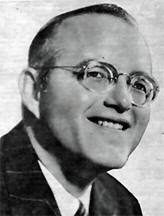 The
Ortodoxas party he started was the "party of the common people, who were
being robbed by the corrupt political pirates." His friends called him "Escobita"
(Little Broom), which was also the emblem of his party and reflected his
obsession to sweep corruption from public life. In his Ybor City speech he
declared that he stood for a "better nation, without thieves and without
traitors to the ideals of José Martí." Chibas related that Mrs. Soriano, a
member of the O'Halloran family of Tampa, had loaned him Jose Marti's gold
ring to wear that memorable evening. She also owned the chaveta, a knife
used to make the cigar that carried the order to start the revolution of
1895, and the pistol that General Maximo Gomez had given to Martí for his
own protection. Chibas informed the public, "I have gold in my hand but
it's not the gold of the people of Cuba, it's the gold ring that belonged
to José Martí, the apostle who found hearts and minds in Tampa which
blended with his." Mrs. Soriano promised that if Chibas lived up to his
promise to implement into practice the ideals of José Martí when he became
president she would give him the precious ring to keep. Chibas responded,
"If I falter in my duties as president, if I fail to reconstruct the
political morals of Cuba, then I expect the noble lady who owns the
precious memento of Martí to send me the pistol to punish myself for not
keeping a sacred promise to the people of Cuba." The
Ortodoxas party he started was the "party of the common people, who were
being robbed by the corrupt political pirates." His friends called him "Escobita"
(Little Broom), which was also the emblem of his party and reflected his
obsession to sweep corruption from public life. In his Ybor City speech he
declared that he stood for a "better nation, without thieves and without
traitors to the ideals of José Martí." Chibas related that Mrs. Soriano, a
member of the O'Halloran family of Tampa, had loaned him Jose Marti's gold
ring to wear that memorable evening. She also owned the chaveta, a knife
used to make the cigar that carried the order to start the revolution of
1895, and the pistol that General Maximo Gomez had given to Martí for his
own protection. Chibas informed the public, "I have gold in my hand but
it's not the gold of the people of Cuba, it's the gold ring that belonged
to José Martí, the apostle who found hearts and minds in Tampa which
blended with his." Mrs. Soriano promised that if Chibas lived up to his
promise to implement into practice the ideals of José Martí when he became
president she would give him the precious ring to keep. Chibas responded,
"If I falter in my duties as president, if I fail to reconstruct the
political morals of Cuba, then I expect the noble lady who owns the
precious memento of Martí to send me the pistol to punish myself for not
keeping a sacred promise to the people of Cuba."
Eduardo Chibas' funeral
procession in Havana, Aug. 17, 1951
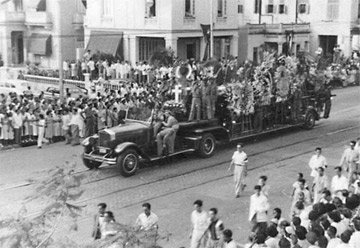 On
Sunday, August 5, 1951, Chibas addressed the Cuban nation over CMQ radio
network. This would be his last verbal broadside aimed at the corrupt
administration of President Carlos Prio Socarras. His last words to the
people of Cuba were for them to "forge ahead for independent, economic
freedom, political liberty and social justice! Sweep the robbers out of
government! People of Cuba, awaken and arise! This is the last time I
will knock at your door!" He punctuated his last statement with a pistol
bullet to his body. He died a few days later. Thousands upon thousands
followed the funeral cortege to
Colon Cemetery in Havana.
The August 26 issue of Bohemia magazine was dedicated to the life of
Eduardo Chibas. A full-page photograph standing before the
statue of José Martí
in Ybor City was placed in his coffin. The cutlines under the
photograph stated that Chibas had made sensational declarations before
the Martí statute and that he was disposed to end his life if he failed
to rid the government of corruption. On
Sunday, August 5, 1951, Chibas addressed the Cuban nation over CMQ radio
network. This would be his last verbal broadside aimed at the corrupt
administration of President Carlos Prio Socarras. His last words to the
people of Cuba were for them to "forge ahead for independent, economic
freedom, political liberty and social justice! Sweep the robbers out of
government! People of Cuba, awaken and arise! This is the last time I
will knock at your door!" He punctuated his last statement with a pistol
bullet to his body. He died a few days later. Thousands upon thousands
followed the funeral cortege to
Colon Cemetery in Havana.
The August 26 issue of Bohemia magazine was dedicated to the life of
Eduardo Chibas. A full-page photograph standing before the
statue of José Martí
in Ybor City was placed in his coffin. The cutlines under the
photograph stated that Chibas had made sensational declarations before
the Martí statute and that he was disposed to end his life if he failed
to rid the government of corruption.
Sarasota
Herald Tribune, Aug. 6, 1951 "Cuban Senator Shoots Himself"
Read this 2013 story by Paul Guzzo on the whereabouts of Jose Marti's
pistol, gold ring, and chaveta.
|
THE
CUSCADEN PARK POOL
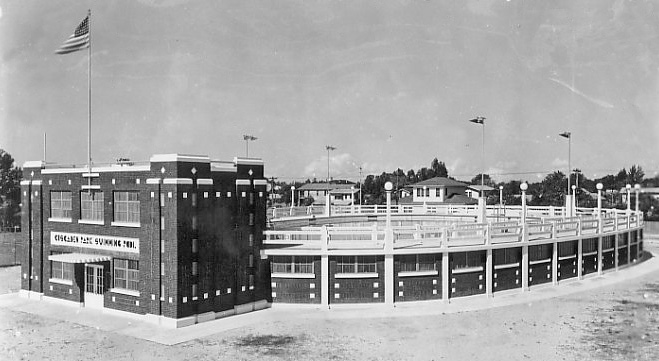
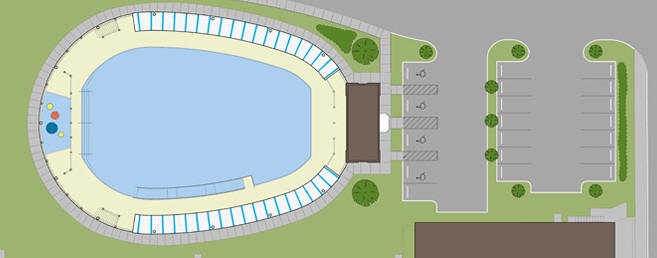
In 1937 the city
built the above-ground, oval pool on 15th Street through the Works
Progress Adm. of Pres. Franklin Roosevelt.
Designed by architect Wesley Bintz, Cuscaden is one
of the few remaining Bintz pools in the country. The two-story red-brick
facility now has lockers and classrooms on the first floor. A promenade
offers vistas of the V.M. Ybor neighborhood and Ybor City.
Cuscaden Park public swimming
pool, May, 1939
To thousands of Tampa tots, summer wasn't summer without the Cuscaden
Park Swimming Pool. They swam, splashed and soaked up the sun, relishing
the area's only public pool. Many took lessons to refine their strokes.
Others just learned to stay afloat. Over the years, countless children at the
Ybor City Boys & Girls Club took their first strokes at the Cuscaden Pool.
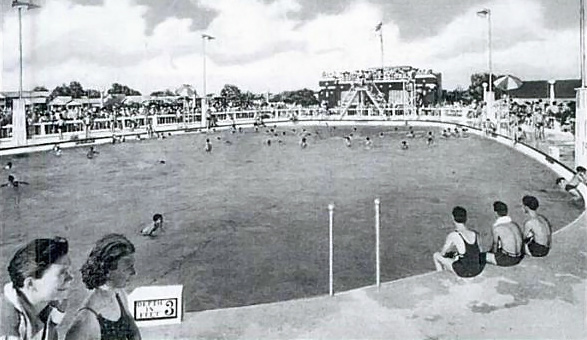
In the old days, there was a small admission charge to swim in the
pool. Max Castro (who later on became an optometrist), friend of
Agustin "Marty" Martinez, used to be one of the lifeguards. Every so often they
had to empty the pool, to clean it, and
whenever they did that, Marty and his friends at the pool had a dance. Manny de Castro, who’s a Filipino
and was retired from the Navy, had a bunch of guys who had a band, a Filipino
band, and when the pool was empty, he would bring the band to the pool and the
would have a dance party.
Cuscaden Park
public swimming pool, 1940s
On Aug. 20, 1943,
Drew Army Field soldiers put on a spectacular show at Cuscaden pool. The
surface of the pool was covered with gasoline, ignited, and when the
entire surface was ablaze, forty-five Drew soldiers dove through the flames
and swam under water to the opposite end of the pool, where they
demonstrated how to break through flames without being burned.
The pool closed in August 1997 due to leaks and old age and sat unused
for several years. When the pool closed, the city considered turning
it into an inline skating rink, but some community members balked. Even
Mayor Dick Greco, who spent part of his youth in Ybor City, pushed for the
pool. In 2002, it
was ready for revival. The city of
Tampa set aside about $3-million to restore the 1937 pool to its
original glory. It was an expensive job -- a new pool costs about $1-million --
but worth the trouble, local leaders said. "Those of us who have lived in Tampa a
long time learned to swim there," said Wayne Papy, the city's recreation
director. "It will become a focal point for the neighborhood." First, the city
intended to declare the Cuscaden pool a local landmark. The issue went to
the Historic Preservation Commission on Aug. 13, 2002, then to the City
Council in September.
Like the Roy Jenkins Pool on Davis Islands, the Cuscaden Park pool has
bathhouses around the perimeter below the deck. Its red brick and
blue and white trim give it a stadium feel. Geometric lettering on
the front adds Art Deco flair. Funding for the project came
from Community Investment Tax money and a $1-million federal grant from the
Urban Park and Recreation Recovery program. The city renovated the
entire structure, replacing the leaking liner and adding community meeting rooms. When finished, it will look brand new, Papy said. Construction
was to be started in 2003 and were completed in 2005. The plan
followed the pool's original design, which did not have a drain system
around the facility's outer walls. During heavy rainfalls, water
overflowed and collected on the deck, leaking into rooms below.
In May of 2010, after more than six years following the 3 million
dollars worth of local and federal tax money to restore the pool, the
Cuscaden Pool will be closed this summer while city officials decide what
to do about leaks at the historical swimming facility.
The pool is not all that will be empty this year. The baseball fields eventually gave way to two soccer fields.
Although the
playground and ball fields will be open, the city plans no summer
youth programs, which in part rely on
classrooms on the first floor below the raised pool. Enrollment in
after-school programs dropped significantly when the city raised
its recreation fees in October.
Tampapix Home
|