Real Florida
Tower of terror
The crew hired to clean up the Sulphur Springs Water Tower was
ready for almost anything creepy, crawly and potentially poisonous
that it could imagine. The moving ceiling was a bit surprising,
though.
By JEFF KLINKENBERG, Times Staff Writer
© St. Petersburg Times
published July 13, 2003
 |
|
[Times photos: John Pendygraft]
|
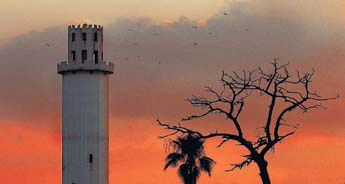
The
sun sets behind the Sulphur Springs Water Tower in north Tampa. It
was built in 1927 as a centerpiece for an amusement park and a
community along the Hillsborough River. Closed for decades, the
city bought it last year and is making it part of a park.
|
 |
| Inside the
tower, Oscar Gomez of Cornerstone Abatement & Demolition of
Tampa puts on protective gear, including a mask, to clean up the
inside of the tower. The main job of the three-person crew was to
get rid of the pigeon droppings. |
|
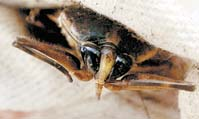 |
Meet
one of the tower’s recently evicted residents, a giant water bug
whose fang injects venom.
|
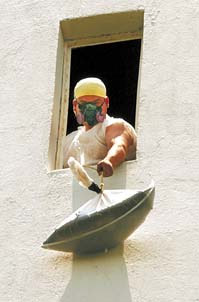 |
Oscar Gomez
lowers a plastic bag filled with pigeon droppings and debris from
the fourth floor of the 214-foot tower.
|
TAMPA - Everybody is in favor of history these days. Politicians,
bureaucrats, archaeologists, teachers, park managers all want to
preserve historic buildings. Nature, however, has different ideas. Wet
things, pop-eyed things with antennae, black things with crunching
mandibles care only about eating and sleeping. An old building is bacon
and eggs to nature. A dark corner in a dilapidated structure is better
than a luxury suite at the Ritz.
The other day, when Rafael Morales looked at the Sulphur Springs
Water Tower, he had a lot on his mind. One thing was the logistics of
breaking into a tower sealed shut for more than a decade. Another was
what he might find and what he would have to do once he broke in.
"It's going to be a challenging job," he said.
Rafael Morales, 46, is the taciturn, sad-eyed operations manager of a
Tampa business known as Cornerstone Abatement & Demolition. Morales
is expert in asbestos removal, lead abatement, mold remediation and
demolition. He is one of those men who can do just about anything with
his hands, who can improvise a solution to a technical problem in the
blink of an eye.
Every once in a while he has to go nose to nose with nature. He grew
up in Mexico, home of the tarantula spider, which prepared him
psychologically to work in Florida, where nature often arrives with
hairy leg or dripping fang, or humorously feels compelled to fly
directly at a man's face in the dark.
Nature can be dangerous, but just as often, it is merely gross.
The job at the Sulphur Springs Water Tower probably should have gone
to the Crocodile Hunter or somebody even braver. Instead, it fell upon
the shoulders of Morales and his crew.
Good thing they don't scare easily.
A dreamer's vision
What was living inside the tower? Well, for a start, Morales had been
warned about the pigeons. Though the tower's ground floor had long been
sealed, the open windows of the upper floors had allowed anything with
wings to get in. Pigeons eat, and what goes in one end comes out the
other. Their mess required cleaning. But pigeons were just half of it.
On the sealed-off ground floor some real Edgar Allan Poe stuff was going
on.
More about that later. First, a little history.
The old tower is probably the best-known, least-known landmark in the
Tampa Bay area. Anyone who drives along Interstate 275 through the north
part of the city notices it. Yet few people except old-timers know the
history of the edifice at the corner of Florida Avenue and Bird Street.
It was built by a dreamer and schemer named Josiah Richardson in
1927. He was in the process of creating a kind of amusement park and
community along the Hillsborough River when it dawned on him that he'd
need a dependable supply of water.
He disdained ordinary, and he disdained cheap. Instead of a typical
Florida water tower - metal legs, a big bulb at the top - he built a
tower that more resembled a lighthouse or a medieval castle. His
construction crew excavated 45 feet straight into the rock, down to a
spring, for the foundation. Above the ground the tower rose 214 feet.
The whole shebang cost $180,000, a fortune in Roaring '20s Florida.
Richardson also put up a sprawling shopping arcade that in some ways
was Florida's first mall. He built a huge water slide, a bathhouse and
an alligator farm. He built a hotel and tourist cottages. "It was
the Coney Island of Tampa," says University of South Florida
history professor Gary Mormino.
From miles away the tower was visible. Tourists and residents
purchased thousands of postcards of its likeness to mail to snow-bound
Northerners. The stuff of Florida dreams, the tower seemed almost worthy
of a Stephen Foster melody.
The dream turned sour when a flood overwhelmed the park in 1933. The
Depression killed tourism. Then came the war. Richardson lost his
fortune and just about everything else. Decades later, the interstate
cut through the property, forever dividing the community. The shopping
arcade was bulldozed to make way for a dog-track parking lot. Richardson
died, and Tampa moved on.
But the tower remained.
No longer a tourist attraction, it became a make-out spot for
teenagers. They scrawled graffiti, drank beer and smoked pot.. A
couple of kids climbed to the top but were afraid to climb down. The
fire department had to rescue them.
A high fence was built around the property. Workers sealed tower
doors with concrete.
The enemy has wings
Rafael Morales is a talented man, but unlike a bat, unlike a pigeon,
unlike a palmetto bug, he has never learned to fly. If he were going to
break into the tower and do his job, he couldn't fly through the upper
windows. He would have to go through the ground floor the hard way, with
sweat and muscle, saw and jackhammer.
Last year the city of Tampa bought the tower, and 13 acres around it,
from McDill Columbus Corp. for $2.85-million. One day the property will
be part of the Sulphur Springs Park and connect public land on both
sides of the interstate. The park likely will include picnic shelters,
barbecue pits, hiking paths, a fishing dock and maybe access to the
tower. If nothing else, lights will be installed soon and the tower will
be visible all over north Tampa.
A while back, a brave urban planner named Tom Johnston, who wanted to
inspect the property, hired a cherry-picker truck to help him get into
the tower. He entered through a third-floor window. There is no
elevator, so he had to climb a wormy, rotting, 76-year-old ladder.
Even worse was the powdery stuff covering floors and window sills.
For decades, pigeons had been using the tower for a hotel - and a
toilet.
"I just wanted to see what we were up against," Johnston
said.
He saw, gulped, and he left. Later, he got heat from his boss, who
told him he had done something foolish. "Don't go up there
again," the boss said. "Old ladders are dangerous. And pigeon
droppings can make you sick."
His boss wasn't joshing. A yeast found in pigeon droppings,
Cryptococcus neoformans, is especially unpleasant when inhaled.
According to Fundamentals of Microbiology, "should the cells get
into the bloodstream and localize the meninges (covering the brain and
spinal cord), piercing headaches, stiffness in the neck and paralysis
could occur. If left untreated, this infection may be fatal."
That's how Rafael Morales ended up with the job. He and his crew were
hired guns. Before history could be preserved, nature had to be run out
of Dodge.
First, scare away the pigeons. Next, clean up their poop. Third, make
the place safe for future work crews. Sounded easy enough.
Breaking through
John Penvose is Rafael Morales' boss and owner of Cornerstone. They
started together in Houston about two decades ago and moved to Florida.
They do a lot of demolition work. Usually, they do inside jobs; that is,
they enter an old building through an old-fashioned door and remove
crumbling, rotting stuff so the place can be renovated.
"Every job is different," Penvose said. He is 54 and has
seen the insides of buildings so dilapidated, they would make his hair
turn gray if he had more of it. "Lots of rats. Snakes. One time I
was in an old building and a cat suddenly hissed in my face. That
doesn't sound like much, but I didn't know it was there, and it scared
me to death. Even worse is going into an old building, throwing open a
door and looking into the eyes of some transient person just standing
there. Well, that shouldn't be a problem here."
Only Superman could have found his way into the Sulphur Springs
tower.
Morales nodded to his two helpers, Oscar Gomez and Manuel Hernandez,
who picked up a big electric saw and attacked the sealed doorway. The
plaster flew, and they dripped with sweat. The plaster settled on their
wet skin until they looked like ghosts.
Next they picked up an 80-pound jackhammer too heavy to be used by
one man. Together they hammered at concrete that yielded grudgingly.
Every few minutes they had to take a break to catch their breath and
rest for the next task.
Gomez and Hernandez, who are in their 20s, are robust young men who
enjoy their food. They are built like Babe Ruth and swing sledgehammers
like the Babe, too. Bang! Bang! Concrete fell away in large chunks.
"The Devil Rays could use them," Morales said. "They
are sluggers."
The last few paragraphs probably took about 30 seconds to read. In
real life, opening the entrance to the tower took four hours. Work.
Rest. Work. Dragonflies grabbed mosquitoes, and wasps hovered, and every
once in a while, a frog would croak from the nearby river. Then the
jackhammer would start all over again.
Eventually, the jackhammer broke through, and musty air poured out of
the hole. Peeking through the hole, Oscar Gomez was careful not to put
his eye too close just in case a mummy reached out for his throat.
The ceiling lives
They got inside. It was dark and damp. The walls wept with humidity,
and faint scraping noises came from the darkness. But more about that
Blair Witch Project stuff later.
Their main job, after all, was to remove pigeon droppings from the
seven levels above. They carried in ladders and floor by floor worked
their way up the tower. They wore white coverall suits and masks. For
hours they shoveled pigeon droppings off floors and used powerful
vacuums to suck up anything they missed. They filled heavy plastic bags
with droppings and lowered the bags by rope through the windows to the
ground. The bags were trucked to Dumpsters, and the Dumpsters were
trucked to landfills.
"It's not fun," Oscar Gomez said. "But it wasn't
terrible."
What was terrible was the ground floor. That had to be cleaned, too.
The ground floor, windowless and dark, was wet and slippery like the
inside of the Nostromo in that Alien movie. In the middle of the floor
was a well, connected to the spring. In a flashlight beam, the water in
the well looked surprisingly clear, though filled with debris, bottles
and shoes and heaven knows what else. Something moved near the bottom.
How did an eel get in there? Who knows? Had it come up through the
spring? Who knows. What was it eating? Easier to explain.
The walls were black with scum. The floor was worse. "What is
this stuff?" Rafael Morales said, staring at a floor that seemed to
be covered with old coffee grounds. Morales aimed his flashlight at the
ceiling above.
The ceiling was moving. That is, the ceiling seemed to have a life of
its own. Morales, who has lived in Florida long enough to be brave when
confronted by lizards, frogs and the occasional garden snake, looked
alarmed.
In the flashlight beam danced many cockroaches. Not one or two, but
dozens, hundreds, maybe thousands. It was hard to tell in the dim light.
They covered parts of the walls and the ceilings, and the pipes and the
corners. They hated light. From time to time a big cockroach fell from
the ceiling and flew off into the dark.
Everybody ducked.
"Well," Morales whispered, "now we know what's in
here."
Now he knew the origin of the coffee grounds at his feet. Cockroach
droppings.
"Time to leave."
Outside, Morales and his macho workers giggled and wiped their boots
on the grass, on rocks and on corners of the building for a long time.
Then they wiped their boots again. Shuddering, they spoke of the long
showers they were going to take when they got home.
Later Morales drove to a Home Depot and walked to the pesticide
aisle. He filled his cart with 8 cans. Late in the afternoon, he
returned to the tower and placed the bug bombs inside the tower and set
them off.
The next morning all the roaches were dead. But nature, as Morales
knows, doesn't give up without a fight. As workers swept up cockroach
bodies, other things emerged from corners, still alive and kicking.
Somebody trotted out carrying something wrapped in cloth. It was
large and black and ominous.
A giant water bug, it was the notorious Hemiptera belostomatidae,
also known as the toe-biter. They have pincers and a fang that injects
venom into their victims, often minnows, frogs and, of course,
cockroaches. The fang was dripping. In the tower, in the dark, fetid
atmosphere of the ground floor, giant water bugs had discovered their
own delicatessen.
"Ah, nature," Rafael Morales said.
Sometimes nature is Bambi and Thumper. But that's in the forest
primeval. In a city, in a historic building, in the dark shadows, nature
often is less cuddly.
 |