|
V. |

Dale Mabry -
Seventh child of Milton H. Mabry, Sr. & Ella Dale Bramlett
MILTON H. MABRY,
SR.
At the
close of his term as Lt. Governor in 1889,
Milton H. Mabry turned his entire attention to his law practice in
Leesburg, Fla. With no
thought of again holding public office, Milton Mabry withdrew
from the political arena to spend the remainder of his
days in quiet, unostentatious retirement of a country
life at his home in Leesburg.
In May 1890, Milton
Mabry began having a large ten-room home built on a hill overlooking Dade City
in Pasco County.
Later that same year, he was nominated for a
position on the Florida Supreme Court and
winning election in Nov. 1890 he began service
on the Court in Jan. 1891. The Mabrys
moved to
Tallahassee, but still maintained their
home in Dade City.
Dale Mabry was
born Mar. 22, 1891 in Tallahassee during his
father's first term as Supreme Court justice.
In 1894, Dale's sister, Eloise, was born in
Tallahassee.
DALE MABRY'S EARLY LIFE AND EDUCATION
At the end of Milton's first term
of Supreme Court justice in 1897, Dale was of
age to begin primary school and the Mabrys
settled at their new Dade City home where Dale and
two brothers attended Pasco County primary
school. In Oct. 1896, Milton Mabry won a
second term on the Supreme Court and began this
term in Jan. 1897. He continued to travel
between his home in Dade City and his
Tallahassee residence when the court was in and
out of
session.
|
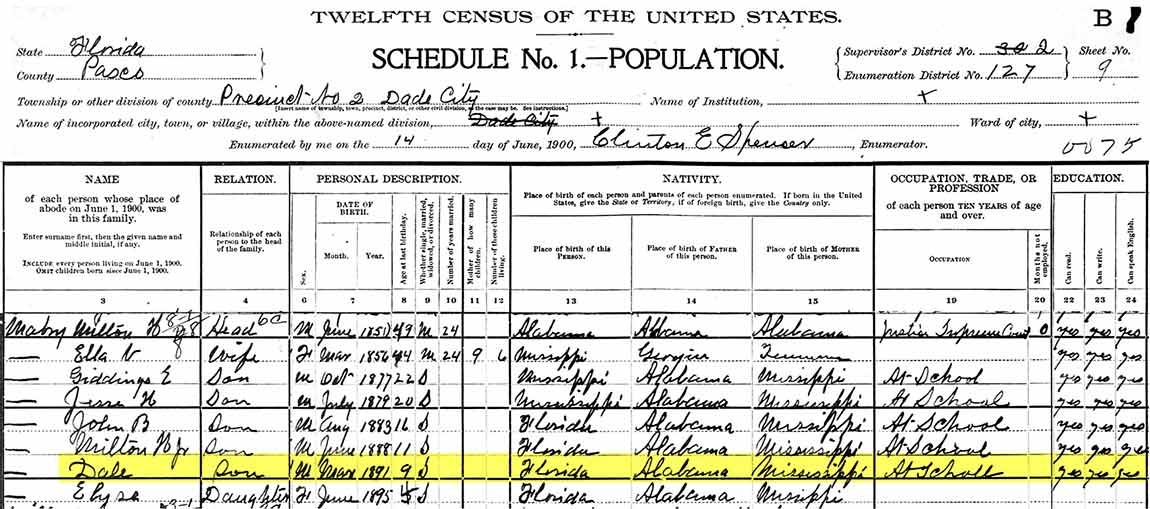
1900 CENSUS, DADE CITY, PASCO
COUNTY, FLA.
|
Dale was
9 years old and attending school. Below him,
"Elyse"
was Eloise, the Mabrys' only surviving daughter.
THE MABRYS MOVE TO TAMPA
In 1903, Milton,
having declined running for a third term on the
court, decided to join his son Giddings in
private law practice in Tampa. Milton, wife Ella. and children Dale
and Eloise
moved to a home on
Bayshore Blvd,
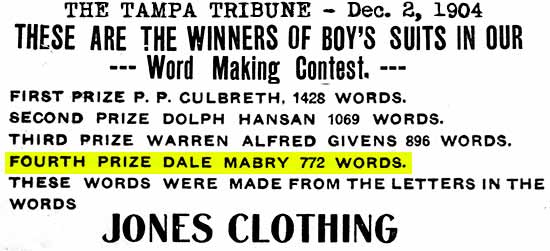
At age 13, Dale
placed fourth in a contest to make as many
words as possible from "JONES CLOTHING"
MOVE TO
TALLAHASSEE
Upon the death of Dale's
mother in Feb. 1904, Milton decided to leave Tampa
and serve as Clerk of the Supreme Court in
Tallahassee, beginning his term on Mar. 31, 1905. Moving there
at about age 14 with his
father, they vacationed for the summer at
Newport News, Va., where Dale's older brother,
Dr. Jesse Hughes Mabry, lived. They returned to Tallahassee
in Sep. 1905.
Dale continued his education at
the Leon Academy where he was a member of the
Debating Society.
In Nov. 1906, Milton
married Irene
Washburne.
DALE'S MILITARY
EDUCATION
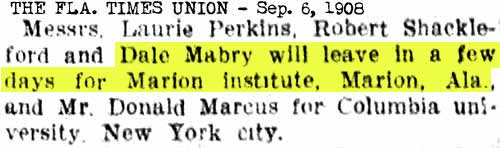
Dale then entered the
Marion Military Institute in Marion, Ala. at the age of
17 in Sept. 1908.
After a year, he
returned to Tallahassee where he became a
clerk at the Capitol building and
according to many newspaper articles, lived the life of a socialite attending
parties, dances, contests and various other social events.
|
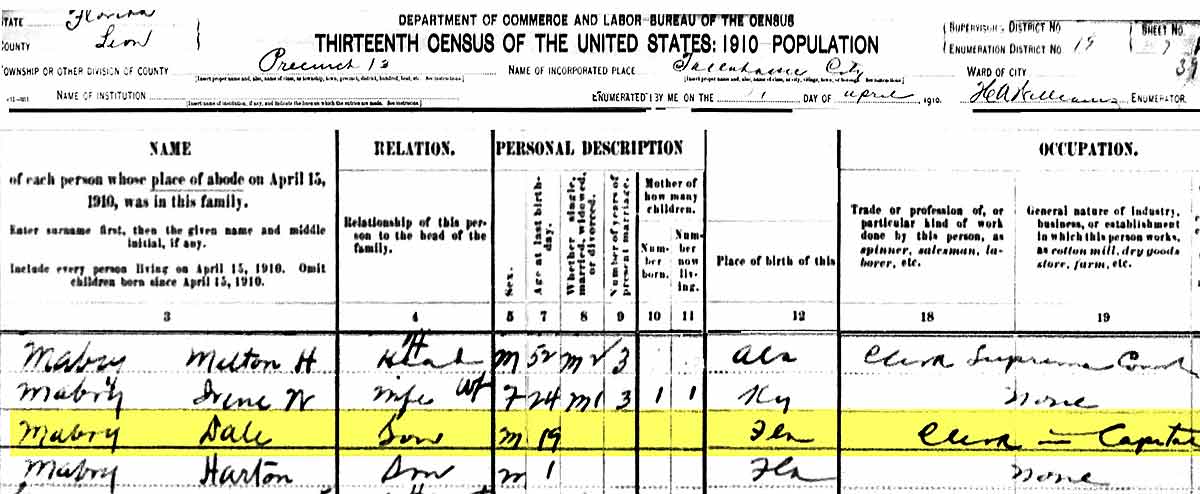
1910 CENSUS, TALLAHASSEE,
LEON CO., FLA.
|
Dale was 19 and
working as a clerk at the Capitol building The Mabrys were
living about three blocks north of the State Capitol.
Milton was recorded as being 52, but he was actually 59
to
turn 60 next month. This was his second marriage,
indicated by the "M2," and his occupation was Clerk, Supreme Court.
Irene was recorded as 24, but she was actually 38. Her
tombstone shows she was born March 28, 1872. This was Irene's first marriage, mother
of one child, one living. Milton & Irene's son Harton was
1 year old.
|
|
DALE MABRY HIGHER EDUCATION
An Oct. 9, 1910 Florida
Times-Union (Jax) article printed in its "Tallahassee News"
section, reported "Mr. Dale Mabry, son of Hon. M. H. Mabry, left a
few days ago to enter Poughkeepsie." This
was the Riverview Military Academy at
Poughkeepsie, NY, where he would have prepared for a career in business.
|
|
Photos and info below are
from
No Longer Standing: Buildings of Poughkeepsie –
Gone But Not Forgotten: Riverview Military
Academy by Shannon Butler at
POUGHKEEPSIE PUBLIC LIBRARY
DISTRICT
where there are more photos.
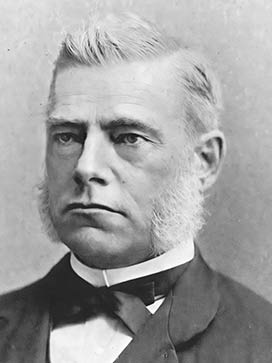
Riverview Military
Academy was one of two schools that popped
up after the closure of Charles Bartlett’s
Poughkeepsie Collegiate School.
Otis Bisbee,
former teacher at the Collegiate School, decided in
1867 to begin a school that would give an
excellent education, grounded in military
tradition.
Otis Bisbee photo courtesy of Toni Couch
Ryan,
Find-A-Grave.
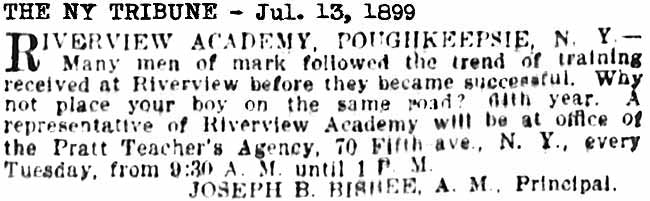
Otis Bisbee died in 1885 at age 62,
Joseph Bartlett Bisbee was his son
and a
grand-nephew of Charles Bartlett.
These photos are
undated.
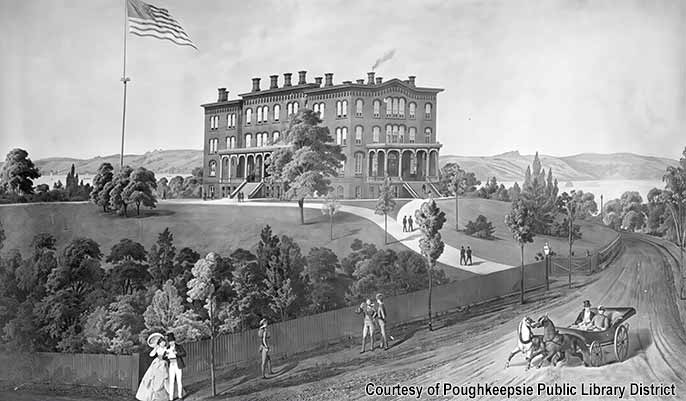
The building
was designed by
J. A. Wood who was famous
for his hotels, armories, and alms houses.
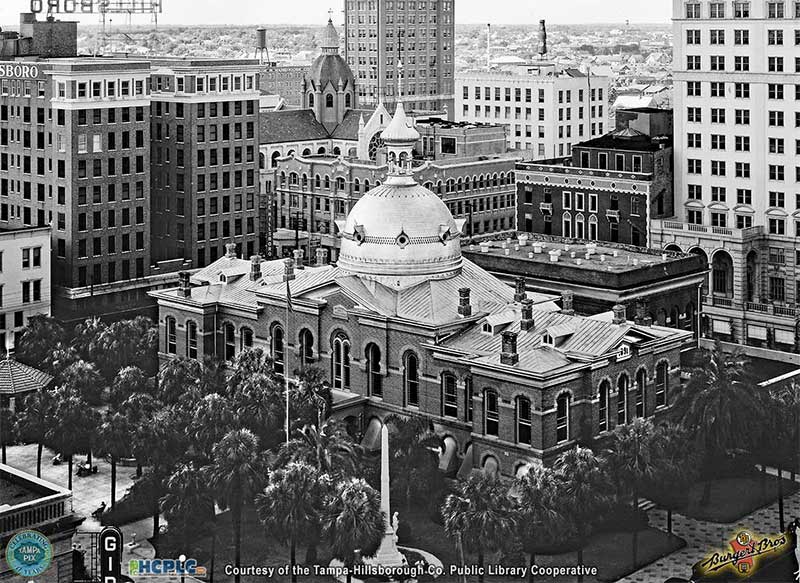
J. A. Wood was the architect of H. B.
Plant's Tampa Bay Hotel, now the University
of Tampa,
and the
Hillsborough Co. Courthouse of 1891 to 1953,
seen below.
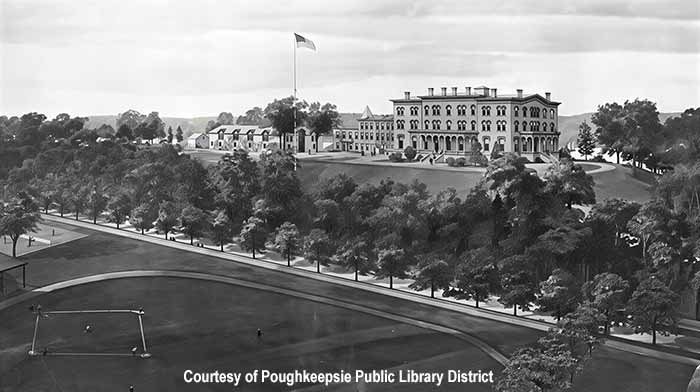
The Riverview Academy
booklet from 1888 suggests that this
institution was always a part of the
Poughkeepsie Collegiate School and that
Charles Bartlett was in charge from 1836
until 1857. Since Bisbee could
not manage to win the property at College
Hill at auction in the 1860s, he purchased
and began constructing a new school just
west of Eastman Park. On a spring day in
1867, the entire school marched from the
College Hill campus to Riverview to begin
classes in their new location. This included
about 5 acres of sporting fields, a
gymnasium, school building and living
quarters. A grand total of $70,000 was spent
to improve the campus which was no doubt
risky but paid off within a year as they
were overflowing with students from all over
the nation.
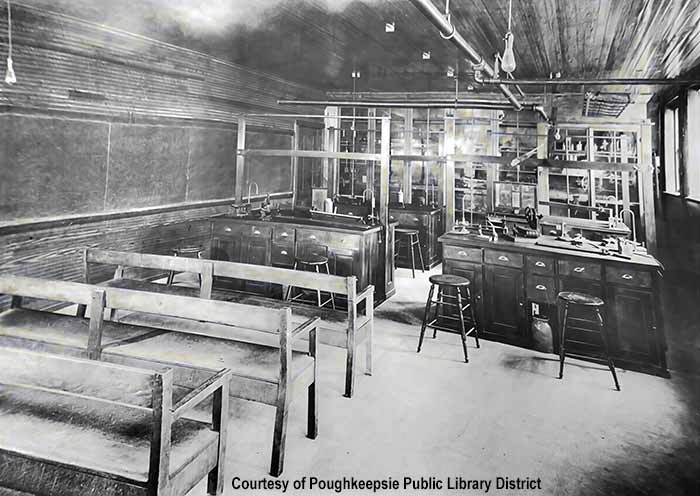
Laboratory classroom
The main
school building had classrooms on the first
floor and on the next two floors were
apartments for the students who were
actually referred to as ‘cadets.’ . A few of his
other buildings in Poughkeepsie still stand
including the Vassar Brothers Institute and
the Vassar Home for the Aged Men. In a
school catalog from 1888 it proclaims that
the building has “hot and cold water on
every floor, is heated with steam, and
lighted with gas. It is believed that the
building is equaled by few in the State for
elegance, spacious accommodation, and
conveniences of school-boy life.”
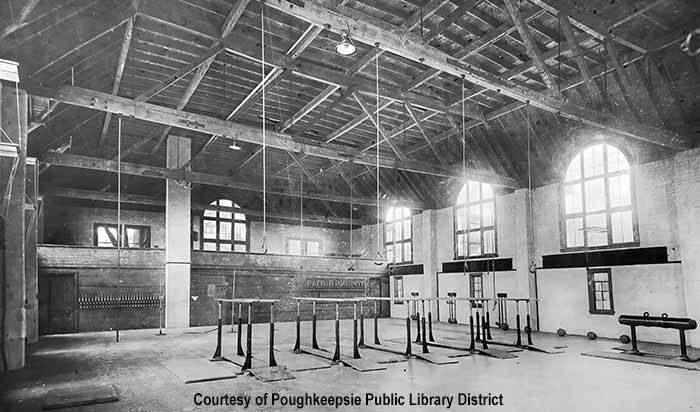
Gymnasium
The school officials
declared that their chief aim for all of
their cadets was “development of manly
character and improvement in academic
study.” There was no special exam needed for
admission and a new cadet was expected to
bring with him sheets, nightshirts (aka
pajamas), their own spoons and forks, ties,
gloves, umbrellas, a bible, and a book of
common prayer (for those who attended the
Episcopal service). They offered courses
in writing, commercial arithmetic,
bookkeeping, history, chemistry, Latin,
Music, Drawing, and of course, Military
tactics and discipline. Former pupils of
the school included the Episcopal Bishop of
New York, Right Rev. Henry C. Potter, Judge
Henry Gildersleeve, and Professor John Henry
Wright of Harvard.
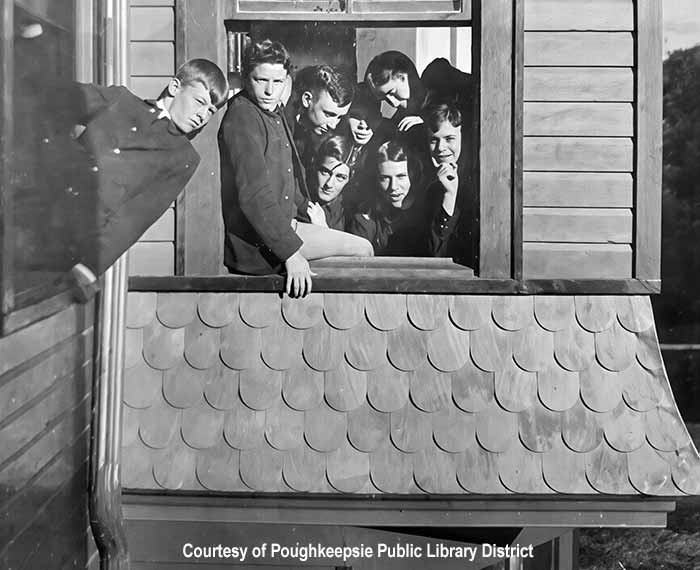
The
school seemed to
do well up until about 1910 when some
financial issues became apparent and in 1913
it was stated in
the Poughkeepsie Journal that $10,000 in
salaries was owed to the teaching staff
alone. By 1921, the school closed down for
good. After that, the building was used by
the Vassar Christian Association as a
community center which they named the
Lincoln Center. Improvements were made to
the site by the WPA during the 1930s.
However, during the course of the
Urban-renewal years, the building was
declared unsafe and condemned by 1965.
Today, if you find yourself kicking a ball
around in the soccer fields at the Lincoln
Park soccer club, you will be walking the
grounds where these young cadets once
studied. |
|
DALE MABRY HIGHER EDUCATION continued
Several articles in the
Pensacola and Jacksonville papers of Dec. 1911 to Feb. 1912
mention Dale going home several times to Tallahassee to
visit his parents while attending school in Atlanta.
The Atlanta Journal of Mar, 3, 1912, published "Dale
Mabry, who has been visiting his father, Judge Mabry of the
Supreme Court, left this week for Tampa where he will
study law with his brother." (Milton was a clerk of the
Supreme Court at this time, not a Justice.)
DALE MABRY'S SUCCESS IN THE REAL ESTATE
BUSINESS
Dale wasn't coming to
Tampa to study law with his brother, as he had no legal
education. He came to join his brothers Giddings and
Milton in the real
estate business. His first sale in the news was the sale
of property in early June 1912 for a lot in Suwanee Heights
to Robert Walden of the Tampa Hardware Co. This was quickly
followed by two more lots at the same development on June 15
and many more over the coming months.
In early Aug. 1912, Dale was
elected secretary of the Baracas class at a meeting at
the YMCA of Tampa. The Baracas was a newly formed
class of the First Baptist church, the members of which
resolved to do what they could to stop the Sunday operating
of shows and other amusements. They believed that the
running of amusement places on Sunday was unnecessary, a
violation of the Sabbath, and some thought was a violation
of the city and state laws.
Ironically, in Nov. 1912, Dale
sold five lots in Suwanee Heights, to two men, one being the
manager of the Alcazar and Bonita movie theaters. His
brother's company, the Mutual Development Company,
had opened this new subdivision, "East Suwanee Heights," in early
December that year. Dale became highly
successful selling lots in Suwanee Heights as reports of his
sales appeared in just about every issue of the Times and
Tribune.
Read about the Mabrys' role in the development
of Suwanee Heights. |
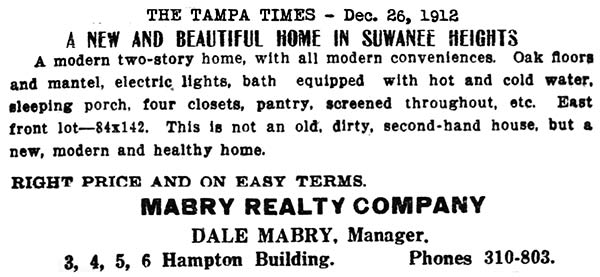
MABRY REALTY CO.
The
Mabry Realty Co. served as the agents for Suwanee Heights,
while the Mutual Development Co. was the owner.
Dale continued to be mentioned
on the society page section as he often attended various
entertainments--luncheons, meetings, dances, picnics,
boating trips, weddings and parties.
The ad at right appeared almost
daily in the Tampa newspapers, until it changed to a
vertical format in Sep. 1913 with Dale as Sales Manager.
|
DALE MABRY CHAIRMAN OF
GASPARILLA FLOAT COMMITTEE
In Jan. 1915 the Tampa Real
Estate board voted to enter a float in the Gasparilla
parade, representative of the board and its objects. Dale
Mabry was appointed the chairman of the float committee.
Hugh C. Macfarlane was planned to appear in full Scottish regalia,
including a kilt. Dale was unanimously elected to choose a
young lady to occupy the seat of honor on the float and
determine the costs and manage the construction of it.
In the summer of 1915, Dale
traveled to Tallahassee to assist his father in conclusion
of his affairs, having announced his retirement as clerk of
the Supreme Court.
SERIOUS AUTO
ACCIDENT INJURY, but which Mabry was it??
The July 31, 1915 Tampa Times
says it was Dale Mabry, the July 31, 1915 Lakeland Ledger
says it was G. E. Mabry.
MABRY "MEAT" IN "AUTO
SANDWICH" subtitled "REAL ESTATE MAN PINNED
BETWEEN TWO CARS."
Dale Mabry of
the Mabry Realty Co. drove a Henderson automobile with Mr.
& Mrs G. E Mabry and Mr.& Mrs. Trice to Lakeland
to attend a meeting at the Lakeland Baptist Church Where
Giddings was the speaker.
From
this point on, only "Mr. Mabry" is referred to.
The car was parked in front of the church and when the
meeting was over, "Mr Mabry" came out to crank start the
car. Not realizing he had left the car in gear, the car
started forward, pinning Mr. Mabry between it and the
car parked in front of it. The cars proceeded 75 to
100 feet down the street with Mabry pinned between them,
ultimately stopping when the front car ran up on a sidewalk
and smashed into a telephone pole. People rushed to the cars
to find Mr. Mabry "seriously injured," and pulled the
Henderson back. Mr. Mabry stepped from between the two
machines and at the insistence of his brother, they called
on a doctor at the Kibler hotel. The physician found
no broken bones or internal injuries, and the party returned
to Tampa. With Mr. Mabry not having any broken bones
or internal injuries, and except for a little soreness, he
said he felt no effects of the experience. He showed
up for work at his office on time the next morning.
The July 31, 1915 Lakeland Ledger says it was G. E. Mabry
who was pinned.
Read
about their version. |
|
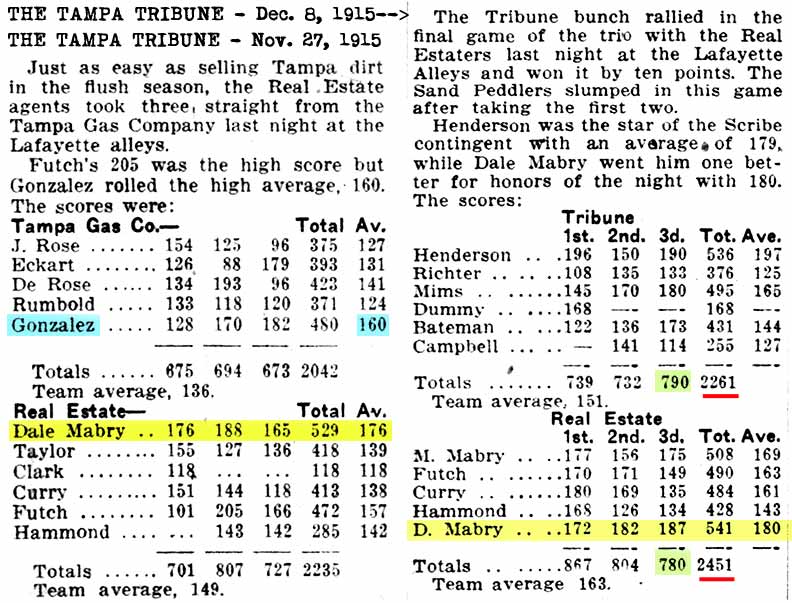
DALE MABRY THE BOWLER
In Tampa, Dale enjoyed bowling
on the Real Estate team in the Tampa leagues and was
quite an accomplished bowler. These leagues played at the
"Lafayette alleys."
The Tribune's reporting is
deceptive, whether intended or not. For the Nov. 27
match, it claims Gonzalez had the high average, but that was
only for The Tampa Gas Co. team. Dale had a higher average.
For the Dec. 8 match against the
Tribune's team, it describes a rally by the Tribune in the
final game, winning by 10 pins, and the "Sand Peddlers"
slumping after taking the first two. It fails to
mention that the Tribune lost the match by 190 pins.
It's likely that the pins were
reset manually by boys or young men, as mechanical pin
setters didn't begin to make their way into bowling alleys
until the early 1920s, and they weren't automatic.
Dale was also a competitive
tennis player, winning many tournaments, mostly in doubles.
|
DALE MABRY FIRES A PISTOL AT
MIDNIGHT
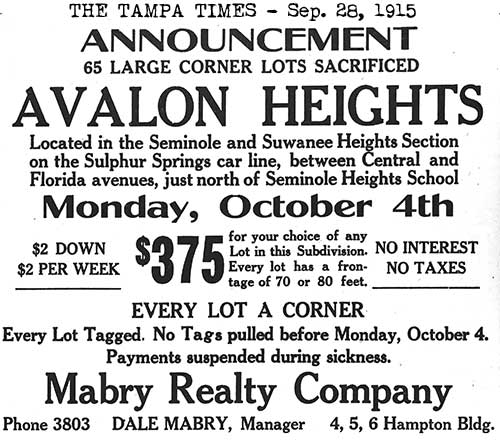
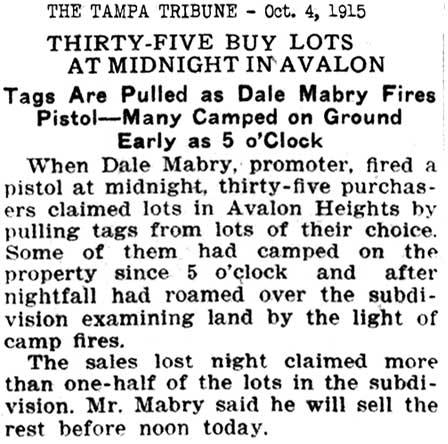
In early Oct. 1915
Dale is described as a "promoter," firing a pistol at
midnight to mark the start of lot sales in a new subdivision
in the Seminole Heights and Suwanee Heights section--Avalon
Heights. Buyers then raced to the lot of their choice
to pull the tag and stake their claim.
|
|
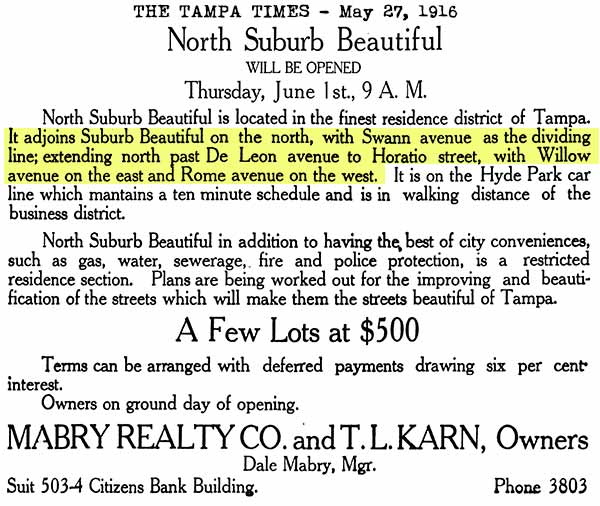
NORTH SUBURB BEAUTIFUL
The
development of "Suburb Beautiful" began between 1905 and
1910 with Alfred Reuben Swann who became a major figure in
Tampa's residential and commercial development.
Swann,
along with Eugene Holtsinger, a fellow Tennessean, developed
a large residential subdivision on Hillsborough Bay named
Suburb Beautiful. Their Bayshore Boulevard development
featured a seawall and a roadway between the residences and
the bay, giving Tampa its beautiful scenic drive. Swann
envisioned Tampa as a major American city.
Swann was
soon joined by his son, James T. Swann, Sr., and grandson
James T. Swann, Jr.
Holtsinger teamed up with Alfred Swann in a
land-development business and built homes in Hyde Park,
Ridgewood Park, Ybor City and West Tampa, as well as Suburb
Beautiful. Holtsinger was also the developer of the area
known today as Channelside.
Read
more about the Swanns.
The bridge over the Hillsborough River at North Blvd.
was completed in 1959 and named in honor of Eugene
Holtsinger.
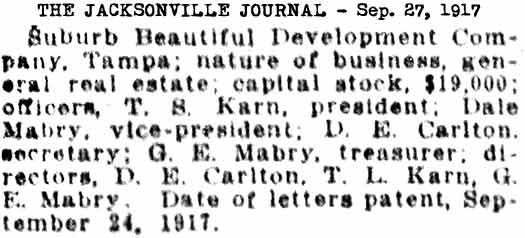
In late Sep. 1917 the Suburb
Beautiful Development Company was incorporated in Tampa with
Dale Mabry as VP. G. E. Mabry was Dale's brother,
Giddings Mabry, who was in law practice with Doyle E.
Carlton as Mabry & Carlton.
THE LOCATION OF NORTH SUBURB
BEAUTIFUL
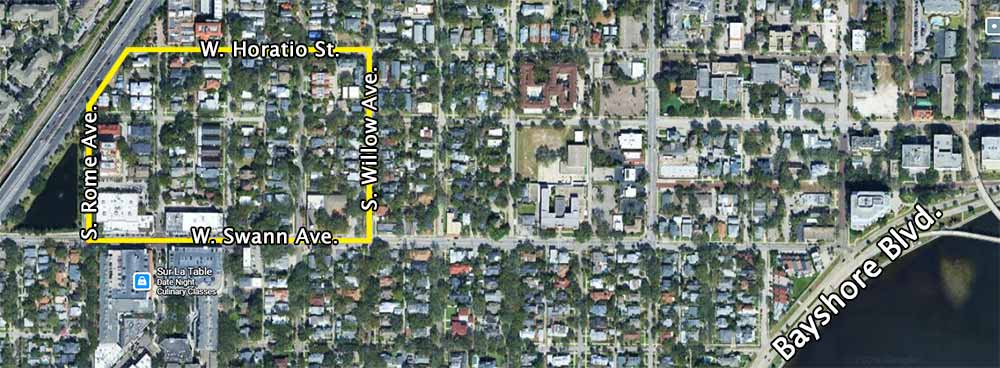

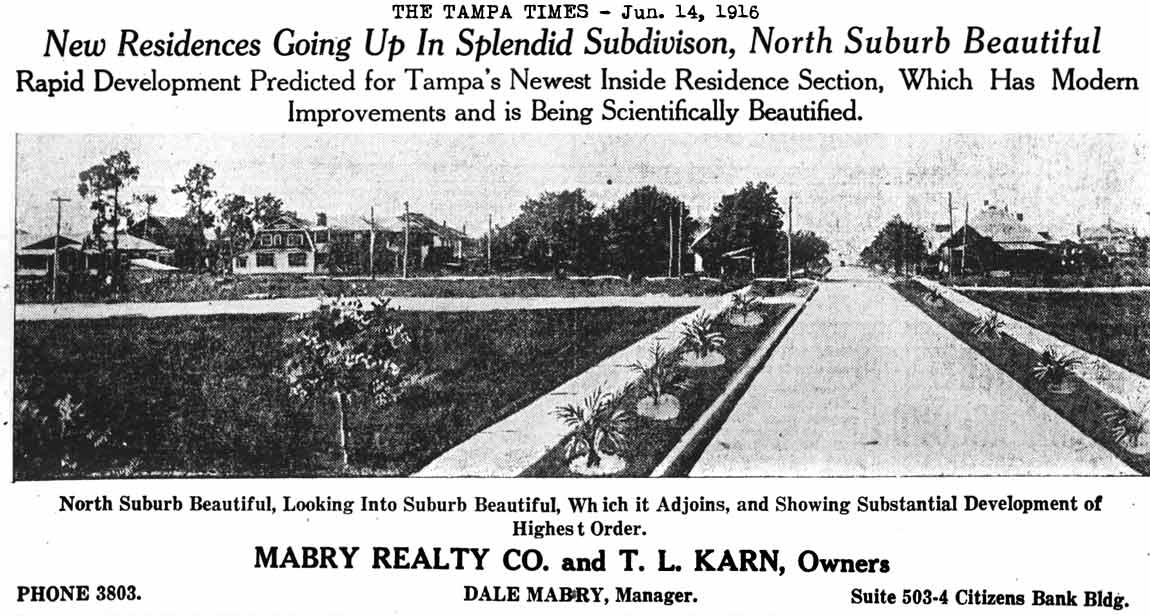
Read the rest of this ad.
|
DALE MABRY MILITARY SERVICE
Dale registered for
the WW1 draft on Jun. 5, 1917 and immediately
thereafter joined the Army. At the time he
was living at 207 Cardy in Hyde Park. Dale was president &
sales manager of Mabry & Owens Co. and corporate manager of
Mabry Realty Co., employed by its officers.
DALE MABRY WW1 DRAFT
REGISTRATION CARD
|
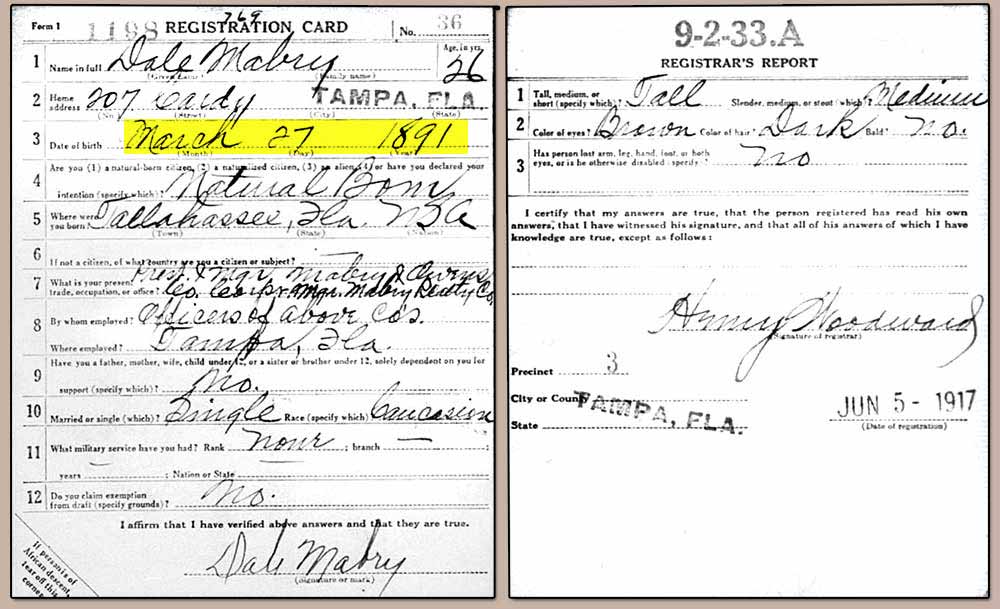
Notice here his date of birth is
recorded as March 27, not March 22 as in other sources.
This mistake could have been made if Mabry was asked for his birth date,
said "twenty-second" but the recruiter heard
"twenty-seven."
|
OFFICERS BOOT CAMP
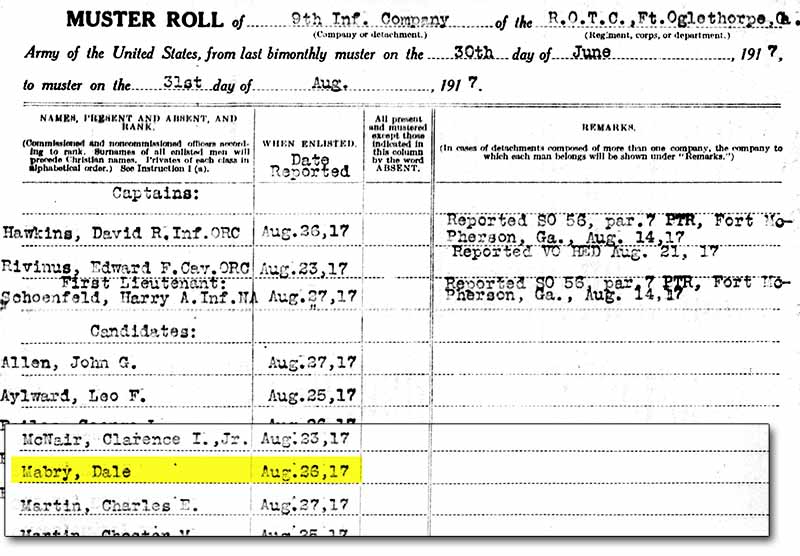
On Aug. 25, 1917 Dale and 13
other Tampa men were sent to Fort Oglethorpe, Ga., on a
train that picked up more men between Tampa and Jacksonville
along the way. The muster roll of the 9th Infantry
ROTC at Ft. Oglethorpe of Aug 31st, 1917 lists Dale as
arriving on Aug. 26, 1917. |
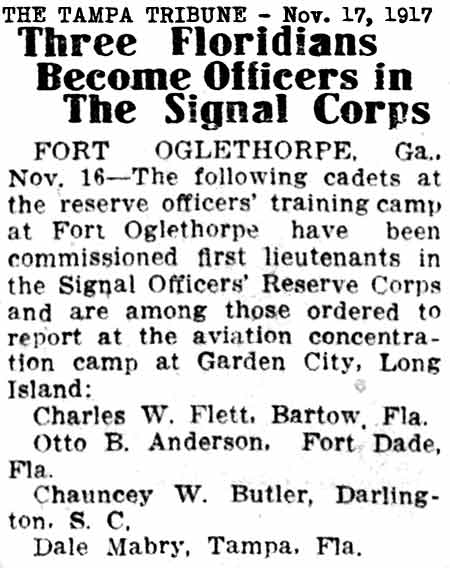
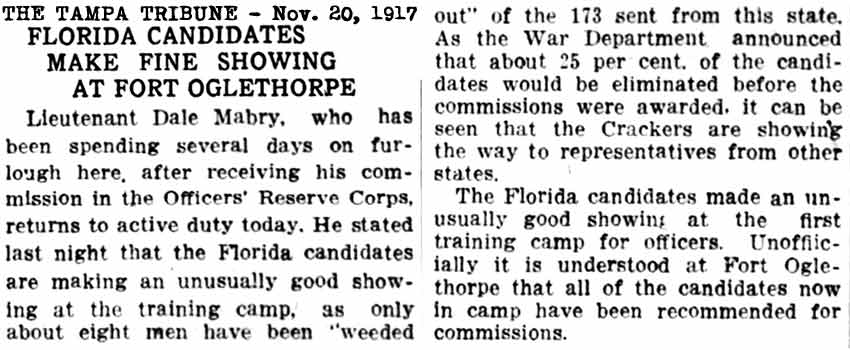
| Just before
completing his training at Ft. Oglethorpe, Dale
went to Atlanta and took the exam for the Army
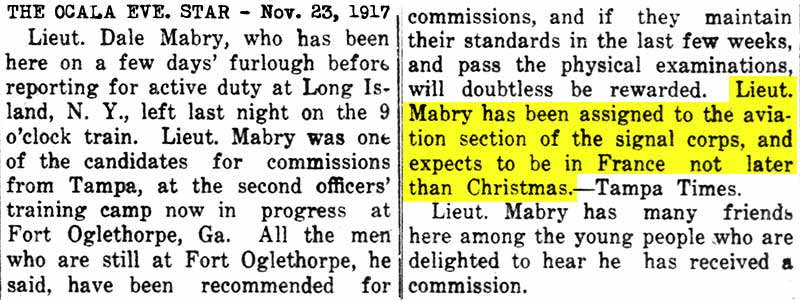
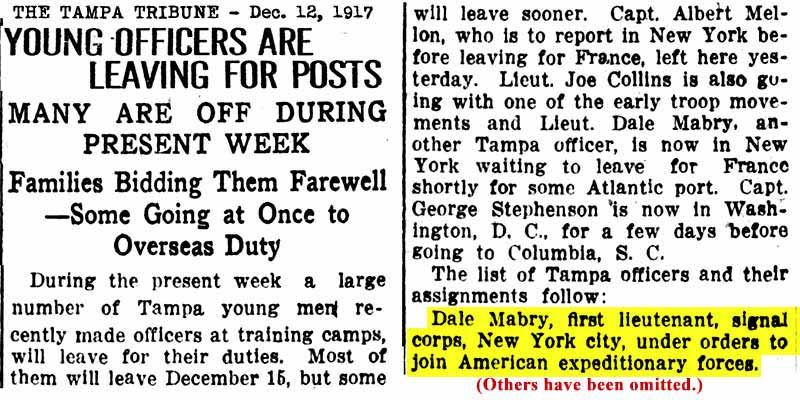
Air Service. In Nov. 1917
Dale was one of four cadets commissioned as First
Lieutenants in the signal officers reserve corps. They
were ordered to report to the aviation camp at Garden
City, Long Island, NY. |
|
The Dec. 27, 1917 Tampa Tribune
reported that "word was received from Giddings Mabry
stating that his brother, Lieut. Dale Mabry, has arrived
safely 'somewhere in France' ...having been assigned to the
signal corps for active service in France."
|
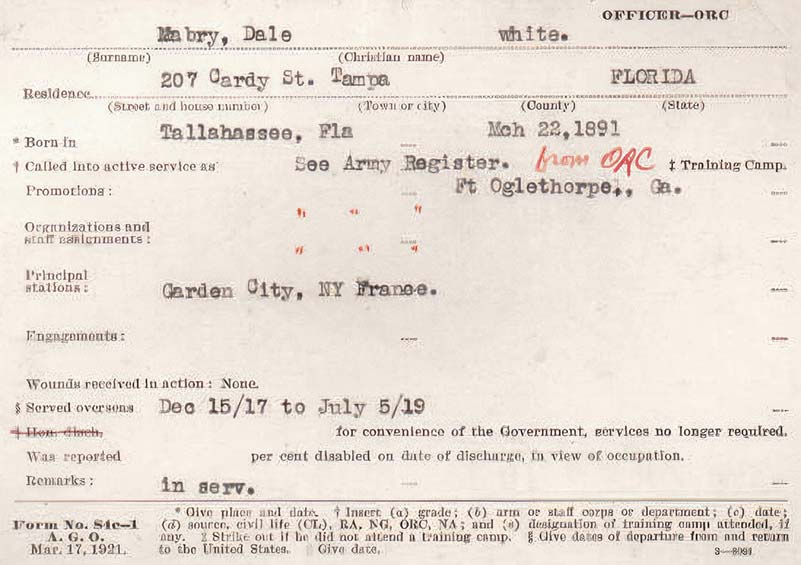
According to his military
service card, Dale was at Garden City, NY which was his
departure station. Dale served overseas as a 1st Lieut. from Dec.
15, 1917 to Jul. 5, 1919 in the American Expeditionary
Forces Signal Corps in France.
A Jul. 15, 1919 Tampa Tribune
article published after Mabry's return home, says "for
the first few weeks in France, he was stationed with the
French air forces, but was then sent to Saint-Mihiel
salient with the Americans, remaining with his own
countrymen throughout the war.
(During World War I,
Saint-Mihiel was captured by the Germans in 1914, and was
recaptured during the Battle of Saint-Mihiel by the American
Expeditionary Forces (AEF) from 12 Sep. 12, 1918 to 19 Sep.
19, 1918)
Dale's military service card
shows his correct birth date.
|
ABOUT THE 10TH BALLOON
CO. from
Dept. of the Air Force Organizational Histories,
presented here in the green sections.
DEPARTMENT OF THE AIR FORCE UNIT HISTORIES, Created: 15 Feb
2014
Sources: US Army Order of Battle 1919-1941. Steven E. Clay.
Combat Studies Institute Press. US Army Combined Arms
Center. Fort
Leavenworth, KS. Nd.
LINEAGE
B Co, 4 Squadron organized
November 13, 1917 Redesignated 10th Balloon
Company
COMMANDERS
Lt Koenig, Lt Palmer, 27 Nov
1917, Lt Henske, 18 Jan 1918, Lt
Lavers, 4 Apr 1918 1, Lt Dale Mabry, 25 Jul
1918
OPERATIONS
The company was
organized November 13, 1917, at Fort Omaha,
Nebr., with Lt. Koenig commanding. On
November 27, 1917, Lt. Palmer assumed
command, Lt. Koenig being transferred to a unit
proceeding overseas. January 18, 1918, the
enlisted strength of the company was increased
from ninety-one to two hundred men, with Lt. Henske replacing
Lt.
Palmer as Commanding Officer.
The first week in
February orders were received to move to Camp
Morrison, Virginia. On February 6th Company B
boarded the train bound for Camp Morrison. Three
days later, February 9th, the company arrived at
Camp Morrison.
We embarked on the
U. S. T. America on June 29, 1918. The
thermometer was hovering around a hundred or
more, but not a man fell by the way, side or
dropped out en route. At 5:30 p.m. the company
was lined up at the pier ready to board and in
short time were started across the gang plank,
onto the Steamship America, a name sufficient to
stir up plenty of sentiment. After getting on
board it was found out that the ship was an old
Italian liner, manned by an Italian crew;
sentiment somewhat dropped. At 7 the same
evening the ship slipped down the river to the
lower bay and lay at anchor until the following
afternoon at 4:30 p.m. when the anchor was
pulled in and the ship started down the bay.
Newport News does not have a Statue of Liberty,
but still, the receding shores of the United
States of America was sufficient statue of
Liberty to give all the attendant thrills at the
thought of leaving home and country.
The next
morning at sunrise several other transports hove
into sight, gathered together in a convoy, and
were joined by a fleet of light destroyers and a
portion of the mosquito fleet. At noon several
other transports and a cruiser joined the
transports, completing the convoy.
(Dale Mabry was probably on board one of these.)
Although the sea was calm end the
weather excellent, many of the men took to their
hammocks early in the day. Nothing special
happened the next few days until after the
fourth day out, the escorting cruiser let go of
a terrific broadside followed by several more
shots. Every one rushed to see to the submarine
but when the smoke cleared away Old Glory was
floating out on the breeze from the main mast of
the cruiser and one by one the transports raised
the flag-- it was the Fourth of July. The
remainder of the voyage was very uneventful, in
fact, decidedly monotonous especially with the
orders at night "Lights out; no smoking."
Early in the morning
on July 11th, fifteen American destroyers met
the convoy as the cruiser that escorted the
convoy all the way across returned. On Friday,
July the l2th, at 6:00 in the evening, land was
sighted. No one knew just where the convoy was
expected to land so rumor was rife as to the
port of debarkation. The question was settled
that evening when the ship anchored in the bay
of Brest. At 9:00 the next morning lighters came
out and the company was taken to shore.
After the company
had all come ashore it was marched to the
outskirts of Brest to a rest camp known as
Pontaten Barracks, supposedly at one time
headquarters of Napoleon and his troops.
During a short stay at this rest camp Dr Pryor,
the company surgeon, earned undying fame with
the company when he ordered all men out at two
o'clock in the morning to take a bath; the water
was cold, the night colder. On July 16; the
enlisted strength of the company was reduced to
one hundred and seventy men, the men transferred
out of the company being sent to the Balloon
School, Camp de Souge.
We arrived at
our training camp, Camp de Meucon, July 17,
where we were taught "how the French do it." On
July 25 Lt. Mabry assumed command,
relieving Lt. Lavers.
|
|
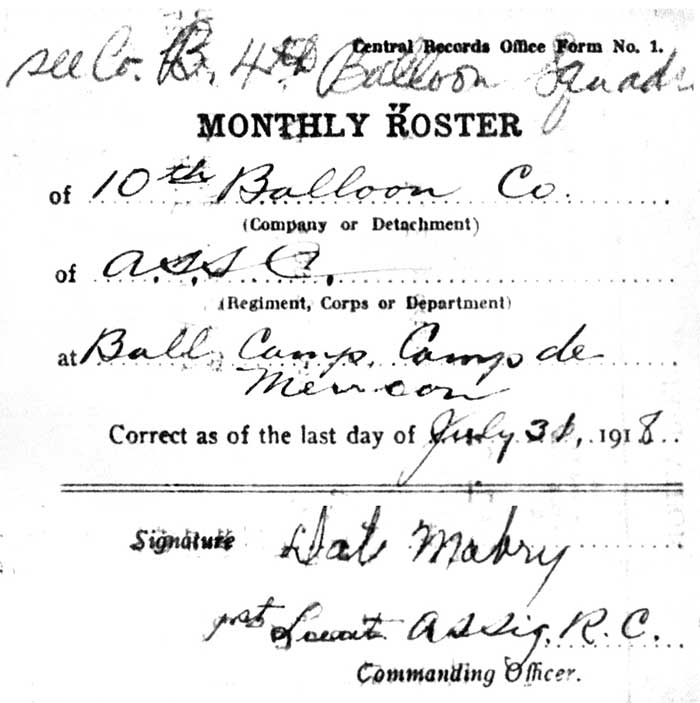
According
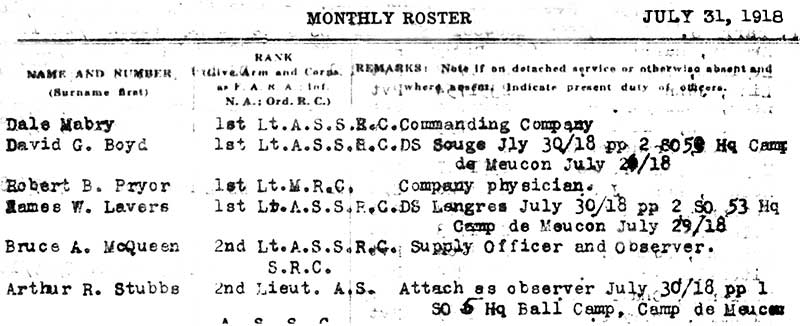
to monthly Army rosters for WW1, in July 1918, 1st
Lt. Dale Mabry was put
in command of the 10th Balloon Co. (which was
previously known as the 4th Balloon Squadron,) at balloon
camp, Campe de Meucon France. |
 |
|


|
Service in the balloon corps was for
reconnaissance and observation, not for combat. The
balloons did not have a propulsion system (no motors,
engines, propellers). They remained tethered to the
ground as they were raised high enough to be able to observe
the enemy. The basket was manned by "observers" who
would use a wired telephone connection to report the enemy's
maneuvers.
BELOW:
U.S. Army balloon being launched from Camp
de Meucon in 1918, France, during the First
World War (1914 - 1918). The basket (lower
center) has just left the ground. As the
stalemate of trench warfare developed on the
Western Front in the First World War, a
variety of aerial reconnaissance methods
were used to map enemy positions. These
included aircraft and balloons. Kite
balloons were more aerodynamically stable
than round balloons. The US entered the war
on 6 April 1917, playing a crucial role in
helping Britain and France to defeat Germany
and its allies. This kite balloon is being
manned by aviators from the US Army's newly
formed Air Forces division. Commander Lt.
Dale Mabry is probably in this photo.
|

|
On August 26 we
boarded a French train and proceeded at last
toward the Front, arriving at Toul, the jumping
off place for the Lorraine Front, the 30th of
August. At dusk, the company piled aboard trucks
and our journey towards Berlin began. The Boche
had succeeded in dropping a shell on a large
ammunition dump near Menil-la-Tour. Because of
the fact that it was burning and the fixed
ammunition was exploding, it was necessary for
us to proceed by side roads that were congested
with all kinds of traffic. |

| Approaching
nearer the front lines, we observed the signal
rockets, flares and Very lights being thrown up
all along the front trenches, these helping to
increase our nervousness at being up there for
the first time. We all breathed easier when at
last we arrived at our new camp in a woods
between Menil-la-Tour and Ansauville.
Our first
night was spent in rat and "cootie" infested old
French barracks. The next morning, because it
was still raining, there were no big guns
firing. We were very much surprised that things
could be so quiet up, there. Fortunately the
trip lasted only one day, the train arriving at
Vannes at 9 the next morning. Trucks carried the
company to a camp 12 kilometers away; quite an
unattractive place, quite inviting after the box
cars and the French trains with their shrike
whistles.
At this camp
training began for active service on the front;
everything taught in the States had to be
relearned for as one man wrote home in his
letter, everything is changed, we have to learn
everything over again except how to handle the
pick and shovel. The company was put through
daily drills, taught the use of gas masks how to
use helmets. Special selected men were
sent to various schools for training, lectures
were given on ballooning on the front, tactical
disposition of the balloon, building of balloon
and everything else connected with the proper
handling of balloons.
During all
this time the company had absolutely no
transportation of any kind or description so the
first week in August, Lt. Lavers was sent away
with orders to get our allotment of
transportation. On Aug. 14 he came back with 7
Kelly Springfield trucks, 3 Fords and one old
Martini touring car that had been rescued from
the salvage pile and coaxed all the way across
France. The transportation has survived to date
in spite of the most strenuous use.
On Aug. 24
orders for duty at the front were received,
equipment was packed, everything gotten in
readiness and on Aug. 26th the company left camp
for Toul this time traveling in regular third
class coaches and not box cars. We arrived
at Toul early on the morning of Aug. 30. As the
company was bound for the zone of advance all
traveling had to be accomplished at night as the
company layover in Toul until evening. The night
was as black as pitch, lights of any kind meant
aerial bombs galore. The sensation of nearing
the actual front where the fighting was going on
gave sufficient incentive for compliance with
any order regarding safety of lives. Along about
midnight the road became crowded with vehicles
of all kinds, guns, transports, of every
description. Darkness everywhere except in the
distance where the shells were bursting in the
air.
The truck drivers were all tense and
nervous, this was their first experience driving
trunks at night without lights and over strange
roads; the men were all keyed up to high pitch.
Suddenly without warning there was a terrific
bombarding up ahead a few kilometers, shells
wont screeching bombs bursting and bullets
flying and the whole sky lighted up for miles
around; ammunition dump had been fired by the Boche shells. This meant a wide detour to avoid
the bursting shells so it was nearly three in
the morning before the company finally arrived
at the place to be set for the camp. Just after
noon on September 1 we were brought to a nearer
realization of the war when a big Hun shell fell
and exploded about two hundred meters from the
Camp. Half the company started on the run to get
souvenirs, the other half did their running
towards-their gas masks, and tin derbies. No
more shells fell nearby, so it was a fifty-fifty
proposition between those who were so anxious to
procure souvenirs and those who played "safety
first. |
U.S. Army Air Service
1918 aerial of artillery Camp Meucon, France

|
Along about
midnight the road became crowded with vehicles
of all kinds, guns, transports, of every
description. Darkness everywhere except in the
distance where the shells were bursting in the
air. The truck drivers were all tense and
nervous, this was their first experience driving
trunks at night without lights and over strange
roads; the men were all keyed up to high pitch.
Suddenly without warning there was a terrific
bombarding up ahead a few kilometers, shells
wont screeching bombs bursting and bullets
flying and the whole sky lighted up for miles
around; ammunition dump had been fired by the
Boche shells. This meant a wide detour to avoid
the bursting shells so it was nearly three in
the morning before the company finally arrived
at the place to be set for the camp.
Just after
noon on Sep. 1 we were brought to a nearer
realization of the war when a big Hun shell fell
and exploded about two hundred meters from the
Camp. Half the company started on the run to get
souvenirs, the other half did their running
towards their gas masks, and tin derbies. No
more shells fell nearby, so it was a fifty-fifty
proposition between those who were so anxious to
procure souvenirs and those who played "safety
first."
At 4.30 a.
m., on Sep. 4, and after balloon 146 was taken
from the bed and adjusted to the winch, two
observers climbed into the basket. The balloon
rose to 300 meters and the journey to the
forward position began, we had just left the
forward position to bring the big gas bag back
to its bed, because of poor visibility, when
five enemy planes made their appearance. They
looked things over but flew away without making
any attempt to shoot down our balloon because
the anti-aircraft batteries began pegging away
at them.
The balloon
was taken from the bed again at 12.30 p.m., and
we journeyed back to the forward position. The
bag was at about 500 meters altitude when the
corporal of the lookouts reported he heard the
humming motor of an-enemy plane. The balloon was
ordered to be "hauled down." It was' descending
rapidly when at an altitude of about 350 meters
an enemy plane dove at it from the clouds. The
machine gunners opened fire and as the first
clip in their guns started to spit, several
anti-aircraft batteries opened up and the battle
was on.
Both
observers, Lieutenants Likens and Boyd, 'jumped
and" their parachutes carried them through the
heavy barrage to a safe landing in a nearby
field. In his first and second attempts to fire
the gas in the balloon, the Boche failed but his
third attempt was successful and the balloon
fell to the ground a mass of flames. The enemy
turned towards their own lines and by doing a
number of spectacular stunts escaped the
barrage. When we last saw them, they were
crossing our lines closely pursued by two
"Spades," trying to "sit on his tail." Infantry
observation posts reported that the enemy's
plane came to earth behind their lines "out of
control." |
|
An article in the Tampa Tribune
of Jul. 15, 1919 says Dale took part in the battles at
Saint-Mihiel and Argonne, remaining there through
the end of the war.
The Battle of Saint-Mihiel
The Battle of Saint-Mihiel was a
major World War I battle fought from 12 to 16 Sep.1918, involving the
American Expeditionary Forces (AEF)
and 110,000 French troops under the command of General
John J. Pershing of the United States against German
positions. The U.S. Army Air Service played a significant
role in this action. |

| On the
morning of Sep. 12th, the great St. Mihiel
drive opened with a heavy artillery barrage at
one o'clock. The great guns roared about us
and a battery of 240s that were emplaced
directly behind us shook our barracks and made
sleep or rest impossible.
The next
morning, during a heavy wind, our balloon took a
"nose dive" into the trees, destroying the
balloon and throwing both observers out of the
basket. Lt. Likens escaped uninjured but
Lt. Boyd received injuries so severe that
he was subsequently invalided home. We
immediately procured a new balloon, inflated it,
and started forward the next night. We moved
each night under cover of darkness along roads
all shell torn and terribly congested with all
sorts of traffic going forward ammunition and
food for the infantry; ammunition, food-and
forage for the artillery, and reserve troops.
Our last move
took us into the woods 2 kilometers south of
Essay and this was our position until September
21. While in these Essay woods, we received our
first real taste of shell fire. A German battery
of 105s opened up about midnight and immediately
a company race towards the old German dugout was
on. No fatalities resulted but there were a
number of narrow escapes racing around corners
and plunging into the trenches leading into the
dugouts. About thirty shells fell, two so close
that dirt was thrown around our tents from their
bursting. |
|
Observation was
an incredibly important role in aerial
warfare in World War I. All major combatants
used observation balloons to observe their
enemies’ trench lines and troop movements.
These hovering mammoths were used for
directing artillery, which required spotters
and observation well beyond the visual range
of ground-based observers. As much as planes
were able to record enemy positions and
movement on film, having real time spotters
and observational balloon baskets linked to
the ground by telephone was essential. It
allowed the artillery to take advantage of
increasingly large guns with vastly longer
ranges.
See rare photos of balloon uses during World
War 1.
|
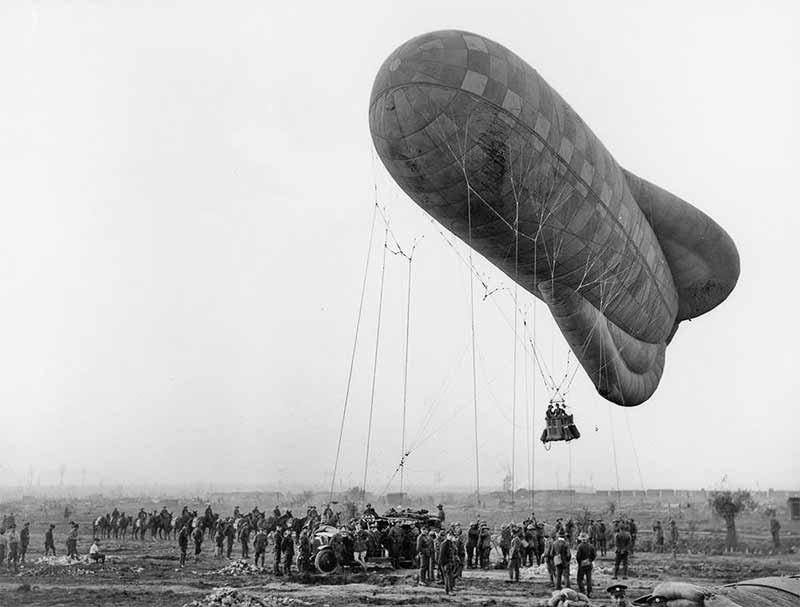
An
artillery-spotting balloon goes into the sky
above Ypres, Belgium.
Photo from the World War 1 Centennial
Commission "Observation Balloons."
|
At the start of
World War I, the organization of the Air
Service of the American Expeditionary Force
included observation balloon units organized
into companies, squadrons, and wings and
each company was equipped with one balloon.
Five companies comprised a squadron, and
three squadrons made up a wing. By the end
of the war 110 companies had been created.
In the field Balloon companies were allotted
to the ground units they supported as
needed. In 1918 June, with squadron
organization discontinued, company
designations were numbered and organized
into groups. Only 35 companies made it to
France with the American Expeditionary Force
(AEF). 17 companies served at the front,
making 1,642 combat ascensions, while six
other groups were en route to the front at
the armistice.
American observation balloon service in
World War 1.
|
| On Sep. 21,
we moved to Jezainville arriving there at noon.
After the company had been fed, a balloon bed
was constructed and the balloon inflated. There
was no observation here the first few days
because of poor visibility. The men busied
themselves by picking up odd bits of lumber
lying around the hill and built a regular
settlement of small shacks, with the result that
our observers reported that the camp from the
air looked more like a Divisional Training Area
in the S.O.S., than a balloon company on the
Front.
We remained
at this position until the signing of the
Armistice and during our stay there, the Boche
aviators were successful in burning two of our
balloons. On the first of these occasions, Sep.
25, Lt. Lavers jumped, and on the second,
Oct. 6, Lt. Likens made his second drop
at the Front. |
See
also
Balloons Up -- The short life of the army balloon service.
| The enemy
artillery made several attempts to shoot our
balloons down and while their deflection was
perfect the range was always short and no damage
was ever accomplished. Night bombers were very
active here and they dropped a number of bombs
on roads leading into camp, too close for
comfort.
We took part
in several demonstrations here, compelling the
Germans to hold heavy reserves in this Sector as
our aid to the Americans that were making the
drive along, the Argonne. Infantry observers
reported a big fire within the German lines one
night and we received orders to fly the balloon
at once. Two observers went up and after several
hours working in a heavy rain that made accurate
observation next to impossible the balloon was
hauled down.
The observers
reported the fire was in Noveant, a small town
south of Metz, and that it had probably been
caused by our artillery, which, assisted by our
balloon, had shelled the Noveant Bridge that
afternoon. It was while we were at Jezainville
that the "dugout slide" was invented and we
found our helmets were not surplus weight as
they had been back in the S.O.S., for the big
shells whizzed and rumbled overhead frequently.
The company had
completed all plans for taking part in the long
expected drive on the fortress of Metz,
scheduled to begin on the morning of November
12, but instead of a victorious advance, the
Armistice was signed, and as far as the company
was concerned, the world relapsed into a period
of prolonged silence, a silence unbroken by the
roar of huge guns, the scream of Boche shells,
and the hum of Boche planes, a silence which
persists to this day, even as the Tenth Balloon
Company sinks deeper and deeper into the
bottomless mud of Ville-sur-Cousances".
Arrival in France
12 Jul 1918
Arrival at the front 30 Aug 1918
ABOUT
THE 10TH BALLOON CO. from
Dept. of the Air Force Organizational Histories,
presented here in the
green sections. DEPARTMENT OF THE AIR FORCE UNIT
HISTORIES, Created: 15 Feb 2014
Sources: US Army Order of Battle 1919-1941.
Steven E. Clay. Combat Studies Institute Press.
US Army Combined Arms Center.
Fort Leavenworth,
KS. Nd.
Read this account in its
entirety at
USAF Unit History website. Some information
presented here has been omitted, and some has
been edited for clarity. |
|
The
Meuse-Argonne Offensive was a part of the
final Allied offensive of World War I. It
was one of the attacks that brought an end
to the War and was fought from September 26
– November 11, 1918, when the Armistice was
signed. The Meuse-Argonne Offensive was the
largest operation of the American
Expeditionary Forces (AEF) in World War I,
with over a million American soldiers
participating. It was also the deadliest
campaign in American history, resulting in
over 26,000 soldiers being killed in action
(KIA) and over 120,000 total casualties.
Indeed, the number of graves in the American
military cemetery at Romagne is far larger
than those in the more commonly known site
at Omaha Beach in Normandy.
Military Records, Meuse-Argonne Offensive at
National Archives
See a detailed description of this battle,
with maps and photos. |


America's deadliest battle: World War 1
Meuse-Argonne Offensive 100 years later
|
THE END OF THE WAR
World
War 1 came to an end with the Armistice of Nov. 11, 1918,
ending the fighting on land, at sea, and in the air between
the Allies and their last remaining opponent, Germany.
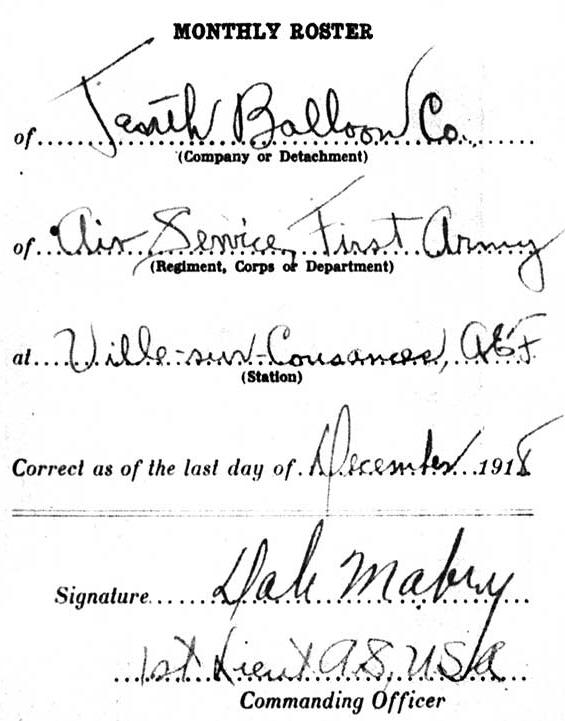
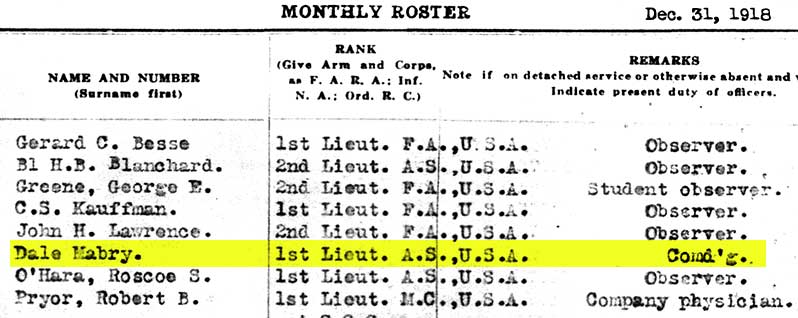
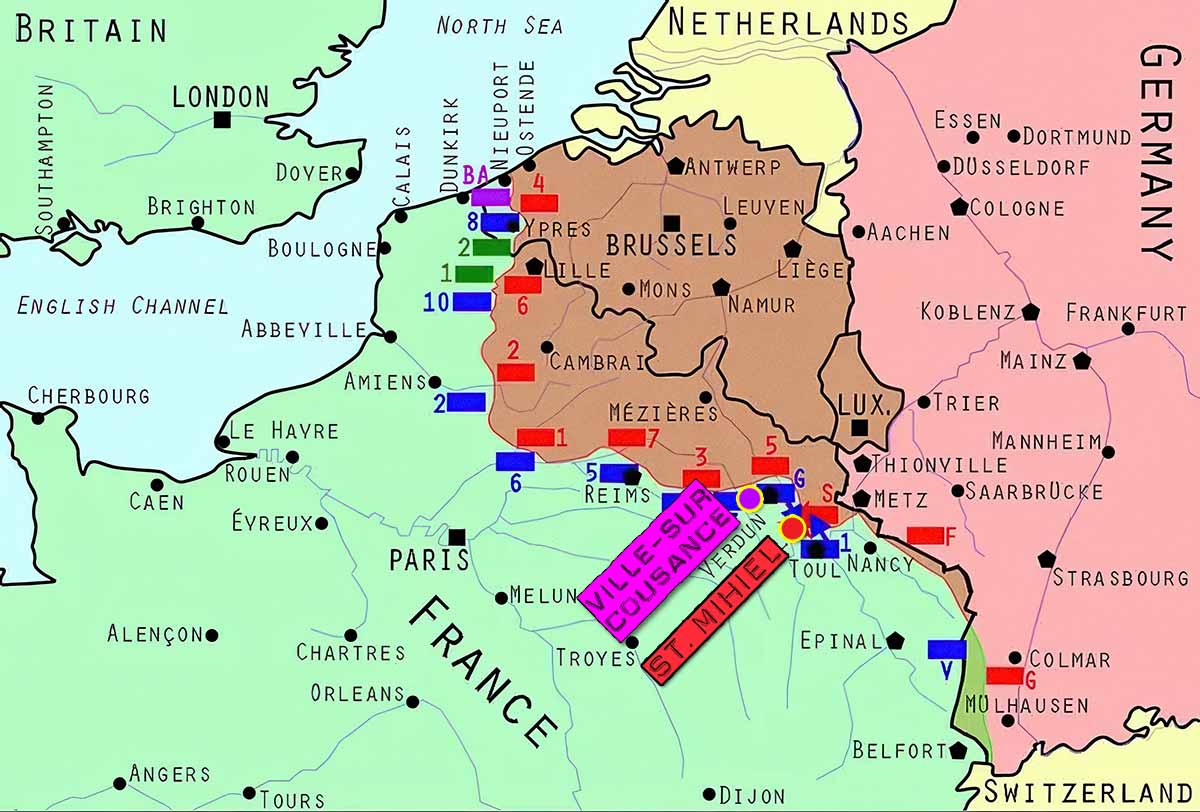
Dale was was stationed at Meucon
until he was transferred to the American Expeditionary Force
at Ville-sur-Cousances in Dec. 1918 where he continued as
1st. Lieut. commanding the 10th Balloon Co. This was located
about 27 miles northwest of Saint-Mihiel in the northeast of
France, which today is about 48 miles from the border with
Luxembourg and Germany.
|
 |
|
 |

|
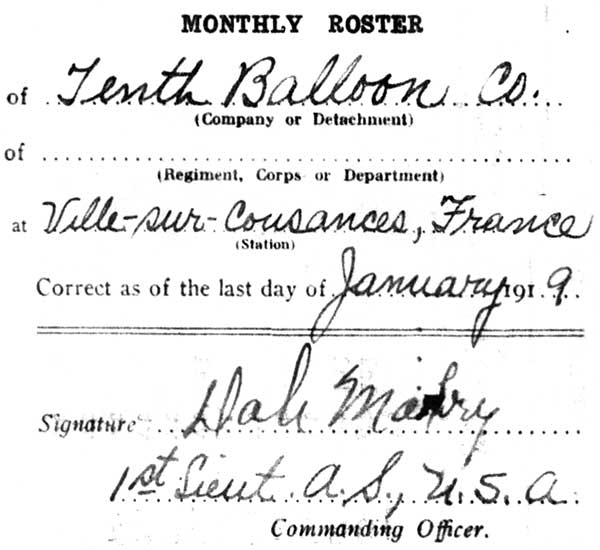
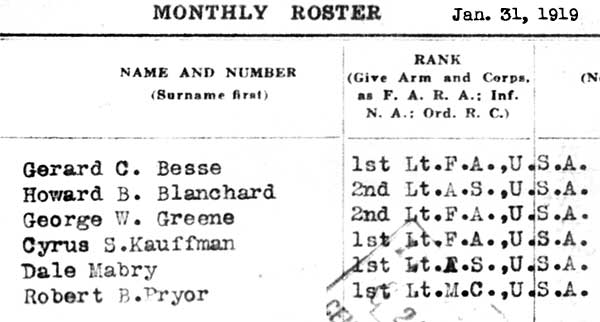
By the end of Jan. 1919, Dale
was was still stationed at Ville-sur-Cousances commanding
the 10th Balloon Co as a First Lieutenant. |
|
DALE MABRY
TRANSFERRED
The Feb. 28, 1919 roster of the 10th
Balloon Co. lists four 1st Lieutenants but Dale is not among
them. Their captain is listed first--Oscar Roman. This
is the first roster to list a captain in the company.
The Mar. 31, 1919 roster of the
10th Balloon Co. lists Captain Samuel T. Moore and 3 first
Lieutenants, none are Mabry. The page
lists the captain, 5 First Lieutenants, a 2nd Lieut., 2
master Electricians, 12 Sergeants 1st Class, 10 Sergeants,
14 Corporals, 4 Chauffeurs 1st Class, 17 Chauffeurs,
and 3 cooks.
The next page begins with "Privates
(cont'd)" listing 9 Privates in alpha order of last name,
from V to W. Clearly at least one page is missing
between the 1st and 2nd pages. It would have listed the
Privates from A to V. Below this, it lists Medical
personnel, a corporal and 2 privates. Then titled
LOSSES DURING THE MONTH it lists 1st Lt. Dale Mabry
transferred on the 15th, but it does not give the month or
year anywhere on the page nor does it show where he was
transferred.
SEE THIS PAGE. More men are listed as either transferred or
dropped. Next is the page which appears to have been
the first page of March 31, 1919. Listing all the
ranks and names, ending with Privates First Class and 5 men
of surnames starting with B, C, and E.
In May 1919 the 10the Balloon
Company was demobilized but it would be reinstated four
months later.
|
DALE MABRY BACK IN TAMPA
|
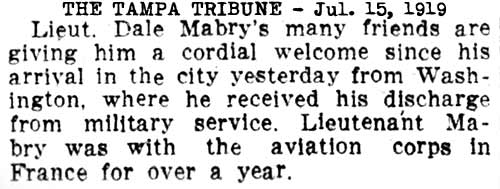
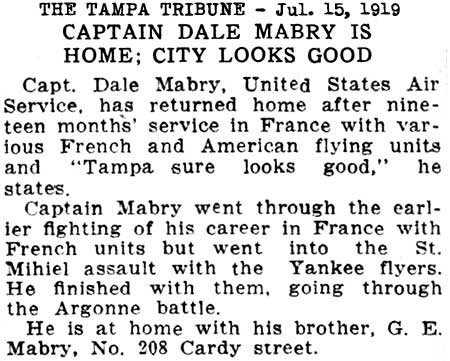
Dale arrived in Tampa
on Jul. 14, 1919. A Jul. 15, 1919 Tribune article
(at left) says he arrived from Washington "where he
received his discharge"..
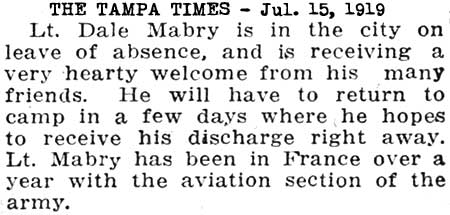
A Jul. 15, 1919 Times article
(below) said he was on leave
of absence and would have to return to camp "in a few days
where he hopes to receive his discharge right away."
But Dale had already been discharged on July 5, 1919.
Another Tribune article on the same day (below) gives a
brief summary of his service in France; he "went into the St. Mihiel assault with the
Yankee flyers" finishing with them through the Argonne
Battle. His duty was for balloon surveillance, not as a
combat pilot of a plane. His military service card presented above shows he
was discharged Jul. 5, 1919.
|
DALE MABRY CONTINUED
ON NEXT PAGE
-
DALE MABRY
PROMOTED TO CAPTAIN AT LANGLEY FIELD, VA.
-
INTERNATIONAL
BALLOON RACE
-
AIRSHIP
MANEUVERS AT
LANGLEY AIR FIELD - THE AIRSHIP ZODIAC
-
THE PRELIMINARY BALLOON
RACE
-
THE ITALIAN
SEMI-RIGID DIRIGIBLE ROMA
-
DALE MABRY IN
ITALY & THE AIRSHIP ROMA
-
TEST FLIGHTS
OF THE ROMA IN ITALY
-
OFFICERS &
THE "SERGEANTS FIVE" OF THE ROMA
CREW
-
ITALY AWARDS
MABRY ORDER OF THE KNIGHTHOOD OF THE CROWN
-
ROMA'S SEA VOYAGE
FROM ITALY TO LANGLEY
-
RE-ASSEMBLY
OF THE ROMA AT LANGLEY
-
ROMA: TWO TEST
FLIGHTS AT LANGLEY AND CHRISTENING AT
WASHINGTON D.C.
-
ROMA COMMAND
PASSED TO DALE MABRY
-
DIAGRAMS OF
THE ROMA'S INTERIOR
-
DALE MABRY IN
CHARGE OF ROMA'S ENGINES REPLACEMENT
-
FIRST FLIGHT TO TEST
ROMA'S NEW ENGINES
-
TWO VERSIONS
OF THE LAUNCH
-
THE FINAL
FATAL MOMENTS
-
THE CRASH
SITE - PHOTOS
-
SURVIVORS AND
VICTIMS
-
MEMORIALS AND
FUNERALS
-
THE CRASH
INQUIRY AND CONCLUSIONS
-
THE AFTERMATH
-
ROMA
MONUMENT
-
ROMA
HISTORICAL MARKER
-
PROCEEDINGS
OF THE U.S. NAVY - THE ROMA CHRISTENING AND
DISASTER
-
A SONG "TO
CAPTAIN MABRY"
-
DALE MABRY
HIGHWAY DEDICATED
|
Tampapix Home |
|