This article appeared in the Journal of American Culture, V111 (Fall, 1985, 11-26, and was reprinted by permission of its editor, Dr. Ray Brown, Department of American Studies, Bowling Green State University, Bowling Green, Ohio).

THE BURGERT BROTHERS OF TAMPA, FLORIDA

By DR. JACK B. MOORE & DR. ROBERT E. SNYDER

From the Journal: Sunland Tribune 16/1 (November 1990), Tampa Historical Society
(Some photos and information have been added for this web page.)

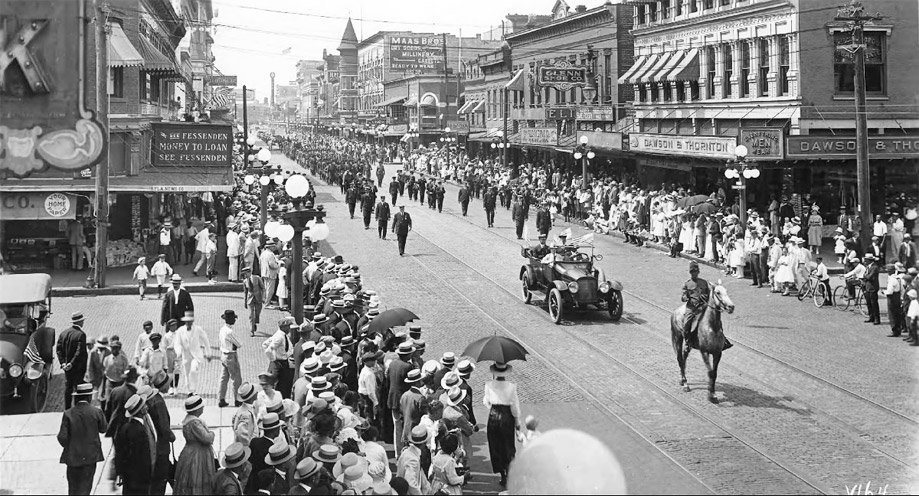
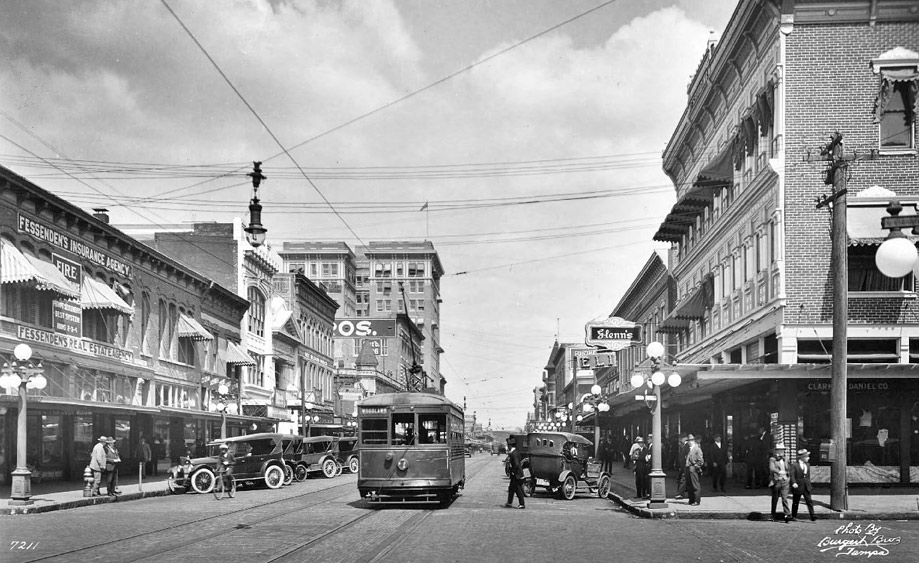
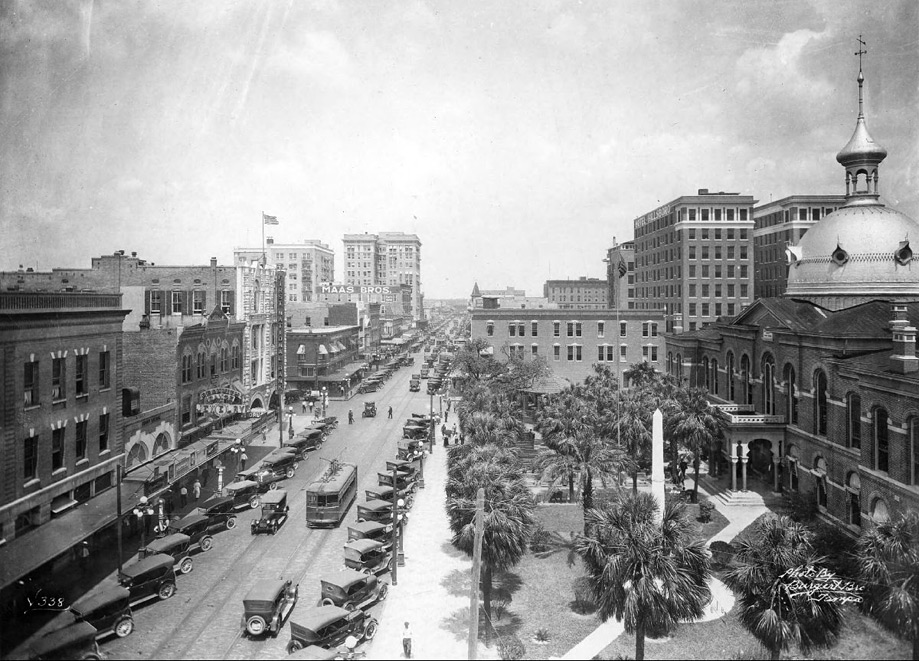
The Burgerts were a family of photographers who came to Florida late in the nineteenth century and established a quite remarkable record in various phases of the photography business, primarily in the state. Three generations of Burgert photographers worked productively from around the 1870s until the 1960s. The Burgert brothers were six sons and one daughter-in-law of the original photographic progenitor of the family, Samuel Burgert. The brothers at various times took, sold or marketed supplies for hundreds of thousands of photographic images usually requested by commercial clients, and in the process coincidentally documented the Tampa Bay region’s development from the little more than a scrubby port village to a major urban center of international importance.1

Hillsborough County Courthouse, Lafayette Street entrance, looking east from intersection with Franklin Street: Tampa, Fla., 1887

The first Burgerts came to the United States in the second quarter of the nineteenth century from Alsace-Lorraine. Samuel P. Burgert was born in 1849 in Cincinnati, Ohio. He married Adelina Jane Barlow, a native of Shreveport, Louisiana, and they had four sons born to them while living in Ohio: Willard (b. 1875), Harold (b. 1876), Walter (1880) and Jean (b. 1882). The family initially engaged in farming in the vicinity of Hamilton and Cincinnati, Ohio. Somewhere along the line Samuel somehow learned to make tintypes and whatever processes were then available in that relatively sparsely settled area to take, develop, market and print pictures. He became a pioneer, itinerant photographer, traveling around the countryside with a horse, wagon and folding tent, sometimes for two or three weeks at a time. He would take a picture, develop it and print it on the spot, and attempt to sell it before moving on. Because photo supplies were hard to come by, Samuel even learned to make his own glass plate negatives.2


Employees standing at entrance to Exchange National Bank building at northeast corner of Franklin (600 block) and Twiggs streets: Tampa, Fla. 1895


1900 - Samuel P. Burgert and José Ramon Sanfeliz in the Burgert studio, Ybor City.  The photo was taken by Jean Burgert.   Cuban born Sanfeliz worked with the Burgert brothers in the late 1890s to early 1900s.  Sanfeliz's pictures were taken between 1897 and 1905, and the film was developed in Burgert's studio.


FLORIDA’S GOOD FORTUNE

During the 1880s, Samuel moved his family to Florida. Samuel worked in Jacksonville as a photographer, and he and Adelina became parents of twin boys, Alfred and Albert (b. 1887). The Burgerts subsequently moved to Tampa, where by 1898 the City Directory listed three Burgerts engaged in the photography business. Samuel and Willard C. Burgert constituted the firm of S.P. Burgert and Son, Photographers, and Jean Burgert also worked for his father and older brother. Samuel introduced the various children to his craft, and always retained a close relationship with them. He expanded his work in photography in Tampa and became a respected citizen of the growing community, being elected Master of the John Darling Lodge of the Masons in 1911. Samuel never retired and worked until his death on September 29, 1918. Adelina apparently did not work directly in the business, but ran the Burgert household effectively and with love until her death on October 10, 1925.3


The 1900 census shows the Burgerts living at 1310 7th Avenue, a multi-family dwelling in Tampa.  Will Burgert was living with his wife and daughter (top) and Samuel was living with his wife and the rest of their sons.  The "6 | 6" in Addie Burgert's row indicates she was the mother of 6 children, 6 still living.  Samuel and Addie had been married 26 years.  The 3 columns that record states names show in order: the person's birth place, the birth place of their father and the birth place of their mother.  Note Samuel's parents were born in Germany.


While Al and Jean were the two principal sons of Samuel and Adelina whose photographic work has endured, all the brothers had some contributions to make the history of photography in the Tampa area, and all were involved in various ways with the community. Willard Chesney Burgert, fondly known as "Will," was probably the most flamboyant brother. He operated a studio in the late 1890s with his father, the Tampa Photo and Art Supply Company, which he founded in 1902 or 1903, and this was his most enduring and financially rewarding job, one that provided work for all the family at one time or another. Will also booked vaudeville acts, and for a time ran his own theatre, the revealingly-named San Souci. In 1913, he was involved in a motion picture company that starred the apparently incomparable Captain Jack Bonavita in such tropical extravaganzas as Voodoo and The Lure of the Jungle. Will was known as a bon vivant, romancer of women, free spender and snappy dresser.

The Burgert brothers gathered on the veranda of the stylish Tampa Bay Hotel on July 17, 1911, a grand resort hotel built by railroad magnate Henry B. Plant. Left to right are Willard, Walter, Alfred, Jean, Albert and Harry. -Rose Burgert Baker Family Album

His grandson claimed that Will would have owned half of Tampa if he had known how to manage his money, but instead he spent it on pretty things such as an aluminum bodied Marmon automobile.4

James Harold "Harry" Burgert was one of the most promising of the Burgerts, but his early death deprived the family of one of its most respected members. Harry, like Will, owned a vaudeville house and theatre in Key West, but from early in the century alternated between Tampa and Key West, working as a commercial photographer. In 1912 he settled with his wife Nettie in a house and studio in Ybor City, the Latin neighborhood of Tampa, and his business there was so profitable that the family moved to a second home in 1914. But just a month after the move, Harry contracted pneumonia and died. His wife took over the business at that time, aided by her brother-in-law Jean Burgert. Nettie and Harold’s son, Thel (b. 1904), would eventually become well-known photographers.5

Information on Walter is sketchy. He once operated a portrait studio in Ybor City, but he also had many other longings. He dreamed of being a doctor, for example, and he dabbled in chemistry and the making of home remedies. He tried truck farming but went bankrupt and returned to photography. Along with Jean, he was part of the first Burgert Brothers firm. Albert "Bert" Burgert had the misfortune as a youngster of having a nursemaid drop him on his head. He never developed full intelligence and, though well physically, mentally was always somewhat childish. Bert never owned his own business, but he worked at various jobs as a valued assistant in the photographic concerns of his brothers. Good-natured and fun-loving, Bert was also a magnificent piano player who performed on pleasure cruises. Late in life he became disoriented and had to be placed in a home.6

1917 - The Burgert's studio on 7th Ave., Ybor

BURGERT BROS. BEGINS

To set the family firm apart from the competition, Jean Burgert began his career as a traveling commercial photographer in 1910. Instead of just portraits, the Burgerts now  photographed any subject anywhere in the Tampa Bay area. This new flexibility, coupled with the acquisition of their only real competition, William A. Fishbaugh's (a Tampa photographer who moved down the Florida peninsula to what he assumed were greener photographic pastures in Miami) firm in 1917, made the Burgert Brothers the premier commercial photography firm in Tampa. Jean and his brother Alfred became the "Burgert Brothers" who would go on to produce the collection that "so magnificently reflects the Tampa region's development through four decades of the twentieth century."

Originally located at 1310-1/2 7th Avenue in the heart of Ybor City's business district, the Burgerts operated from 1899 to 1963.  From the start the Burgerts were commercial photographers and, from the start, successful. Not long after their opening, they began hiring some of the best photographers in the area. Roscoe Frey started working for the brothers in 1919 as a photographer and darkroom technician at $15.00 a week. Al Severson joined the firm as a photographer in 1924. Frey and Severson described a typical day at work as picking up a handful of photo orders in the morning, and shooting pictures all day for real estate agents, contractors, department stores and other businesses.7

The Burgerts also took excellent news photographs. Frey remembered braving hard winds with Jean Burgert to photograph the wreckage around Tampa Bay following the hurricane of October 25, 1921. "As Frey anchored and steadied the wooden tripod, Jean hurriedly snapped pictures of Bayshore’s caved-in seawall, splintered railroad tracks and roofless homes." The two men worked all night by candle and gaslight to develop the pictures. Then, just as the exclusive photographs were about to be mailed to World Wide Photo, Al Burgert decided that the sensationalized publicity would be bad for Tampa, and so only a few of the photographs were released in the local newspaper for publication.8


Bayshore Boulevard brick pavement and sidewalk damaged by hurricane storm surge, Oct 25, 1921


All negatives, whether produced by one of the brothers or an employee, were inscribed in a corner with the words "Burgert Brothers," a name written so proudly and openly that it seemed more a decorative logo than identifying signature. The negatives were also stamped with numbers which were then recorded in a ledger usually with a precise but sometimes frustrating general descriptive phrase or word indicating subject or locale. Typically, each ledger listing also contained the date the picture was taken.

See more of the Burgert's 1921 hurricane photos by searching for "hurricane" here.


Hurricane-damaged house of J. Brown Wallace at 1101 Bayshore Boulevard, Oct. 25, 1921

View of Bayshore Boulevard showing hurricane storm surge damage to streetcar tracks, Oct. 29, 1921


HEADQUARTERS OF BURGERT BROS. OPERATION This was the Burgert Bros. Studio at 407 E. Lafayette St. (now Kennedy Blvd.) where the photographers turned out their perfect images. A sign advertising the practice of commercial photography prominently hung over the doorway. Display cases along the storefront featured a sampling of recent photography work. Photo was taken July 20, 1922.

The excellence of their earliest photographs was probably due more to Jean’s skill than Al’s. Thel Burgert said that Jean at first had to teach Al (who had been working as a bookkeeper and office manager for his brother Willard) a lot about photography, but fortunately Al was a quick learner and it did not take him long to learn the technical details. Almost from the beginning their business was extensive. They developed many long-standing large commercial contracts such as Stone and Webster, the forerunner of the Tampa Electric Company; the King Edward Cigar Company; Borden’s Dairy; the International Truck Company; Florida Motor Lines; all sorts of building contractors; Mallory Shipbuilders; Atlantic Coast Line Railroad; and Cuesta Rey Cigarmakers, who made cigars for the King of Spain. They ranged far in their work, both in subjects and geographically, carrying out fashion ads and window displays in Tampa for Maas Brothers, Falk’s and Wolf Brothers; aerial photography for local land developers; and similar assignments for concerns in Tallahassee, Jacksonville, the Florida Keys and elsewhere in the South as far away as Alabama and Louisiana. They built their business through their own skill, Al’s salesmanship and the referrals they received, because of their good work, from the local Chamber of Commerce and the Photographers Association of America. They were known widely as skilled, reputable photographers. Their greatest competitors were Robertson and Fresh, who were in the same type of business as the Burgerts and who also did quality work. Robert Mallory, who was also a Tampa photographer in the 1920s and ultimately owned Southern Photography and News Supply, Inc., said of the Burgert Brothers, "We were competitors, but I don’t think they ever thought of me as a competitor. They always thought they were the tops."9


Van Dyke's Service Station with Hav-a-Tampa Cigar stand on side at 7800 Nebraska Avenue in Sulphur Springs, 1921

Eli Witt Cigar Company truck, with advertisement on side, posed on street in front of 7th Avenue public library, Oct 15, 1922


Al Burgert bass fishing in 1922


PHOTOGRAPHING ’GARGANTUA’

Al Burgert with camera and protective gear

Al Burgert's photo of Gargantua

The skill with which they practiced the craft, or art, of commercial photography became so widely recognized in the 1930s that Life magazine asked them in 1935 to become one of the publication’s Southern correspondents. The best known work Burgert Brothers did for Life was a series of photographs Al took in Sarasota, Florida, of the Ringling Brothers’ recently acquired gorilla, Gargantua.10 The huge, ferocious-looking animal was very temperamental from all the attention he was receiving, and would throw whatever was at hand in his cage at bothersome reporters and photographers. He would, for example, crush his metal food plate and hurl it at aspiring picture takers. In order to get the picture he wanted, Al resourcefully equipped himself with a baseball catcher’s face mask and chest protector.11 [Photo shows it was actually a football helmet and shoulder pads.]

Read the magazine article to learn about the risky procedure he used and see more of his photos.

The Burgerts also took pictures for Life of the "Louisiana sugar industry" and a watermelon harvest in Adel, Georgia.12


Al Burgert in 1925 and 1935

WORK IN WARTIME

THE BURGERTS RECORDED HISTORY IN THE MAKING …Spanish American War soldiers photographed at Ybor City studio in 1898

While the Burgert Brothers’ business did not suffer greatly during the Depression, Thel Burgert said that World War II at first kicked their commercial business in the head (perhaps because the War slowed down the usual forms of construction, the Burgerts’ staple business). But the Brothers were soon able to pick up all sorts of government and war-related work. Tampa shipyards like McClosky, Daniels and Tampa Dock, were turning out ships every two to three weeks, making all kinds of vessels, even prefabricated ships made from cement. Every couple of days each ship had to have a progress photo taken, and the Burgerts took many of these. They also opened a portrait studio near Drew Field that was very lucrative because the boot camp at the field had at some times over 150,000 men, and the population of inductees who trained at the camp changed every six or seven weeks. Most of the men wanted portraits for their mothers, wives and girlfriends and Burgert Brothers took many of these, installing an operator at that studio who took the shots and sent them back to the Burgerts’ Jackson Street studio for processing.13

McMullen School of Aviation group at Drew Field: Tampa, July 16, 1928

Al also opened a small portrait studio near the Western Union Building in downtown Tampa where pictures were taken and similarly sent back to Jackson Street for processing. The studio was in a two-story building with three developing darkrooms upstairs, a room for drying and spotting pictures, a room for washing prints and a darkroom for loading film into cameras. Downstairs were finishing rooms and a desk area for transacting business. Al’s wife Ethel handled billing of accounts and delivering the pictures at the desk area. After World War II, the portrait studios were phased out. Until the time of these portrait studios, Al took most of the studio photographs himself, but the burden of the additional portrait photographs and the shipyard progress pictures necessitated additional help.14

In its heyday the studio employed about ten people: two office girls to answer the telephone and handle billing; a couple of photographers and apprentices to carry out commercial picture-taking; some darkroom people for developing and printing photographs; and a person to retouch photographs. Working conditions at the studio were very good, with Christmas, birthday and occasional surprise parties, and a bonus at Christmas for the employees.15

Jose Vila cigar cans, 1947

NO DISCRIMINATION

Like many Southern cities, Tampa prided itself on having good interracial relations, but there was a definite color line throughout the area--and state--during the decades the Burgert Brothers were in existence. One Burgert employee during the 1940s said that there was racial discrimination in the photography business in the early days, an extension of the segregation that existed on streetcars, at water fountains and at other public facilities in Tampa. He stated that the Burgerts never had any black or Cuban people working for them in the photographic end of the business, though he thought there might have been black or Cuban people as cleanup workers. He said the Burgerts did, however, do a lot of work for black and Cuban customers. Another employee, Roberta Lucas, claimed in a separate interview that although the Burgerts did not have any minority employees, the studio never had a color line. The Burgerts did assignments for everyone. Thel Burgert said that the Burgerts practiced no kind of discrimination whatsoever. Willard Burgert, he said, had a Negro employee named Robert, and Al and Jean had black employees. All the Burgerts spoke Spanish fluently for business reasons and there was really no reason to hire Spanish speaking people.16 Simon Rose, a photographer at the studio, was Jewish, and though prejudice against Jews was less in Tampa than against Negroes, there was still anti-Semitic discrimination locally. That Rose was Jewish was completely unimportant at the studio.17

Only a small amount of product shooting was done in the studio--for example, pictures of bottles or cigarettes--for print advertisements. Most of the commercial work was done on location and outdoors in black and white. Al had a few favorite locations for his commercial work: The Tampa Terrace Hotel, a really beautiful place in downtown Tampa, now a parking lot; the Palma Ceia Golf and Country Club; the Tampa Yacht Club; Bayshore Boulevard, where there were large, new houses, and stately trees lining the Bay; and Tarpon Springs with its colorful sponge fishing docks.18

Woman weighing cans of grapefruit at California Packing Corporation, 1948

Al developed the crisscross record-keeping system. Every photograph was recorded by the negative and by the topic. Within a matter of minutes any negative in a collection of thousands could be located. This system reflected Al’s meticulous ways. He did not see himself as a chronicler of history, but simply needed an efficient retrieval system to keep his business straight. There was a strong demand for reprints of old photographs. The standard charge was $1.00 for a linen-backed photograph that added to the life and durability of the photograph and made it easy to bind into an album.19

FINEST EQUIPMENT

Thel Burgert claimed that Burgert Brothers had what he called the first reliable charge for photography work in the area and that their rate schedule was then replicated throughout the surrounding country. On a photography assignment the first half hour of driving time was free, but after that the Burgerts charged either for the time or the mileage. The first photograph of a scene would cost a certain amount, and for every duplicate of that scene the cost would be reduced depending upon the quantity ordered. The standard fee they established early in their operation was $4.50 for an eight-by-ten. The Burgerts also charged waiting time. If the crew arrived at a location and the customer delayed the shooting, the customer was billed for the lapsed time.20

The Burgert Brothers believed that to make quality photographs the best equipment available was needed. They operated on the principle that a poor lens made a poor picture and a high quality lens made a sharp picture, and reliable equipment eliminated a lot of work and trouble. Consequently (at least early in their careers) they always tried to purchase the most up-to-date equipment available, even though selection was sometimes limited.21

They had, by the 1940s, at least three 8" x 10" box cameras, three Speed Graphic cameras and one cirkut camera.22   In addition to these they owned a variety of lenses--Wollensak, Bausch & Lomb, Zeiss, Tessaric and Unar. The Wollensak would be used, for example, for copying and for wide-angle outside views, and the other lenses for various other foci and distances.23

THE CIRKUT CAMERA

Typical Cirkut camera of the early 1900s

They were the only commercial studio in town with the cirkut camera, which they seem to have possessed from their earliest days in the business. This instrument would take a photograph 7-10 inches high and from 2-5 feet long. It was used for group shots, banquets and panoramic views. People would line up in a semicircle so that every person was the same distance from the camera.24  As the cirkut camera gradually rotated, the photographer could take a sweeping picture of almost 360 degrees. The photographer would wind up a clock motor, and the camera would slowly swing around the semicircle exposing the film as it moved along. The cirkut camera gradually went out of use as the type of film it needed was discontinued, and the wide-angle and ultra-wide-angle camera lenses were introduced. The camera the Burgerts used might have been manufactured by Century.25


1920 Cirkut camera panorama photo

Click photo to see full size - Downtown Tampa looking eastward from rooftop of City Hall

More Cirkut camera full size photos:
Same photo as above but without compression
Looking east at downtown and Hillsborough River from rooftop of Bayview Hotel, 1920
Construction on Davis Islands looking north towards downtown, 1925
Police carnival in Ybor City at 19th St. & 3rd Ave, 1925
Rides at same carnival, 1925

To see all of the Burgert's Cirkut camera photos online (there are 440 of them), go to Hillsb. Co. Library website, use search term Cirkut, choose photo to view by choosing to view "full" view.  Then use Internet Explorer zoom tool to view full size.
   

The brothers also owned a movie camera called the Devri. It was used to make commercial shorts for the movie theatres.26 They had contact printers for 8" x 10" pictures and cirkut negatives, and Kodak enlargers for the smaller 4" x 5" film. Among the other equipment were developing trays, washers and dryers.27 A lot of the equipment was Eastman Kodak.28

Occasionally they had to construct or adapt special equipment. They owned an International van that was especially modified to meet their photographic needs. The truck had special jack levelers so that if the vehicle stopped on uneven ground the levelers would level it. On the roof was a platform that could be elevated by crank to the height necessary to shoot the scene. To protect delicate photography equipment from bouncing and shifting around over rough roads and quick stops, the inside of the van had several compartments where the equipment fit snugly and could be securely fastened down. They also made a special camera for aerial shots. They took parts from an Araflex and other cameras and reinforced the bellows so that air currents would not tear the camera apart as they shot from the open cockpit. The Burgerts would set the camera at a fixed altitude so that their coverage of highway construction, real estate and groves came out clear.29

PHOTO RETOUCHING

Waitresses at bus station lunchroom, 1948

Most photographic supplies were ordinarily not a problem, and the Burgerts were careful whenever possible to have ample stock of whatever was needed at hand. The studio purchased its supplies in bulk from Tampa Photo Supply, and there was one room in which a large inventory of supplies was always stacked up.30 They tried to keep at least one month’s supply of paper and film on hand. This meant the Burgerts had at least 1,000 sheets of paper in ready supply. Even though Tampa’s climate was very hot and humid, the paper and film never had to be refrigerated, only stored in a darkroom. These supplies usually had a one year expiration time. When materials were in short supply, photographers had to improvise; for example, by cutting down 8" x 10" to 4" x 5" pieces because the smaller film size was difficult to obtain,31 or cutting down 4" x 5" to 2" x 2 1/2." Another reason film was cut was that the silver used to coat the negatives was in tight supply and expensive.32

One of the more interesting jobs at Burgert Brothers, and one in which they always seemed to have an expert, was photo retouching. From the early 1940s until the close of World War II, Roberta Lucas worked at this craft in the studio and at home. Photographic retouching involved removing from a picture whatever was not wanted and adding items the photograph needed. A street view might require the retoucher to remove adjoining buildings or pedestrians from the sidewalk, and then add such features as trees, shrubs or a paved street to highlight and accentuate the scene. These items were added by drawing them in, and this is where Roberta Lucas’ skill as an artist-she studied art at Oglethorpe University-came into play. Her skills were used to outline, highlight, accentuate or modify various features in the photograph, or to add new features.33 For one series of photographs taken in the mid-1930s, Al Burgert accompanied a friend, George Brown, on a hunting trip to the Crystal River area, taking along his camera but not a gun. He snapped some seemingly random scenes and later gave these finished, unretouched pictures to Mr. Brown. But he also used one of the photographs in a sales campaign for X-Cel dog food after having his retoucher stiffen one dog’s tail and shift a tree, presumably to make a more effective picture.34

1930 - Woman with gladiolas and ferns

REMOVING WRINKLES

The tools of the retouching trade were for Roberta Lucas a lead pencil, etching knife, magnifying glass, and creamy colored viewing board. The retoucher would place a negative on the work board with a magnifying glass over it. As light was directed upward through the glass viewing board, the retoucher would work on the negative. Further details of the retouching procedure depended in part on the chemicals that had been used to process the negative and on the condition of the negative: the slicker the negative, the softer the lead in the pencil, for example. A good photographic retoucher was indispensable to a successful photographic business. The retoucher could remove blemishes caused by chemical spots and dust, repair crack damage caused by old age and carelessness, and remove a person’s wrinkles. Customers frequently brought in old prints for repair or fixing up. A family might bring in an old Civil War photograph and want something removed, like a carriage, or they might want a person highlighted by taking others out of the scene. The retoucher commonly had to draw on parts of a photograph, and these features would be built up progressively over stages. A dress might be torn, hand missing, and these items had to be taken care of.35

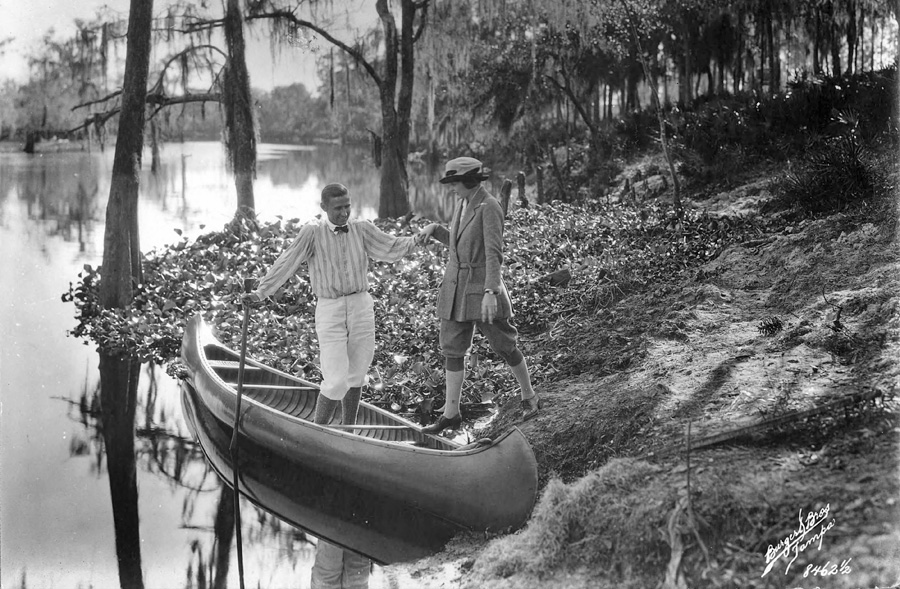
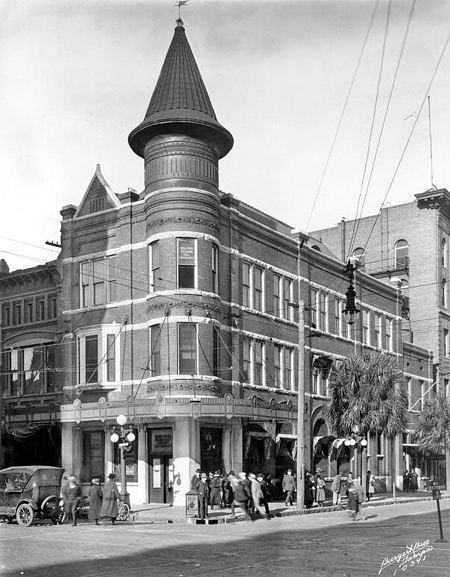
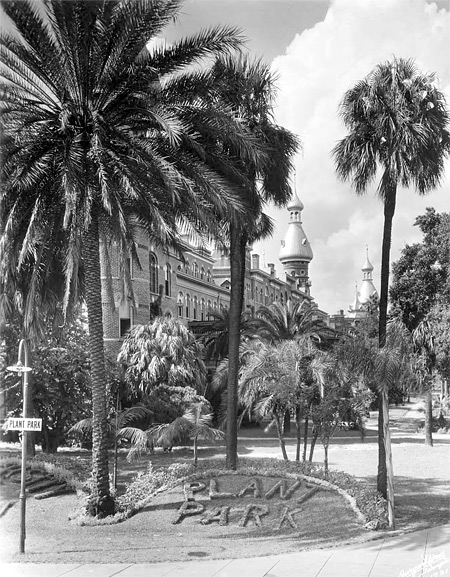
The many thousands of pictures for which the firm of Burgert Brothers was responsible reveal a corporate creative entity that produced superb commercial photography with never a hint of pretentious or staged artiness. If they were artists, they were so because of the consistently high quality of the craft they practiced with care and dedication. There is no indication that they ever read art-in-photography books. They seemed never to pose people strangely in their pictures or to wait until people arranged themselves in obviously striking patterns; they did not photograph buildings from odd angles; they appeared not to seek out odd settings for their images, nor to take photographs under weird lighting conditions; or depict momentarily grotesquely juxtaposed objects. Almost invariably their pictures demonstrate straightforwardness, naturalness and clarity.


HAIL HIS MAJESTY, KING GASPARILLA XV
This regal picture features D. Collins Gillett, president of Temple Terrace, Inc., the largest citrus grove in the world, and the real estate developer behind Temple Terrace, shown in his royal robes when he was King in 1923. He married into the wealthy and influential Lykes family, to Matilda Lykes Turman Gillett. He died nearly penniless in the 1930s.


1947 advertisement

To attempt to catalogue the type of pictures they took would be to list a lengthy and Whitmanesque variety of photographs of nearly all aspects of the city’s and region’s life during roughly the first half of the twentieth century. While most of their pictures show the commonest physical elements of the city--an incredible variety of buildings and houses--out of every hundred images will emerge several of more unusual byways of everyday experience; a snake cult; a group of deputies proudly circling a mangled still; a King of the Gasparilla Festival who looks for all the world like Roscoe Fatty Arbuckle, the silent film comedian. It is difficult not to view the hero of this portrait--his plump body draped like a stuffed royal couch with soft furs, his round seamless face and plump wattle all of one smooth surface like a beach ball, tiny baby dolls standing near his round fingers, aping his costume--as an example of satiric portraiture. Yet it cannot be that the Burgert photographers were aiming at ridicule. They never did: they aimed at reality. The picture is not, however, an ordinary one for the Brothers, for most of their photographs were totally sober works, void not only of obvious artifice but of unintentional elements of the grotesque. If they showed something strange, the strangeness was in the scene and not in their capturing of it.

NO NUDE PICTURES

The Burgerts never photographed nudes. Al Burgert never even mentioned the subject, Roberta Lucas said. Some of the men who worked for Al did take nude photographs, but not with Al’s knowledge. They might snap nude pictures of their girlfriends, for example, and would sometimes play pranks with these pictures by grafting the head of one person on another’s body. They would never show the pictures to the three or four female employees in the studio, but stayed hidden in the developing room giggling about their prank. The female employees were not as innocent, naive or prudish as their male co-workers might have felt. After all, Roberta had studied art, where drawing nude models was a normal part of her training.36 Still, none of the Burgerts ever engaged in nude photography. It was a taboo as far as they were concerned. The Burgerts all had the highest standards of excellence and never wanted to do anything that would subject them to ridicule or tarnish their names.37 Most of the time Burgert Brothers took pictures for clients who demanded no tricks (except for minor retouching) but insisted upon clarity and accuracy in the reproduced image. This essential client wish formed the chief boundary of their craft, and within the boundary they operated apparently happily. There usually is no point of view -- social or aesthetic -- apparent in their images, as there usually is in the images of the well-known art and documentary photographers of the twentieth century. Perhaps they would best be described by the term “topographic photographers," exhibiting in Beaumont Newhall's often repeated words, "concern . . . with the literal, straightforward representation of the most characteristic aspects of things and places." They could also be considered, for the totality of their production, documentary photographers, capturing the changing rural and urban life around them yet seemingly not possessing any particular attitude toward the life they were setting down. Certainly no attitudes dominate their pictures.

HISTORIC ENTERPRISE

PIONEER COMMERCIAL PHOTOGRAPHER: JEAN BURGERT seated behind early twentieth century view camera, taken by Milton Plumb, Tampa Tribune, July 17, 1964.

They seem never to have thought of themselves as anything other than commercial photographers, and their aim was to reproduce images that looked like the real thing, undecorated and unmodified. The corporate entity of Burgert Brothers apparently never thought of itself as engaging in either a historic or artistic enterprise, but the photographs Burgert Brothers produced, and transmitted to posterity, demonstrate historic and artistic awareness. Al Burgert died in 1956 and Jean Burgert in 1968. Some 6,500 prints made from the firm's negatives are now in the possession of the Tampa/Hillsborough County Public Library, and perhaps 35,000 precious negatives remain unprinted in the collection, not to mention a far lesser number of negatives and prints in several smaller collections.

Burgert Brothers was a commercial photography firm, and fortunately for the area a superb one. They are worthy representatives of the hundreds, possibly thousands of commercial photographers who accurately and often beautifully recorded the American scene.

Read more about the Burgerts and their photographic collection at Preserving the Memory of Ybor City, Florida by Cameron B. LeBlanc, Emory University.

Rita Maria Ruiz Escuela, my great grandmother, became so ill in 1912 after the birth of my grandmother, that she thought she would not live much longer.  She went into Ybor City to the Burgert studio and had this portrait made.  It is the only photo of her in existence and probably the only photo of her ever taken.  Two years later, she had a son, and lived until 1917 when she died from the influenza outbreak in Tampa.

FOOTNOTES:

1 Thel Burgert interview, 25 February 1982, Punta Gorda, Florida. We have tried where possible to keep close to the language of our informants so that we would not stray from their intended meaning.

2 Thel Burgert interview; Rose Burgert Baker interview, 9 December 1981, Tampa, Florida.

3 Thel and Rose Burgert Baker interviews.

4 Ibid.; Anne DeLotto , "A Catalog of Memories: The Burgerts’ Amazing Time Machine Crystallized History As It Happened," Weekender section of the Tampa Times, 21 August 1981, 9-11.

5 Thel and Rose Burgert Baker interviews.

6 Ibid.

7 DeLotto article; Sharon Cohen, "Early Tampa Preserved," in Florida Accent section of the Tampa Times, 21 April 1974, 4-8.

8 DeLotto article.

9 Thel Burgert interview; Roberta Lucas interview; Robert Mallory interview, January 1982, Seffner, Florida; Simon Rose interview, 17 December 1981, 21 January and I November 1982, Tampa, Florida.

10 DeLotto article.

11 Thel Burgert interview.

12 DeLotto article.

13 Thel Burgert interview.

14 Roberta Lucas interview.

15 Ibid.

16 Thel Burgert interview.

17 Simon Rose interview.

18 Thel Burgert and Simon Rose interviews.

19 Thel Burgert and Roberta Lucas interviews.

20 Thel Burgert interview.

21 Thel Burgert interview.

22 Simon Rose interview.

23 Thel Burgert interview.

24 Thel Burgert interview.

25 Simon Rose interview.

26 Thel Burgert interview.

27 Simon Rose interview.

28 Roberta Lucas interview.

29 Thel Burgert interview.

30 Roberta Lucas interview.

31 Simon Rose interview.

32 Roberta Lucas interview.

33 Roberta Lucas interview.

34 George Brown interview, 24 February 1982, Oldsmar, Florida.

35 Roberta Lucas interview.

36 Roberta Lucas interview.

37 Thel Burgert interview.


Al Burgert & Gargantua   |   1920 Cirkut Camera view of downtown    |   Tampapix Home

Visit Bryan Weinstein's "TampaChanging", a site dedicated to displaying beautiful historic Tampa photos, some by the Burgerts, that transition into the same scene from the same vantage point today.  See how much has changed, and how much remains the same!